Supreme Court links

I am a Supreme Court junkie.

I lamented the retirement of Linda Greenhouse. I perk right up when I hear that a report from Nina Totenberg is coming up on NPR, and actually have an autographed picture of her. Wait, maybe it’s aging SCOTUS analyst hotties that I’m actually jonesing for! Every June I pore through the news looking for analyses of the crush of decisions that come out at the end of the term.

At its best, the SCOTUS represents the highest form of philosophical debate in this country and probably the world. At its worst, it reveals the role that politics plays in distorting moral decision making.

I’m in the middle of Jeffrey Toobin’s book on the Rehnquist court, a court that included an 11 year stretch without a change in the lineup. It takes the old conventional wisdom (Thomas is an isolated crank, Kennedy’s the swing vote, O’Connor is the pragmatic center, etc.) and goes much further, really fleshing out who these people are and how they think. Although he still does judge Thomas rather harshly, as a ghostly, underqualified and ultimately pitiful presence on the court. [update 12-Nov: Finished the book. Alito doesn’t fare well either, and from that you might draw some partisanship on the part of Toobin, but I think he’s balanced and he certainly shows affection for moderate conservatives like O’Connor. A great read!]

The 2008-2009 term started this week. Here are some useful resources:

www.scotusblog.com

www.scotuswiki.com

PBS NewsHour Supreme Court Watch

New York Times Supreme Court coverage

Dahlia Lithwick’s Supreme Court Dispatches at Slate

But for a down-and-dirty raw data view, the best is probably:

The Oyez Project — countless resources, but most amazing are their audio recordings, with synchronized transcripts, of the oral arguments. For example, here’s the oral arguments in Boumediene v. Bush from Dec 2007, the case that upheld habeus corpus. And here’s Neal Katyal’s argument in Hamdan v. Rumsfeld. Scalia wisecracks! Breyer maneuvering! Oh my!

Electric Vehicles, part 1

2010.

Maybe as soon as Fall 2009.

Virtually every car maker is now talking about coming out with an electric vehicle, and soon. And I mean every one, including makes that haven’t had much of an enviro profile up to now — GM, Ford, Chrysler, Nissan, Volkswagen, Mitsubishi, all making announcements recently. Now, certainly, a lot of this is just PR to catch the wave and attract bailout money (and more on three specific models below), but it does seem like 2010 will be a watershed year for electric vehicles. One could debate whether “2010” means “calendar year 2010” or “model year 2010”, but by late CY2010 I am certain that electric vehicles will be all over the news, and all over the dealer lots.

I last bought a new car in 2000, and I keep my cars for 10 years, so I’m due in 2010. Technically I’m due in early 2010, and frankly I can’t wait (ladies and gentlemen, if Consumer Reports’ repair database says that a make/model is unreliable, you better believe it). But I probably will be willing to wait until late 2010 if there are indications that the right model is coming.

I’m prone to obsessing about upcoming purchases, so I basically prohibited myself from really studying electric / hybrid cars until I was 2 years away from the next purchase. Which meant that starting last spring, I started keeping up with car news. There are a number of news feeds that I keep up with now:

That last one is the most prolific, and the most bewildering. The Truth About Cars (TTAC) takes no prisoners in their treatment of the auto industry, especially the US industry, and it’s interesting to be able to read this insider info without the polish, or kow-towing, that you’d get in Car And Driver or The Detroit News. They’re quite opinionated over there at TTAC, to a fault, but in between the blowhard editorials by owner Robert Farago you have lots of juicy insider info, usually days or weeks before the mainstream press gets around to it (or doesn’t). There’s also Jalopnik and Autoblog, but I don’t have the time to figure out which one has the tone and coverage that best suits what I’m looking for. I’m already looking forward to the day when I buy the car and can stop keeping up with this firehose of data.

Electric Car Myths

Any discussion of electric vehicles has to start off debunking some myths.

Myth #1: With an electric car, you are just transferring the point of pollution.

Let’s take the worst case, an electric car powered 100% by the dirtiest coal power plant. In that case, it turns out that you will emit 70% LESS carbon dioxide for any given distance traveled. A large power plant is simply far more efficient than the little portable gas engine in your car. [source: http://www.evworld.com/evguide.cfm ]

And realistically you won’t be in the worst case most of the time — you’ll be drawing power from cleaner sources than the dirtiest coal. In the BEST case scenario you can charge using solar energy from your roof. That is just not even possible with a fossil-fuel solution. An EV turns “can’t” into “can”, as in “I CAN drive using clean energy if I want”.

Myth #2: Anemic performance

This myth has some legs to it. Batteries don’t have nearly the energy density of gasoline, so you’re starting with a disadvantage right away. Car makers shave every ounce they can from the car’s weight (thus improving the power/weight ratio and thus performance) anywhere they can, and that includes the drivetrain … and the battery! So you just have less energy to start with. But electric motors are inherently more efficient at converting energy to motion than internal combustion engines, and fast electric cars do exists (see Tesla and the NEDRA). This myth is rapidly being busted.

Further, you can actually argue that electric vehicles have better performance. Unlike internal combustion engines, electric motors have full torque even at their lowest speeds. In a series hybrid, the gas engine simply doesn’t ever directly interact with the driveshaft, but is instead used to power a generator. So you will always get that nice torquey response.

Myth #3: Poor range

Yup, a pure electric vehicle is going to have a lot less range than a regular car. Which is why hybrids are so popular. You still get the efficiency of an electric, but with a gas tank for the long rides. Most of my driving is 10 miles or less, so having the gas capability for the occasional long trip is fine.

My Own Desires

– I have to be able to plug it in to charge it. Period. I am not interested in hybrids that merely improve gas burning efficiency. I want the option of not using gas at all. Note that I’m not excluding gas/electric hybrids here; I just want to be able to plug it in and use the cheaper and more efficient energy from the grid.

– performance — I would never be happy with the geriatric wheezing of a Prius; I need a car that leaps off the line and can be thrown into corners; this will probably be the toughest criterion to meet.

– instant throttle response — electric cars have fundamentally different drivetrains than gas combustion engines. Regular gas-engine cars need multi-speed transmissions because of the gas engine’s limitations. Electric motors have wide RPM range and torque across that range, so it’s possible that there won’t be a transmission at all (like the Tesla) or it’ll have a CVT. It’ll be sad to give up my stick shift, but as long as I still have the instant throttle response, I’m happy.

– series hybrid only — no cheating, no letting the gas engine drive the wheels directly; gas engine should only generate electric power for the motors and hopefully some battery charging; also known as a “range-extended electric vehicle” (REEV).

Specific models

Chevy Volt

This is the one that’s getting a ton of attention in the press, and has lots of mindshare, and it’s all about politics. GM wants a bailout ($25B, $50B, $75B, oh my!) and they’ve rushed this electric hybrid into view as proof that they have a plan for the future. It’s a huge fraud, but they’ll likely get what they ask for, because it’s also election season, and there’s an awful lot of swing votes in the rust belt. [see note below about the timing of this post]

The Volt concept vehicle had everyone excited (personally I thought the sightlines from inside would be awful, worse than an Audi TT) but then GM got real and came out with … a dull econobox. Maybe in person it’ll look better, and maybe I’ll warm up to it, but right now I’m not enthusiastic. Plus it’s a GM, which is a huge black mark in my book.

In the Volt, a gas engine powers a generator which supplies electric power to the electric motor; this is a serial hybrid design instead of a parallel hybrid like the Prius, and that’s what I want. I want wheels driven by electric motor, period. The latest word is that the Volt’s gas engine / generator will indeed drive the electric motor but not charge the battery. That’s too bad but I don’t think it’s a dealbreaker for me. However, all this rumor mongering does illuminate the fact that this is all vaporware.

Nice little review from ArsTechnica (Oct 2008)

Toyota Prius

I’m NOT talking about the models on the streets now, which are the 1st and 2nd generation models. The 3rd generation Prius will be a plug-in, and as of Aug 2008 the word is that Toyota bumped it up from a 2010 to a 2009 model, meaning it’ll be out earlier in 2009, and thus will be the first major PHEV to market. That’s going to steal a lot of thunder from GM’s Volt, and it’ll be a far more mature (read: reliable) solution than GM ever could pull off, so look forward to some serious GM propaganda whenever that Prius does come out.

Paul Niedermeyer of TTAC said this in Aug 2008 regarding Toyota’s plans for battery technology: “Toyota sees Li-ion as a step towards higher capacity (air) batteries. But they’re covering all the bases, keeping NiMh in production for low-cost hybrids, and Li-ion for the plug-ins. The real point here is that the cost effectiveness of Li-ion plug-ins is going to be terrible, unless gas more than doubles in a few years. Toyota feels that serious EV’s and plug-ins will require the new battery tech before they can really take off, unlike GM, Tesla and Fisker, who are banking all on Li-ion.”

I seriously doubt that Toyota can come out with a Prius that will appeal to me on performance and styling, but they’re the 800 pound gorilla in this market and can’t be ignored.

Tesla Roadster

Ah, Tesla. Nerds swoon over Tesla. It’s the ultimate geek fantasy car — all-electric, looks and drives like a Lotus, great brand name. For years now Tesla’s been running the PR machine, promising near-supercar performance and decent range in an electric car. But they’ve taken f-o-r-e-v-e-r to get to market, and as of right now they’ve delivered about 15 units yet burned through massive amounts of funding. Turns out that there are lots of nerds with lots of money who are so smitten by this thing that they’ll throw their investment cash at the company just to be associated with it. I’ll admit to idly fantasizing about spending $109,000 for one of these. Especially after reading glowing reports like this one.

Here’s a great Fortune article with a behind-the-scenes look at what happened within Tesla (Elon Musk vs Martin Eberhard, transmission troubles, etc.)

And keep an eye on TTAC for the latest inside scoop via their Tesla Death Watch.

A few comparisons

Comparison of Toyota Prius PHEV (3rd gen) and Chevy Volt:

http://www.thetruthaboutcars.com/the-great-hybrid-showdown-chevrolet-volt-vs-toyota-prius/

Comparison from Nov 2007:

http://www.diyelectriccar.com/blogs/2007/11/six-major-preproduction-electric-vehicles-compared.html

and commentary on the above from the Slashdot crowd at the time (some insightful, some not at all):

http://hardware.slashdot.org/comments.pl?threshold=4&mode=nested&sid=367453

Other media coverage

And in the past month or so, PHEV coverage has really picked up in the mass media, to the point where I can’t keep up:

CBS’ 60 Minutes feature: “The Race For The Electric Car”

New York Times Magazine cover story on clean energy solutions driven by the private sector

CNN story on aftermarket plug-in conversions

EV-World comparison of PHEVs and series vs parallel hybrid discussion

Electrical infrastructure

Looking for somewhere to invest your money?

Think about what kind of impact large-scale adoption of EVs would have on our energy infrastructure. Currently we use petroleum (tankers, pipelines, trucks, gas tanks) to move that energy around.

If energy coming into this country via petroleum (joules) is to be replaced by electric power generated natively (sticky energy, as Andy Grove puts it), then there is going to need to be a massive upgrade in the power transmission infrastructure, and infrastructure that is already buckling. The Northeast Blackout of 2003 was ultimately traced to an Ohio company’s failure to do even basic maintenance on their transmission lines, and the failure of FERC to enforce standards. (By the way, California’s 2000/2001 blackout problem was due to market manipulation by Enron and the like, not lack of infrastructure. Blackouts in December? Come on.)

July 2008: General Motors is teaming up with 30 utilities in 37 states and with the Electric Power Research Institute to develop a charging infrastructure for electric cars: http://news.cnet.com/8301-11128_3-9996348-54.html?hhTest=1

Ethanol and Hydrogen

Ethanol-based solutions are simply out of the question. Ethanol production is a wildly negative energy process, so if you’re using Ethanol you’re actually making the environmental situation worse. Sure, you’ve reduced dependence on foreign problem, but that’s only half the problem we’re trying to solve here.

So why do why have ethanol-based solutions? Here’s Bob Dole in 1996, as legislation was being crafted to support (read: fund via taxes) ethanol production and distribution:

“There are 21 farm states, and that’s 42 senators. Don’t waste any more of our time or your time telling us it’s a bad idea, because they’re going to do it.”

Fortunately, that was in 1996, it’s now 12 years later, and some common sense has seeped into the national brain and the bloom is off the ethanol rose. John McCain has stuck to his guns and remains against ethanol subsidies, which considering he’s flipped on just about everything else means that the ethanol lobby is weak. Thank God that’s over, at least in the horrible corn-based energy -negative form that we’ve seen it. Perhaps sustainable ethanol production will arrive and mature in the form of switchgrass or something, but for now it’s just nothing more than a talking point.

Hydrogen fuel cell cars are interesting, but at this point they are still an academic exercise, for several reasons. One, there is no hydrogen distribution infrastructure in place, and two, high pressure tanks to hold enough H2 don’t exist. But even if those logistical problems got solved, the truth is that a fuel cell process is still one third as efficient as a purely electric process (for illustration, see these slides from Martin Eberhard: 1 2 3 4). And this even holds true for ethanol, diesel, etc. — if you’re set on using any form of flammable liquid, then use it to generate electricity and then power the car, since that’s twice as efficient as burning it directly in an IC engine (slide). Electric generators and motors are simply far too efficient to pass up.

Wrap up

In the last couple months this topic has received a lot of attention from the mainstream press, especially with the soaring gas prices and Detroit’s we-have-electrics-we’re-not-dinosaurs push for a bailout. But I’ve been mildly interested in this for over a decade, and seriously looking into since this spring.

So, there’s the state of the market as I see it in September 2008. This is just a snapshot in time, and some of what I’m saying above may be outdated by next week, not to mention next year. But by this time next year (2010 model year start) we should be seeing some new models actually appearing on the market, and I’ll start looking at things like battery warranties, driving performance, electric power costs, etc.

Moving to an electric vehicle changes “can’t” to “can”, and I’ve now decided to personally change “could” to “will”.

Hopefully by no later than the end of 2010. Mark my words!

[note: I’m publishing this in late November but backdating the post to September. I’ve been collecting info into this post for a year, and had this post pretty much ready to publish in Sept, but then didn’t actually do it. I have NOT been keeping up with the news on this front since Sept; in fact I’m aware of some developments that have taken place since then that modify the above slightly. Alas, all I have the time for right now is to just go ahead and publish this. Sometime next year I’ll come back around with a Part 2 update.]

Hubble Science Briefing

Space Shuttle Atlantis is sitting on the pad and scheduled to launch on October 10th to the Hubble Space Telescope on a “servicing mission”. This will be the 5th and likely last servicing mission to Hubble, since the shuttle is due to be retired in 2010. As usual, NASA last week conducted their press briefings on this mission, 30 days prior to launch. The briefings included the usual information about the mission, the crew, the scheduled spacewalk work, etc.

In addition to those briefings typical for any shuttle flight, they conducted a “science briefing” to explain what the work of this servicing mission was going to do for the scientific capabilities of Hubble. The purpose of the mission is primarily to A) replace two instruments with new and improved models, and B) attempt repairs of two other instruments. The science briefing was primarily to explain what the new instruments were going to do for science.

In the briefing was an all-star cast of astronomical scientists: – Ed Weiler, NASA administrator – David Leckrone, Hubble senior scientist – Robert O’Connell, committee chair for one of the two new instruments – James Green, principal investigator for the other new instrument – Heidi Hammel, scientist representing users of Hubble

Each of them made a short speech and then the rest of the briefing was turned over to questions from the press. I would encourage anyone with even a fleeting interest in science or astronomy to take the time to download and watch the entire briefing, as it is truly fantastic stuff they’re talking about, and these guys do a great job of explaining it to regular people. Certainly science could use a bit of a pep talk after weathering the last 7 years of the Bush administration’s hostility to science and objective truths.

In particular, the last person on the dais, Dr. Hammel, give an impassioned 10-minutes speech on the impact of Hubble on science and indeed on culture. It’s an astonishing and beautiful statement on where we are in astronomical science and where we may be headed if this shuttle mission goes as planned. I’m surprised the press room didn’t erupt in applause when she finished.

Dr. Hammel’s speech starts at the 38:50 mark in the first half of the briefing that I’ve linked below. If you don’t have time to watch the entire 90-minute briefing, at least watch her 10 minutes.

download page for first half of briefing download page for second half of briefing

Update 13-May-2009: Sadly, I see that the above download links no longer work. I have not been able to find the briefing on Youtube, and the repeat briefings from a couple weeks ago did not include Dr. Hammel. FORTUNATELY, I did find most of Dr. Hammel’s speech incorporated into a nice 5 minute video right here. Please check it out!

Bill Sayle, 1942-2008

Bill Sayle was a professor at Georgia Tech. He passed away earlier this year; I found out via a mention in the national IEEE newsletter (page 17 of this PDF), and then earlier this summer the GT ECE newsletter featured an article about him (page 3 of this PDF).

I have to admit that I did not know him that well, but 15 years ago he had an impact on the direction of my career.

From 1985 to 1990 I attended Georgia Tech in pursuit of a degree in Aerospace Engineering (AE). I exhibited rather lackluster performance in acquiring my degree, basically slouching my way through 5.5 years of studies. The truth is, I found many other things much more interesting, and just didn’t really care that much about AE. It didn’t help that the aerospace industry had tanked in the late 80’s as the end of Cold War paid a peace dividend and the defense industry shriveled. But I can’t just blame the industry for my inability to find AE work; my GPA was definitely crap, mostly weighed down by 3 or so years of serious slacking off. It was only in the last 2 years or so of getting the AE degree that I really started trying, but at that point I had so much weight on my transcript that I could only pull my GPA up to a 2.4 . Georgia Tech is a hard place, and AE one of the hardest degrees, but that’s still rotten.

So I graduated (in Dec 1990) and started working full time. As a temp slave. Seriously, I had an AE degree from Georgia Tech — one of the most difficult degrees from one of the most difficult schools in the country — and I was working as a filing clerk at a government office downtown via a temp agency. I discovered that year how little I needed to survive, because I made $11,000 that year, and that paid for everything, including rent and car insurance. I made the best of the job (eventually developing some procedures and computer tools for them) but kept on looking for “real” work. This went on for a whole year.

Finally in early 1992 I got a job as a field engineer with a company in the Atlanta suburbs that did contract work in the nuclear power industry. They simply accepted anyone with a GT degree and then trained them to do the field work. And off I went to nuclear plants around the country. Some other time I’ll write about my experience working in nuclear power.

In 1994, I had been out of college and in the workforce for 4 years. Knowing that Georgia allowed you to claim in-state status (and the ridiculously cheap tuition rate) after 3 years of non-student residency, I had my eye on returning to Georgia Tech to get another degree. At one point in my life I had fantasized about doing this endlessly, working and going to college and just accumulating degrees, but these days I’ve happily put my academic life behind me. So anyway, at the time I was thinking about going back to Tech. I quit the nuclear job in Dec 1993 and took a month or so off to relax, do all those things I would do “if I just had the time” and think about what I would do next. ( I learned something about myself in those 1-2 months: left without constraints or demands, I don’t get much done.)

I decided to indeed go back to Tech fulltime and get an Electrical Engineering degree, but a Bachelor EE degree, not a Masters EE. I had become interested in EE as a utilitarian degree, one that I could apply at home and in the community, certainly moreso than one can apply an AE degree. So I really wanted to learn the basics of EE, not study some EE niche as a master’s student.

Getting a second bachelor’s degree brings up a bit of institutional bureacracy. Georgia Tech allows you to apply credits earned at any time over the past 10 years to any degree, so I could use all those basic course credits (Calc, Physics, English, etc.) accrued during my AE studies in the 80’s and apply them to an EE degree. I just had to take all the EE courses, about 80 credit hours worth, which it turned out would take about 18 months of fulltime study. I had started at Georgia Tech (and received my first course credit) in 1985. If I was starting this work on the second degree in 1994, and it was going to take me 18 months, and I needed to take a quarter off in the middle somewhere to make some money, I was going to be in a bind. By 1996, the 10-year sliding window was going to start killing my first credits from 1985 and 1986 — basic courses that I certainly did not want to have to take again. I needed an 11-year window.

And so that’s where I was in February 1994. I wanted to A) get accepted back into Georgia Tech to get a second degree, and B) I needed a waiver from them for the 10-year window, just a slight extension. And remember that my first tenure with Georgia Tech was rather unimpressive — I barely got out of there with my AE degree, with a truly awful GPA.

So with all that in mind, I wrote a letter to Bill Sayle, laying out this situation and requesting admission and the waiver. To my delight, I guess he saw my potential and said that A) they’d admit me and B) he’d endorse my waiver request. To be fair, I realize now that older students are safe bets, because they’ve crossed that maturation threshold that is hit-or-miss with regular college-aged students.

I made some contacts in the nuke industry and started coordinating some nuclear contract work (1-2 months at a time) to fit into the school schedule. Over the next two years just two of these contract jobs paid for the study months (rent, food, tuition, etc.) They were very hard work, with 72-hours weeks (the regulated maximum allowed) but with very good pay, enough to pay for my expenses for the rest of the year.

Exactly 2 years later, in March 1996, I finished my EE degree and started working at Scientific Atlanta as an electrical engineer. Unlike my first time through Tech, this time I’d done fantastically well, landing on the Dean’s List every quarter. Considering my poor performance the first time, I’m pretty proud of that. So I like to say that I’ve been on both sides of the academic fence — the smartass slacker in the back of the room who barely survives to get the degree, and the smartass brown-noser in the front of the room who takes furious notes, engages the professor a lot, ruins the curve and gets the honors.

Bill Sayle was a small but critical part of that transformation, and I thank him for it. RIP.

Future Shock

Note: I drafted this post in 2008 but I guess I never finished it and I definitely never published it. In 2025, when Typepad shut down and I moved this blog to a new domain, I discovered this old post sitting here drafted. I am publishing it now as-is (backdated to 2008) to capture my thoughts, even though this particular post was clearly just a brief jumble of notes. I don’t even know what I was thinking 🙂 But maybe someday I’ll come back and figure it out. So, here I go, pushing the publish button …

Singularity

Wired Found

http://www.metafilter.com/73510/Artifacts-from-the-Future

Children of Men “Crimson King” video

http://www.foreignoffice.com/projekts/movies/children_of_men.htm

http://www.foreignoffice.com/

Congress: fund science and exploration

[I mailed the following letter (paper / snail mail) this week to Senator Saxby Chambliss, Senator Johnny Isakson and Representative John Lewis. Please consider doing the same.]

Dear Senator / Representative:

I am writing to you today to express my support for the funding of science and exploration in general, and for three projects specifically. I do not have a personal financial stake in any of these projects, and I do not work in these industries. They simply fire my imagination about what we might accomplish and learn in the future as we continue to research the world around us.

I urge you to support funding for all three of these projects.

  1. Arecibo and NSF – Arecibo is the gigantic radio telescope in Puerto Rico that suddenly is facing a drastic funding shortfall. Arecibo is responsible for many, many discoveries about our universe, too many to enumerate here. Further, generally, the National Science Foundation continues to do great things and deserves their funding request.

  1. Spares flights to ISS – NASA continues to plan the last flights of the Space Shuttle, with a targeted end to the program in September 2010. The last two flights are “contingency flights”, and while that’s a dull name, those are quite important missions. Without those last two flights, the International Space Station will not have the critical spares needed to ensure operation through 2015 and beyond. These are spares that could easily be the difference between “we’ll have that fixed in a week” and “abandon ship”. Please protect funding for these last two flights.

  2. Alpha Magnetic Spectrometer to ISS – The AMS is a huge scientific instrument that is already built and ready to launch to ISS. Unfortunately, NASA currently plans to leave it on the ground, forever. With just one more shuttle flight, this last piece of ISS could make it to orbit.

I’m sure your science advisor can tell you more about these projects. Please make sure that he keeps you aware of legislation that affects these, and let your congressional colleagues know how important they are.

In general, funding of projects like these is a fantastic investment in our future, both for purposes of financial return and motivation of the next generation. As a boy I spent countless hours studying the results of the robotic expeditions to the plains of the Mars and the outer solar system, submarine exploration of the bottom of the seas, and manned activities in low earth orbit. I’m sure if we continue to fund these activities that we will be inspiring a whole new generation to pursue science and engineering careers.

This is not a form letter, which I’m sure you get a lot of. I hope you’ll bear these concerns in mind as you go through the last few months of the session.

Flat Bridget visits Atlanta

This is a story about Flat Bridget. Flat Bridget is the flat version of Real Bridget, who read the story of Flat Stanley at school. So Flat Bridget was created, and then Real Bridget decided to send Flat Bridget to visit Uncle Chris and Aunt Sharon in Atlanta.

Uncle Chris was very excited to receive Flat Bridget! IMG_1385s He took her to the airport, where they watched the planes coming in to land. They flew right over their heads! It was very loud, and Flat Bridget wanted to cover her ears.

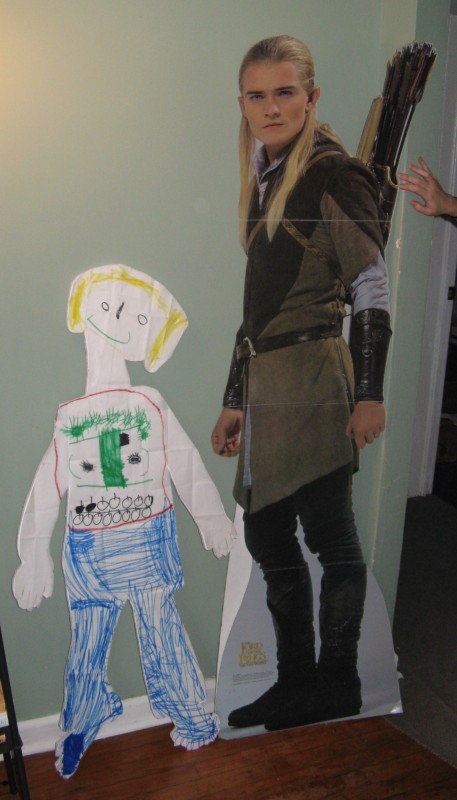
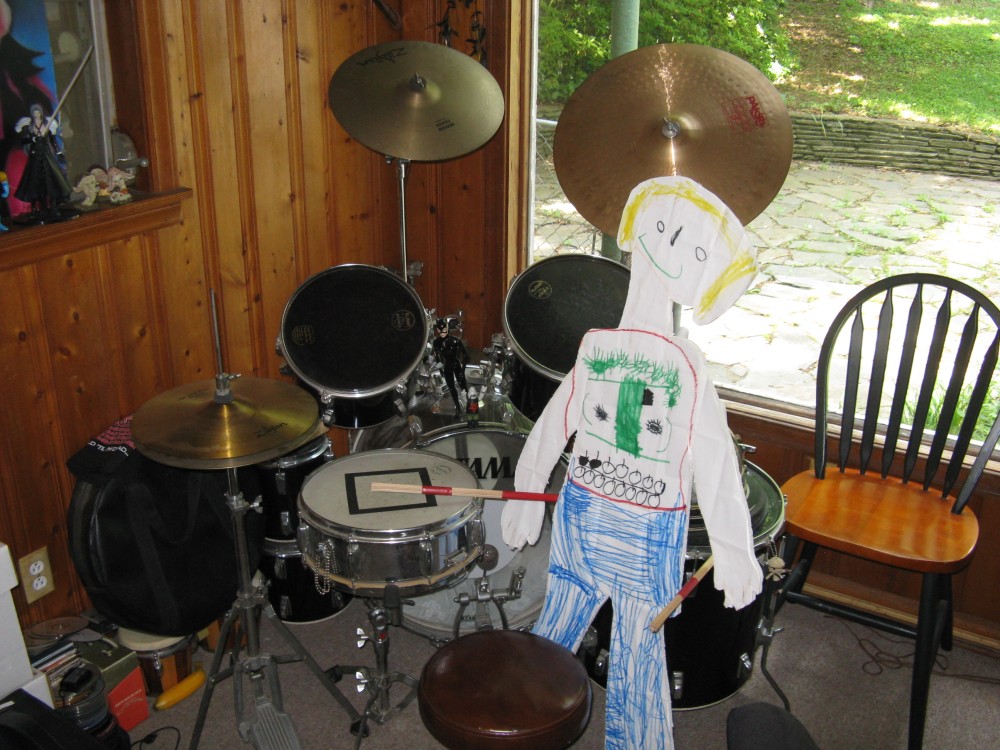
IMG_1346s Flat Bridget went with Uncle Chris and Aunt Sharon IMG_1347rs to visit some friends who had two new kittens. The kittens liked Flat Bridget so much they stood right on top of her! Then Flat Bridget got to meet IMG_1363s Flat Legolas from a famous movie about hobbits. She even had a chance to play the drums!
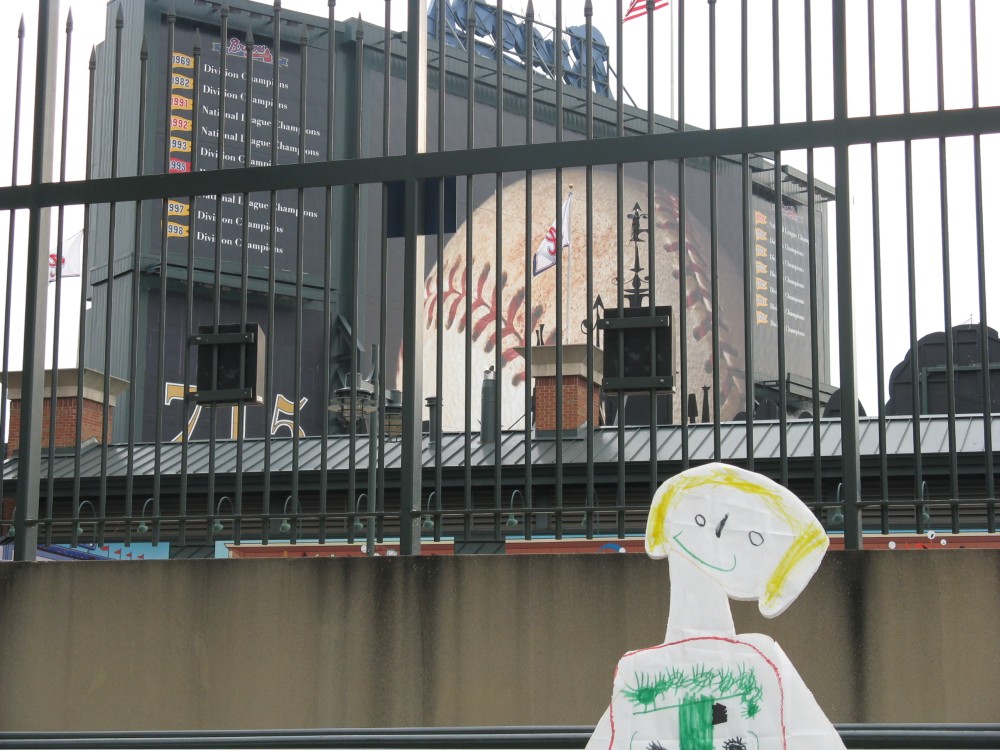
Uncle Chris and Flat Bridget went to the baseball stadium, Turner Field, IMG_1388s but there was nobody there. They did get to look through the fence at the giant baseball. Play ball!
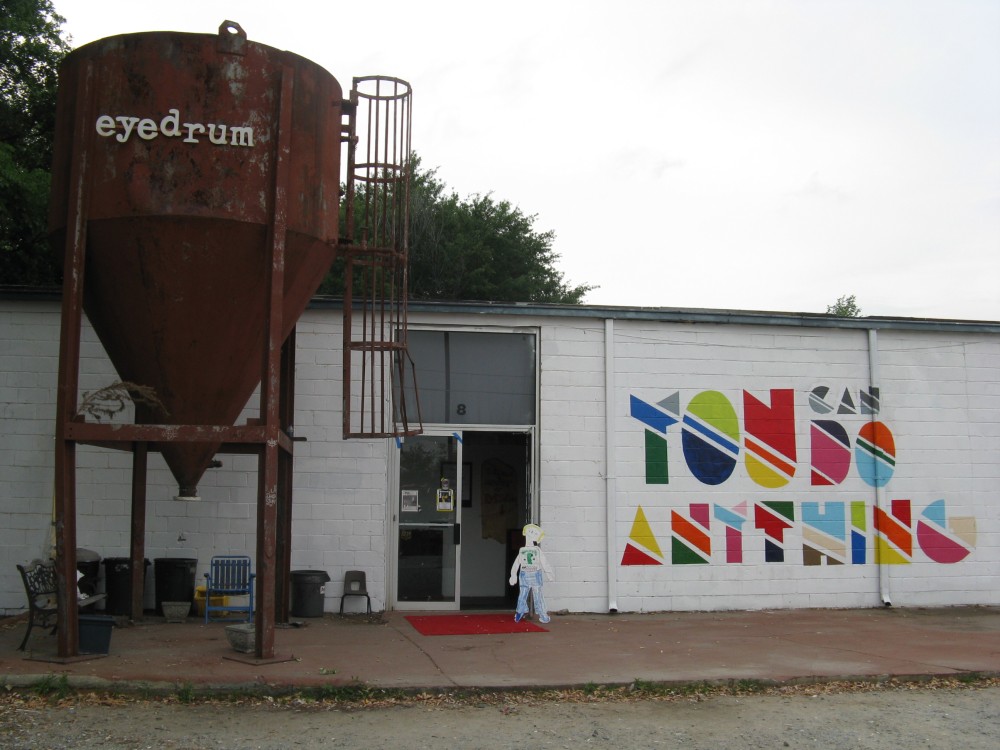
IMG_1391s Flat Bridget then went to visit Eyedrum, which is a place that Uncle Chris likes to go to. IMG_1393rs When Uncle Chris wasn’t looking, she climbed up on the silo out front — Flat Bridget, get down from there! IMG_1402s Then they went inside, where Flat Bridget looked at strange art and then IMG_1405s got up onto the stage and spoke her mind!




Next Flat Bridget went IMG_1411s downtown to work with Uncle Chris. She played on the big CNN sign with another little girl who was also visiting, and then IMG_1415s she watched some people announcing the news like they were on TV.
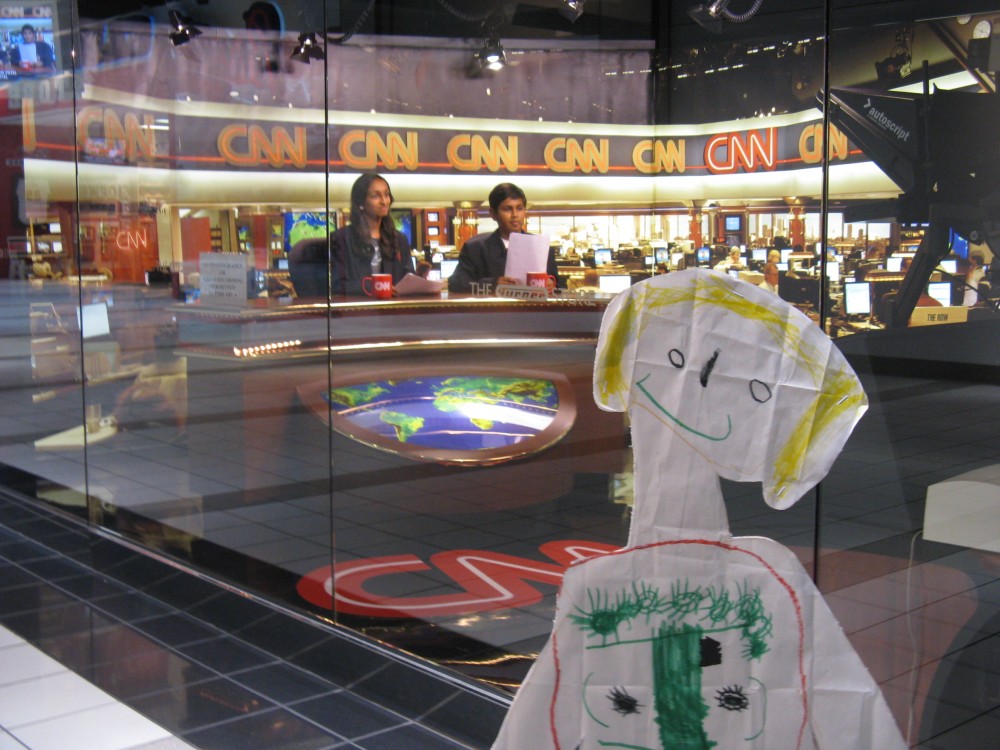

Then they went across the street to the park. IMG_1420s She wanted to run into the fountains with the other children but Uncle Chris said “Flat Bridget, you are made of paper!” and would not let her go in. Look at the tall skyscrapers! See how some of the windows look different? A very strong storm called a tornado came through downtown Atlanta and broke many windows in the skyscrapers. But nobody was hurt and they are now fixing all of the windows.
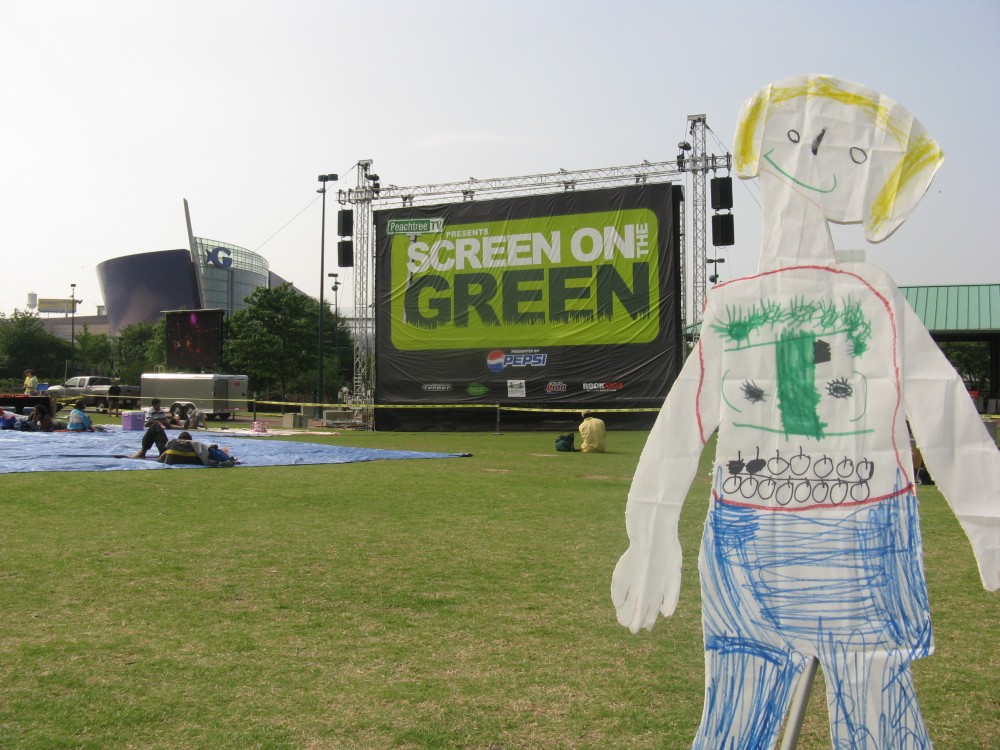
IMG_1424s Later that night there was going to be a movie in the park, but it was going to be a famous movie about a big shark. Shark movies can be scary so Flat Bridget didn’t want to see it. But in the distance, can you see the building with the “G” on it? That is the Georgia Aquarium, and Uncle Chris is going to take Real Bridget there when she comes to visit Atlanta. Lots of fish and sharks and whales and dolphins and all kinds of water creatures!
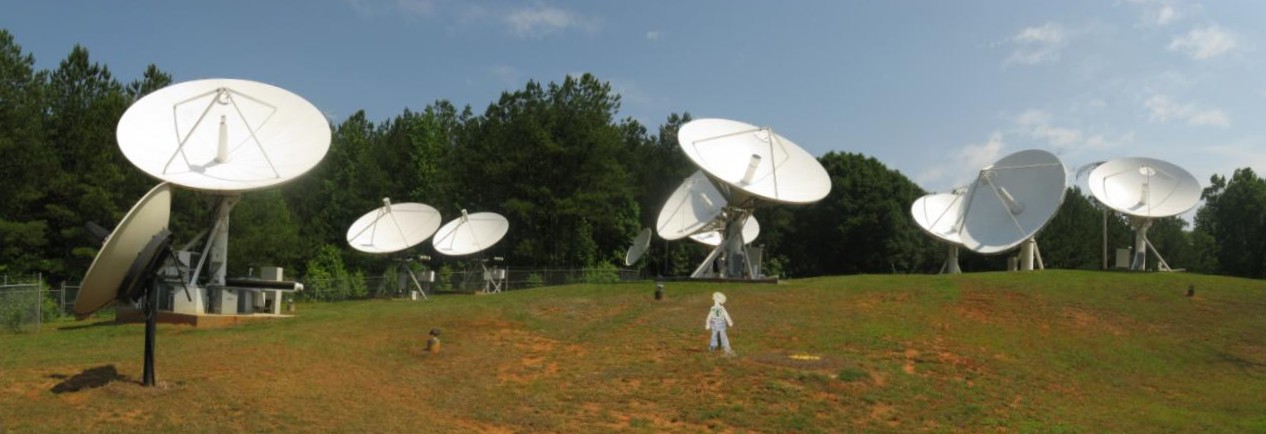
IMG_1427_panorama Next Uncle Chris took Flat Bridget to another place that he works. It’s a place called a teleport, where they have many big satellite antennas that are pointed at the sky. The antennas are talking quietly to the satellites very high in the sky, much higher even than airplanes.
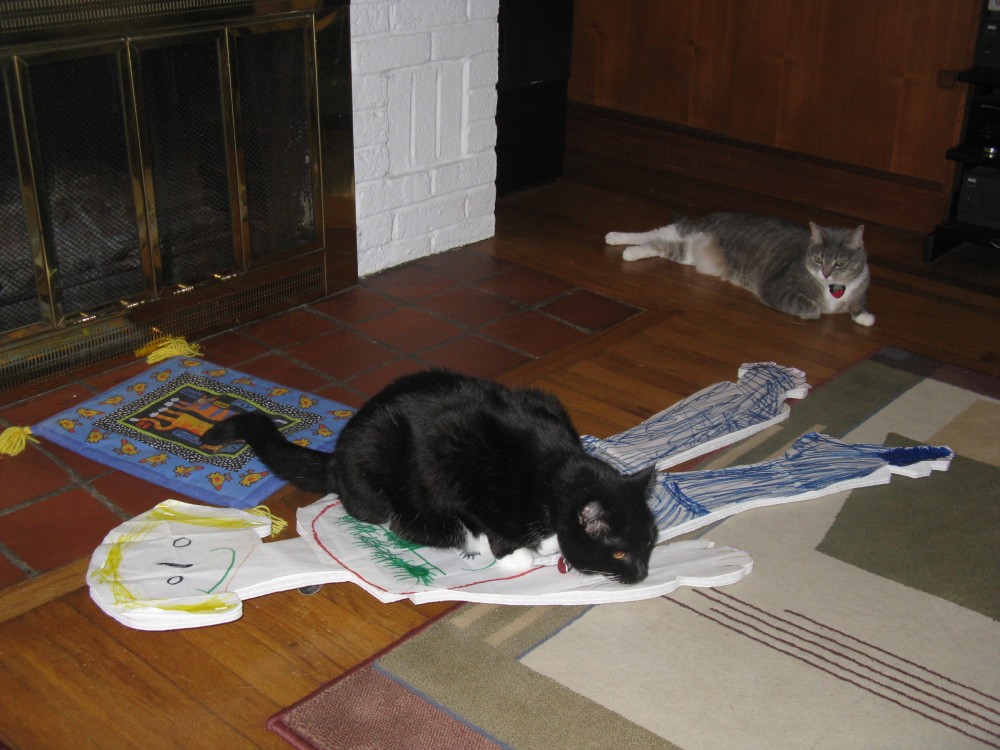
IMG_1443s Flat Bridget came back home with Uncle Chris and Aunt Sharon, where their cats Maggie and Penny were very curious about the new stranger in the house and spent a lot of time sniffing and exploring. IMG_1433s After a while we could see that Maggie liked Flat Bridget very much!

Finally, Flat Bridget posed for a picture on the back deck with her aunt and uncle. And it was time for her to go back home to Petaluma and be with Real Bridget again!

Solar system exploration and the Planetary Society

[update: fixed some links, added Mars Live link, added details on CNN coverage] The Phoenix lander arrives at Mars’ north pole region on Sunday night. This is an event I’ve been anticipating for over a year, since before the misson launched last August. Since then, the U of AZ team has been doing a fantastic job with outreach, and I’m seeing news of this event pop up all over the place, from the New York Times to Slashdot to CNN. There is a flood of resources available on the net for this landing: * Phoenix Mars Landing Real-Time Simulation — great status display of what is happening when, updated live * NASA’s own Phoenix blog * The Planetary Society’s blog (by astro-hottie Emily Lakdawalla) –normally covering many topics, but for the next week or two wholy focused on Phoenix * Mars Live blog (UK) * Live status via Twitter — very short blog post with the latest bits of status * Live chat on night of Phoenix EDL: #space on irc.freenode.net — this requires IRC software, something most people aren’t familiar with On TV, there will be multiple (!) ways to watch this. CNN will cover it, in fact they are devoting a whole hour to it on Sunday from 7pm to 8pm, when it’ll all be over except for the cryin’. Miles O’Brien, former anchor and space fan, will be hosting the hour live from JPL in Pasadena and will have Steve Freaking Squyres on air with him as commentator. Wow! The Science Channel (one of the Discovery networks) will have coverage, but that channel is hard to find. Finally of course you can go to NASA TV (via cable/satellite TV or online via www.nasa.gov) — their coverage starts at 6:30pm on Sunday. Afterwards, refer to this NASA TV schedule to find out when follow up press conferences will be aired; right now it looks like it will happen every 1-2 days in the afternoon, but check the schedule for that. I’d expect to see first photos come down around 9:30pm. This is a terribly risky event — as one of the mission managers said at the press briefing yesterday, EDL (Entry Descent and Landing) is just about the most complicated thing to pull off in the world of robotics. And there is a long history of Mars eating space probes that we hurl at it. The last time we successfully landed on Mars with retro rockets, Jimmy Carter was in the White House. The only two successful landings since then have been done using an airbag landing system, literally dropping to the surface and bouncing and rolling to a stop. This mission is too big for the airbag solution, so they’re back to the old retro rocket design. Watch the Phoenix landing animations and you’ll agree that it just seems terribly difficult. Frankly I will not be surprised at all if they fail, not due to lack of confidence in their abilities, but because this is just so incredibly hard to do. It would be a crushing disappointment, especially for the people have been working on this for a decade. So you will indeed see the most deliriously happy engineers and scientists ever on Sunday night if they survive the landing. Less than 48 hours and I can’t wait! The rest of this blog post is about my interest in planetary exploration in general. As a kid in the 70’s, I was rather obsessed with the Viking landers, and I can remember paging through the National Geographic reports over and over. My room was postered not with cars or girls (although that came later in college, late bloomer huh?) but with pictures of the planets from the Voyager flybys. And I’ve remained interested through the years, but it’s only the past 2-3 years that I’ve really come back to it. A lot of resources are appearing on the internet, and it’s given me the luxury of being able to practically gorge myself on mission plans, launch and space activities, scientific data and discussions of all of the above. The latter is the best of all — instead of relying on magazines or even net news sites for a sense of progress and community, in the last couple years there have sprung up internet forums where I’ll find hundreds and thousands of guys like me who are poring over every last shred of news about each mission. Nasaspaceflight’s forum is the best for manned spaceflight (i.e. the space shuttle and the International Space Station), and UnmannedSpaceflight’s forum is the best for the robotic probes. Those guys are hardcore and I usually just sit back and watch. The Planetary Society has been involved in this and pushing hard for decades now. They are essentially a lobbying organization, with thousands of members (inluding myself) who all believe that it is our collective human destiny and mandate to explore beyond earth. Emily Lakdawalla’s blog is one of their outreach efforts, and she does a stellar (*rimshot*) job of illuminating the latest news and bringing it into context. Mat Kaplan hosts Planetary Radio, a weekly half-hour show that brings it even further down to Earth (is this mic on?); in Atlanta you can hear that show on WREK 91.1 FM on Sunday mornings at 8am, although I just listen via their archive at www.wrek.org; outside of Atlanta you can just go to their web page and download the mp3. As you get into all this, one of the things that you learn is that manned spaceflight is horribly expensive, as compared to unmanned spaceflight. From the perspective of science and research, it is actually terribly wasteful to send astronauts into space. The shuttle and ISS programs inhale massive amounts of money, and the unmanned probes (Mars Rovers, Cassini, Swift, Hubble, etc etc etc) get by with the comparably little crumbs that are left over in the budget. Further, even the manned spaceflight program lately seems to be heading in the wrong direction. In the year after the Feb 2003 Columbia shuttle accident, the Bush administration put together a new “Vision for Space Exporation” (VSE) that set out a long term plan for the manned space program, involving retiring the aging shuttle fleet and developing new rockets, with the new end goal being to put men on Mars. That is very exciting, and there’s no question that a goal like that really captures the imagination of the public. However, in the VSE, the stepping stone to that goal is to return to the Moon. And that is the rotten part. Returning to the Moon as if it’s a stepping stone to Mars is a fraud on two counts. First, the Moon is old news. We’ve been there, and scientists will tell you that there is NOT any compelling reason to go back. We already know it pretty well, and it’s just not that interesting anymore. Second, the orbital mechanics involved, specifically a concept called “the gravity well”, mean that the Moon can NOT be used as a literal waystation or stopping point on the way to Mars. It’s like saying that in order to get to Everest, you must first reach the peak of Kilimanjaro. Which leads to the better idea: go to an asteroid as a stepping stone to Mars. That IS an interesting destination, and it COULD conceivably be a way station on the way to Mars. Certainly, getting astronauts out to an asteroid and back (millions of miles away, much further than the moon) would be a wonderful intermediate step to demonstrate all the engineering that would then need to be scaled up for the Mars trip (50+ million miles away). With all that in mind, the Planetary Society recently convened a few “Town Hall” meetings around the country. Actually, they started with a VIP-only event at Stanford in February, where lots of space scientist luminaries got together to discuss this problem. Then they took it to the public in the form of public meetings where regular people could voice their opinion. They actually only did it in two other cities: Boston and Atlanta. Why Atlanta, I don’t really know, except that two separate contests that the Planetary Society had recently held were both won by two different Atlanta groups, so perhaps we were just high on their radar.

Held at Georgia Tech on May 7th, they brought in a couple Planetary Society bigwigs and added a few local folks to form a panel that started off the discussion. But then they stuck to their promise and handed the mic out to the people in the room. And moderating all this was … Bill Nye the Science guy.

Now, I’m sure we all have our snickering opinions about the goofball we all saw on his PBS science show. But I have to say this: that guy is whip smart, he knows how to work a room, and he knows how to turn the most inane comment into a constructive point. The Planetary Society has a great asset in that man (he’s their Vice President). The meeting went on for two hours and it was clear that most in the room were strongly in support of the things I’ve talked about above, in particular the idea of going to an asteroid or two prior to the Mars jump, instead of going to the moon. And maybe all this whining by us space nerds has had an effect, because a couple weeks ago NASA announced that they are now considering a manned mission to an asteroid. Eeeeeexcellent. (spoken with the voice and fingers of Montgomery Burns) Now, if we could just get AMS up to ISS before the shuttle retires …

I’ll close this long post with this. Here’s a fantastic article by an astronomer about what it’s like to work a night at the Keck telescope on Mauna Kea in Hawaii:

http://www.mikebrownsplanets.com/2008/03/blue-hawaii.html

http://www.mikebrownsplanets.com/2008/04/bluer-still.html

art, music and technology collide in Atlanta

A couple weeks ago I had a chance to attend one of the “Art Papers Live” lectures. Art Papers hosts presentations by prominent artists a few times a year, and every one of the handful I’ve been to has been fascinating. Mind you, I didn’t go to art school and don’t have any training in the fine arts, so I’m sure the things these guys talk about is old hat for most art scenesters, but it’s all great brain fodder for me.

This time the presentation was by Daniel Canogar, a Spanish artist who works with light and projection, primarily through the use of fiber optics in large (sometimes public) installations. His modest demeanor hid a sharp intellect and he provided fascinating insights into his own processes and art in general.

A while back I was able to go to another Art Papers Live and see Christian Marclay give a talk on his work. I was already familiar with him through my exposure to the music underground. We had one of his records at WREK — it was a vinyl LP that consisted of 4 LP fragments that had been joined together to form one LP, and of course when you played it you’d get this blip-blip-blip channel-changing effect where you were listening to four different recordings interspersed with each other, about half a second of each one at a time.

Anyway, back to the thing with Daniel Canogar, it happened to be held at the Institute for Paper Science and Technology (IPST), an industrial research operation located in the far corner of Georgia Tech campus. They’ve got a little museum off the lobby that showcases the history and technology of papermaking. It’s interesting enough although a bit … dry.

Coincidentally, Dorkbot ATL was holding one of their meetings the same night in the same area of campus, so when Canogar finished I hoofed it over to the Dorkbot meeting. Alas, I got there just minutes after they’d finished. I don’t kow if this is representative across the nation, but the Atlanta chapter of Dorkbot is mostly focused on using electronics in new ways for the purposes of music composition. This is probably the case because the leader and founder of the chapter is a music professor at Tech (yes, they exist). So at these Dorkbot meetings you get less dorky robots and more dorky music electronics. It’s alright, I’m just usually underwhelmed by it.

Walking back through the west campus dorm area to get back to my car at IPST, I was struck how artless Georgia Tech campus is. I mean, I spent five years of my life living in that exact spot (in the west campus dorms) and I didn’t really find it objectionable, but I guess now with my greater exposure to .. the world, it just seems … uglier. Of course, this is what architecture critics are alwasy jumping up and down and screaming about. It all just seems so completely devoid of imagination or human expression.

There was another annual Listening Machines event at Eyedrum; this annual event has Georgia Tech music technology students presenting their creations. Occasionally I get to go see Sonic Generator (yet another Georgia Tech music operation, hmmm); actually, I’ve only seen one so far. I’m giving these short shrift because I’m not sure whether I actually like them. I go, but I’m not sure I really enjoy it. But I go anyway.

A similarly minded event from a couple years ago involved a visiting artist from Australia. Guy Ben-Ary was doing a residence at Georgia Tech and had a one-night installation at Eyedrum. What he did was take a culture of neurons (rat cells, if I remember correctly), maintain them in a culture, and wire them up with fine wires with which to sense and stimulate them. Then those sensed signals were connected to robotic arms that moved according to the signals. With pen in hand, the arms drew patterns on paper. The results were not particularly compelling visually, but it made for a thought-provoking evening. He also did a presentation at Dorkbot which was actually quite fascinating.

Attending events like these often gets me thinking about life in Atlanta in general. It seems to be perpetually balanced between middle-American cheese (Shoney’s, megachurches, discount outlet malls, W stickers, OTP) and “real” urban city life (music subcultures, art cinema, actual pedestrian street life, F stickers, ITP). Most of the time Atlanta is just provincial, lacking in serious art presence, public art, or any kind of street character. But if you try a little bit, you’ll find plenty going on under the plastic sheen.

making panorama photos

I will shortly be updating most of the New Zealand posts with some more pictures*. During the trip I took some panorama photos, which are simply series of photos taken from left to right that, when joined together, form a wide panoramic view of the scene.

The problem is the joining, also known as “stitching”. If you just glue them together it looks stupid. So you have to use special software, and this capability has been available in computers for many years now. Usually when you buy a digital camera these days, it comes with a software CD that will help you make the panoramas. And further, many cameras now have a “stitch assist” mode, which helps you align the next shot as you take the left-to-right series of photos, so that when you get to the computer part later it lines up a lot better.

And at the extreme, a few cameras will do the joining of the photos in the camera, producing a panorama within the camera without requiring a computer or software. THAT is cool, but unfortunately that capability is currently exclusive to Kodak cameras, and they are crap, at least compared to Canon cameras. Oh well.

So that put me in the business of having to use stitching software on a computer. I wanted to use my Linux machine for this, but ran into a few dead-ends there. There is a plugin and process for doing it within GIMP, but I don’t have the time or patience for what sounded like a terribly tedious process. There is the hugin package, to which people have given glowing reviews, but it’s not available for the (2-year-old) version of Linux I’ve got. I’ll be overhauling the Linux install later this year and look forward to using hugin then to improve on these panoramas, but for now it’s not an option.

So that dumped me back over to using Windows. Ugh. Fortunately, I found out about autostitch, which is a very simple program produced by a coupla grad students at U of BC. You literally just dump the images into it and do nothing but wait for about a minute, and out comes a gorgeous, perfect, blended panorama. It’s really amazing what them smarty pants college kids can do given Moore’s Law …

This is Wellington!

Img_0333_panorama

* Apologies to those of you who subscribe to this blog, as you will get several nuisance alerts about the posts being updated as I go through them, and this might not be the last time, as Sharon and I have more details and narratives to add to the daily posts …