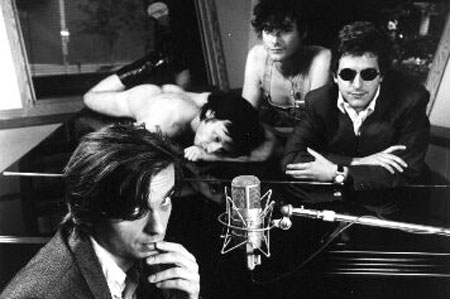
Jesus Lizard

Jesus_lizard OK, well, I feel really silly making a post about the Jesus Lizard. Of all the bands that I would consider my favorites — Unwound, Superchunk, Jawbreaker, Melvins, Gang of Four, Tar, Unsane, Jawbox, Mission of Burma — I would generally not include JL in that list. But to tell the truth that would probably be a kneejerk reaction to their popularity. Back in The Day, in my world, the Jesus Lizard was just about the most obvious band for everyone in indie rock to like (or claim to like). As in, even frat boys eventually knew about them ’cause they could come to the shows for the mosh pit, which of course meant that my kind would turn up our collective noses at them.

This week JL started a reunion tour (another thing I used to turn my nose up at) and are playing in Atlanta tonight. I bought my ticket as soon as I heard about this, two months ago, and have been practically giddy with excitement ever since.

Touch and Go has rereleased all four of their JL albums (Head, Goat, Liar and Down), remastered and with new liner notes, and they are as stellar as the day my scrawny college ass first heard them. Even better with the liner notes and having now actually read all the lyrics. (that David Yow is not right in the head)

Damn, this is embarrassing! Go on …

JL were simply the kings of the indie rock world in the early 90’s; only Fugazi would be comparable in my mind. A whole generation of dudes will hear the words “I don’t know, he’s a nice guy, I like him just fine” and know that what must follow is “but he’s a mouthbreather” and then commence convulsing to some sound that only they can hear.

The Pure EP debut lacked McNeilly, but produced the perennial live crowd pleasers “Blockbuster” and “Bloody Mary”. With the Head LP they burst out of the gate as a full fledged four piece, an entire album at full gallop. The locomotive bass riff for the opening track, “One Evening”, has popped into my head at least once a week for literally two decades now.

Goat followed a year later and is the album that contains most of the huge “hits”. Opening with the sinewy stomp of “Then Comes Dudley” (and, live, the requisite Yow moves on that one) , it cruises through the triple threat of “Nub”, “Seasick” (I can swim! I can swim!) and “Monkey Trick” on the the way to becoming one of most iconic albums of the decade. Picking favorite songs as about as pointless as picking favorite bands, but “Nub” may very well be the best JL song for me, starting with the Duane slide opener, waltzing through typically creepy Yow lyrics and pounded flat by Sims and McNeilly. The first video in the Youtube search linked above is a proper video for the song — who knew that JL did videos?!

There were albums after that, but I guess I lost interest. Frankly I had perfection in my hands already with Pure, Head and Goat. Sorry guys.

JL are the most pure expression of rock power and abandon that has ever graced a stage. I remember listening to the LPs over and over, but all that was just an appetizer for seeing them live. Checking my old show list just now … I saw them 7 times in 4 years, meaning I never missed them whenever they passed through town. Duane Denison alternating his iconic Travis Bean (with the aluminum T headstock) between pastoral, chiming runs and stinging, roaring chords, all with that characteristic twang. David Wm. Sims’ fearless but workmanlike attack of his bass, doing his spasmatic guitar neck yanking moves. Mac McNeily’s from Atlanta so we took pride in seeing our hometown boy make good by punding out rhythm for the most furiously rocking band ever. As Joe Lally says in the new Head liner notes:

The Jesus Lizard is my idea of a perfect band. A classic drum-bass-guitar trio playing a music aggressive enough to drive their front man to physical feats that alter reality and leave witnesses wondering weeks later what exactly happened.

And David Yow is still getting pushed to that limit. I traveled to Chicago in Sept 2006 partially because Yow’s and Sim’s earlier band, Scratch Acid, was reforming for the Touch and Go festival there. Yow and Sims did their thing there as well as ever that night and I’m looking forward to it tonight. I’m going to be in pain afterwards though, that’s for sure.

Hey look, Mac McNeilly wearing a WREK T-shirt!

UPDATE: Services were rendered to my great satisfaction.

http://www.youtube.com/watch?v=sI1mHjzxfo8
http://www.youtube.com/watch?v=_8Q3AfTaoxQ

http://www.youtube.com/results?search_type=videos&search_query=jesus+lizard+atlanta&search_sort=video_date_uploaded

Full Moon on Halloween

Dbrodeur7 I’ll keep this relatively short for now. This weekend we are hosting a loooong planned event at our house: the full moon will be rising over the trees across the street, and I’ll have all three of my telescopes set up for anyone to look through. We did this once in 1997 or so, with my first telescope, and it was a total riot watching the kids freak out. This time, I’ve got three telescopes (including a really nice new one) and will have them all set up. We’ll be doing this all three nights, Fri-Sat-Sun, so come on down if you’re in Atlanta and at all interested. The moon rises over the trees at around 6pm each night, and probably will be visible for an hour or two before we lose it in the leaves of the big oak over our own house.
Tganey3 We invited a gazillion people, and if you’re reading this chances are you got the invite, but if not then just come on down. If you don’t know where we live, or don’t know how to contact me, or don’t even know me, well, sorry!
By now I had intended to have written separate posts for telescope #2 and #3, but that’ll have to wait.

Come on out, even if the forecast looks like clouds or rain, as we’ll just be hanging out crying into our beers.

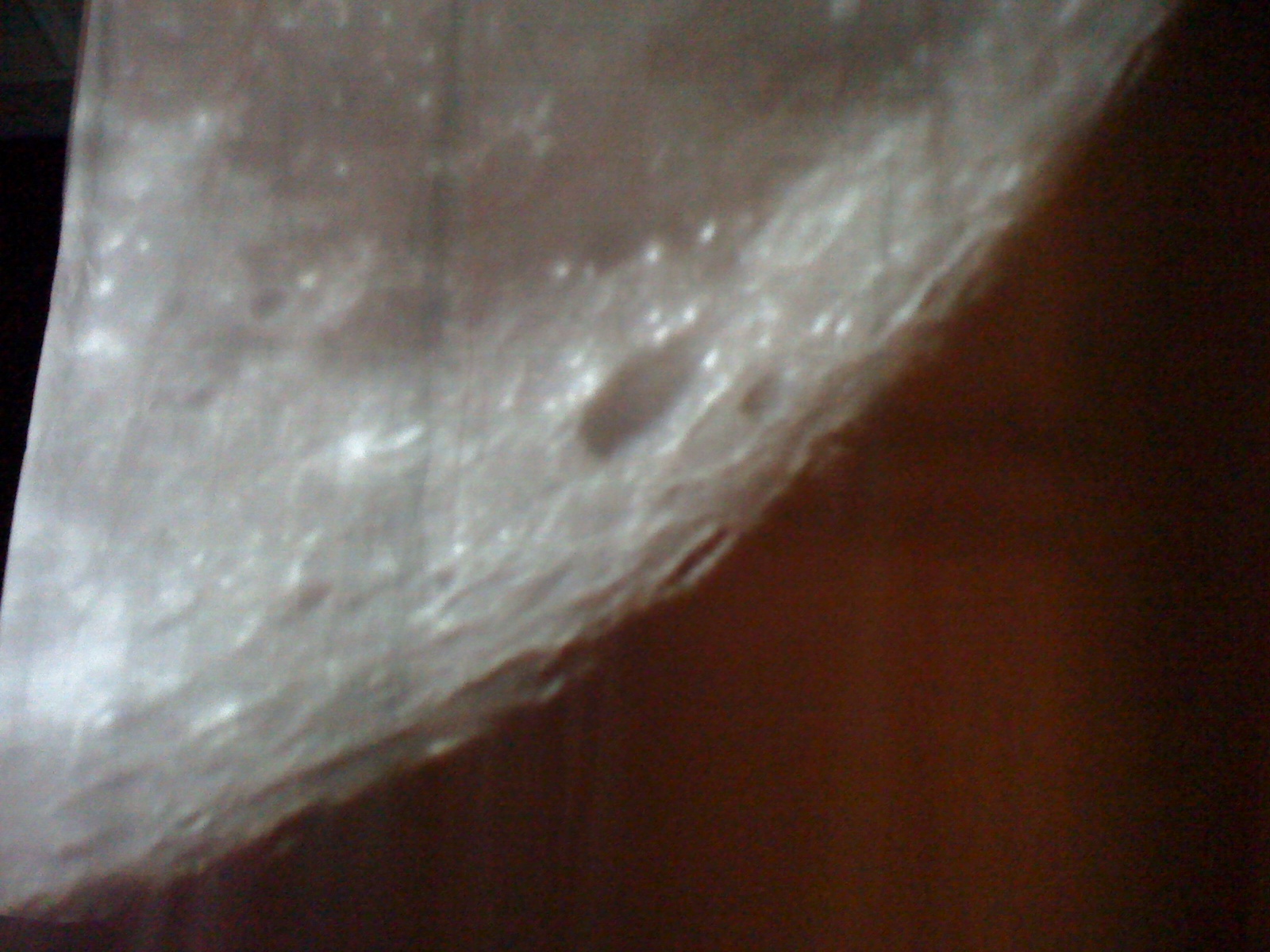
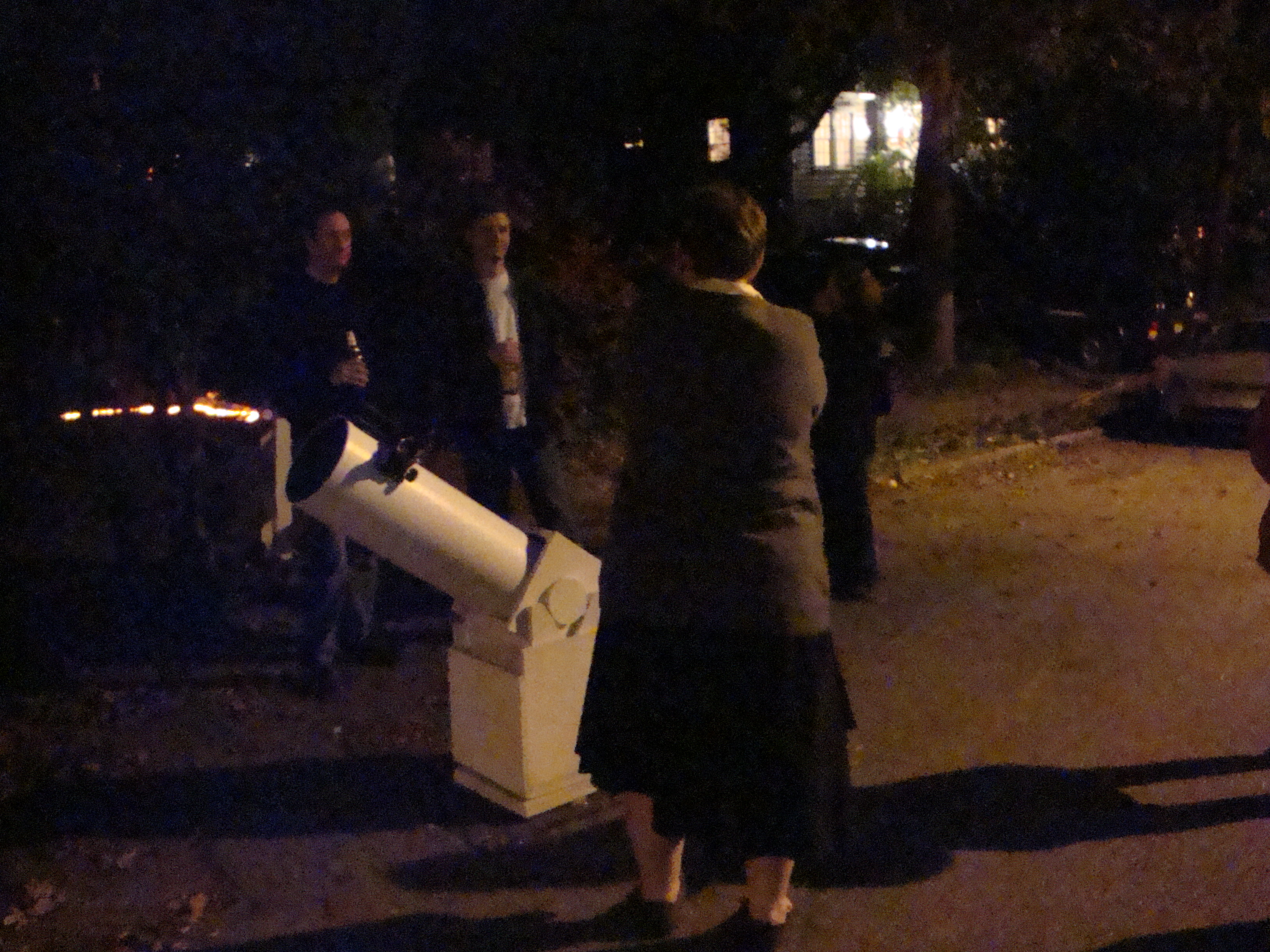
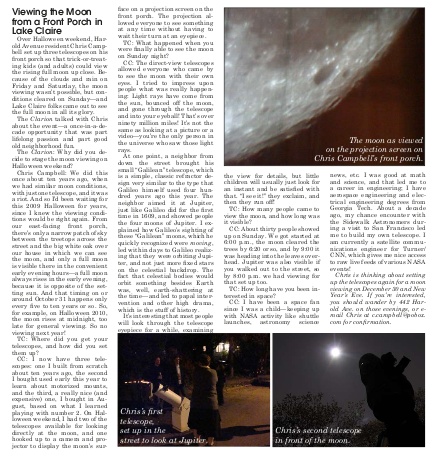
UPDATE 1: Mother Nature didn’t cooperate on Friday or Saturday (Halloween proper) but Sunday was beautiful and lots of people came over. I was so busy I forgot to take pictures. Other people took pics though, so I asked around and got a few that I’ve posted here. The moon pic above is from David Brodeur and shows the view of the moon that I had projected on a screen on the front porch; it’s something I’ve done before and literally stops traffic! LCN-article The other picture is from neighbor Tim Ganey and shows of some of us standing around my old homebrew telescope out in the street, after I moved it out there later in the evening to look at Jupiter. Sadly there are no pictures of the “real” telescopes set up on the front porch. Who knows, maybe we’ll do this again someday soon!

UPDATE 2: the monthly newsletter for our neighborhood, the Lake Claire Clarion, did a full page spread about this event in their December issue (PDF, 2.1 MB, see page 3), with a fairly extensive Q&A with me about what we did and the few photos that we did happen to get.

We planning on doing this again in Spring, so watch for the invite!

The Porch Rebuild

We’ve been planning this project for a long time.

Newfrontporch We’ve got a brand new front porch and the Halloween weekend event will be christening it for us. Front1 To the left is a picture of what it looks like now, post rebuild, and to the right is what it looked like before. Probably doesn’t seem like much of a difference to you, but pretty much everything underfoot was completely rotten or otherwise unnavigable, and I hated the old columns. All that has been replaced and we can now have people tramping across our porch without us worrying about them falling through into the basement! Or falling off the edge, because there was no railing before either. And the steps don’t strike fear in the hearts of elderly anymore. And so on.

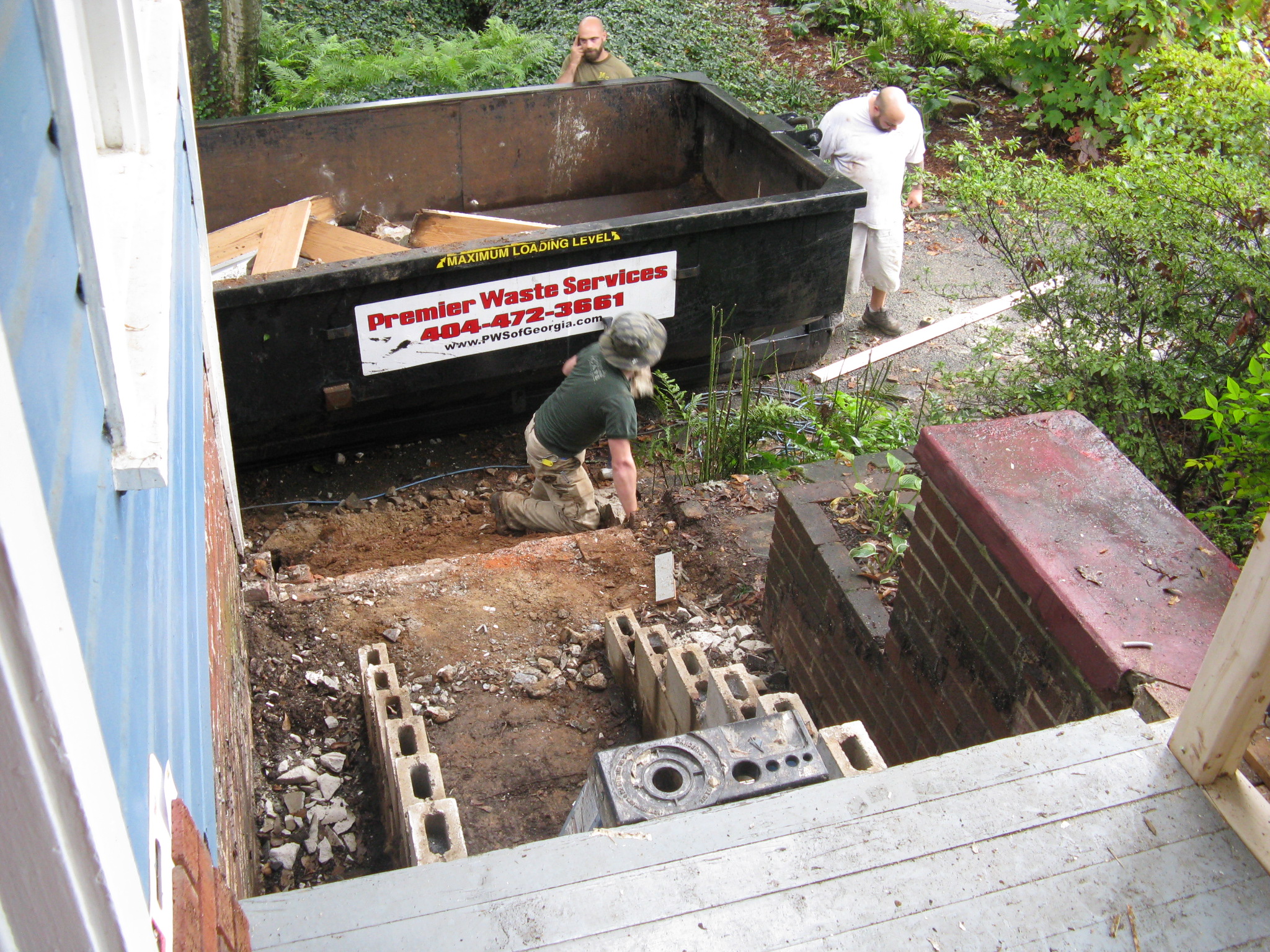
IMG_1107 First up was the demolition and rebuild of the front steps. The old lower section had been poured in place, but over time part of it had settled, to the point where the amount of “rise” for each tread was basically a random number between 6 and 10 inches. The old upper section was a strange prefab design, made of formed concrete piece fitted together. IMG_1137 The steps were actually evenly spaced, but the whole thing basically felt loose, and when you stepped on it the sections would clatter a bit, making a disconcerting hollow rattle. Altogether, this made for a worrisome adventure for pretty much any visitor.
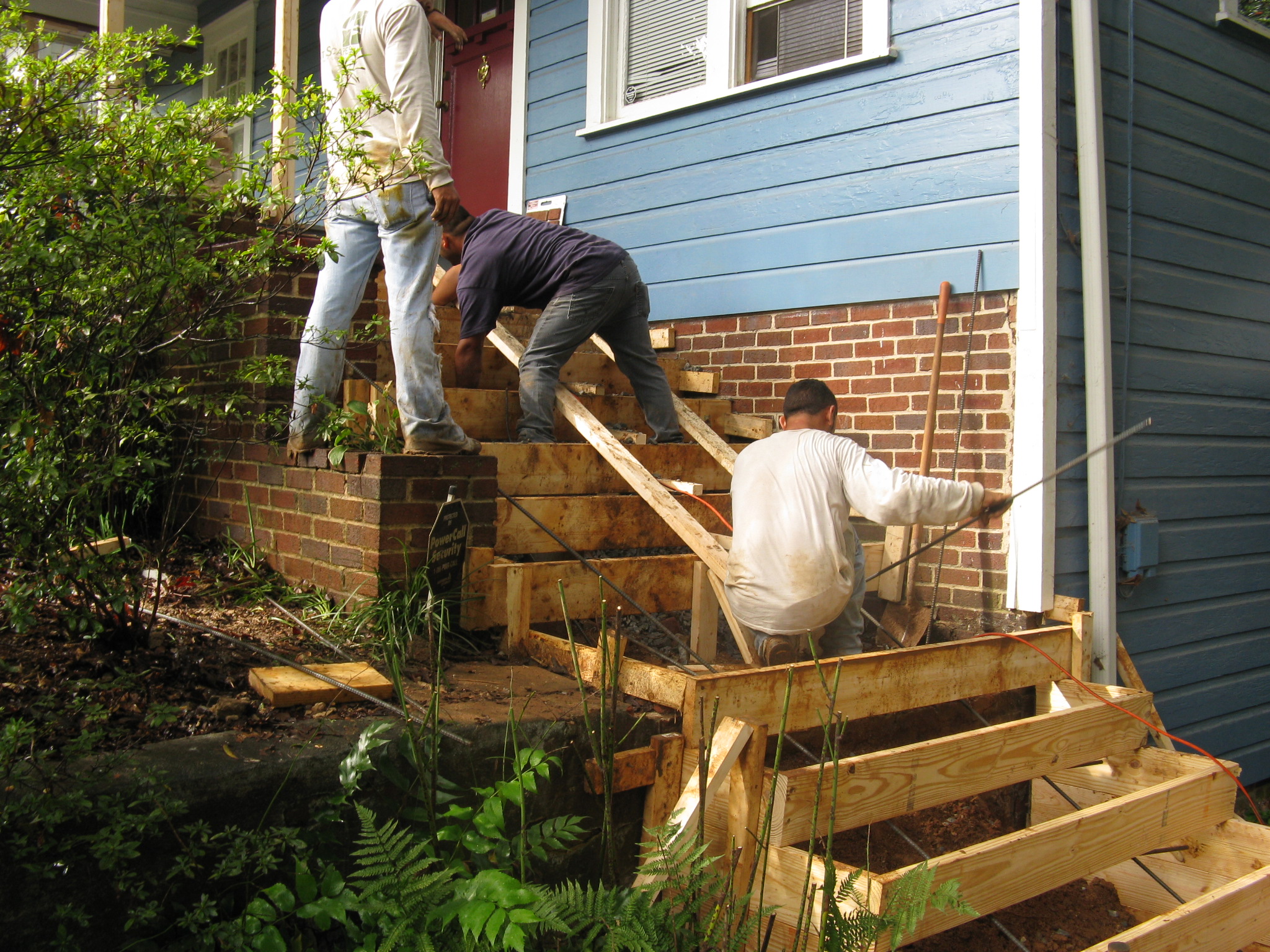
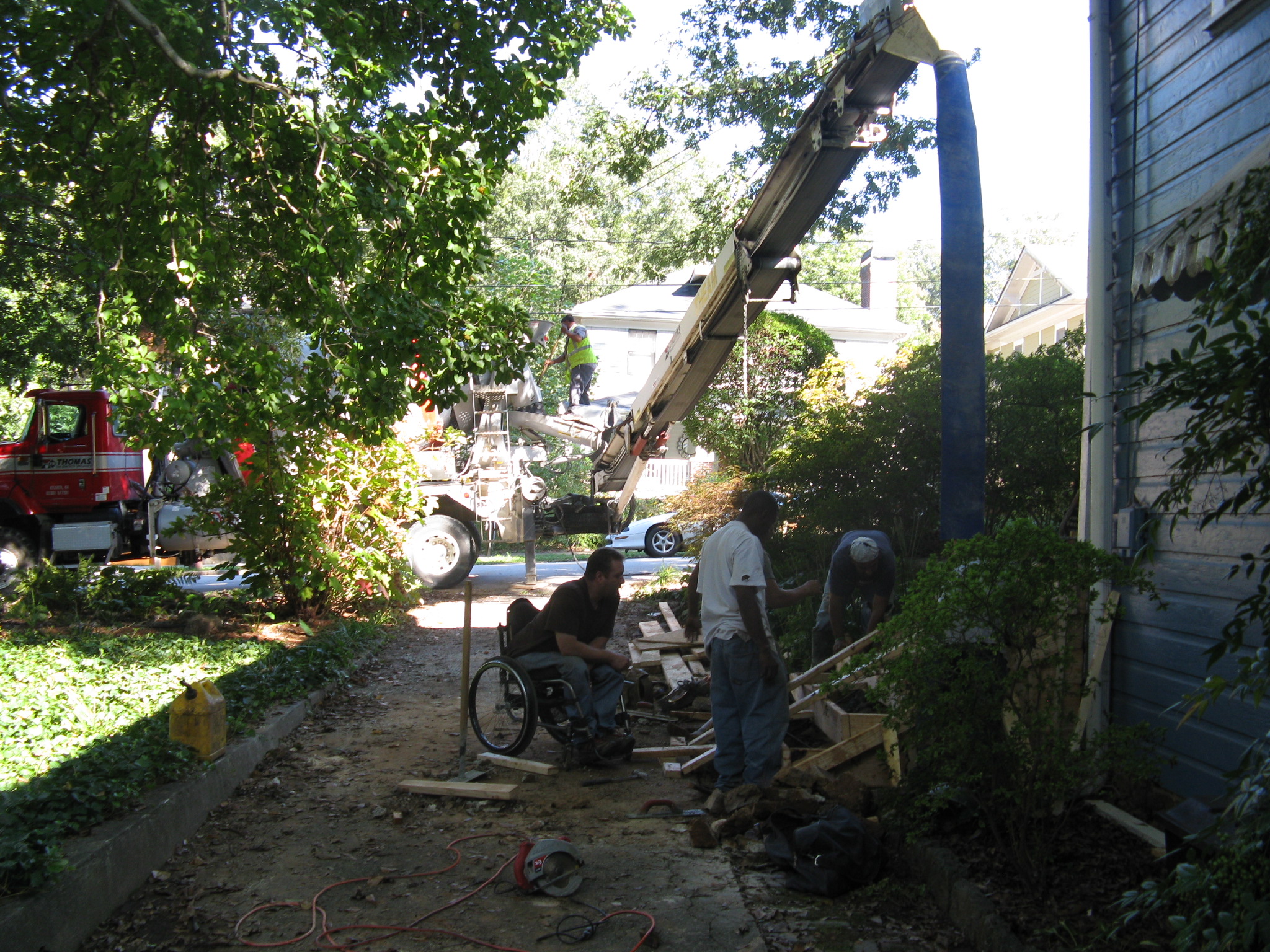
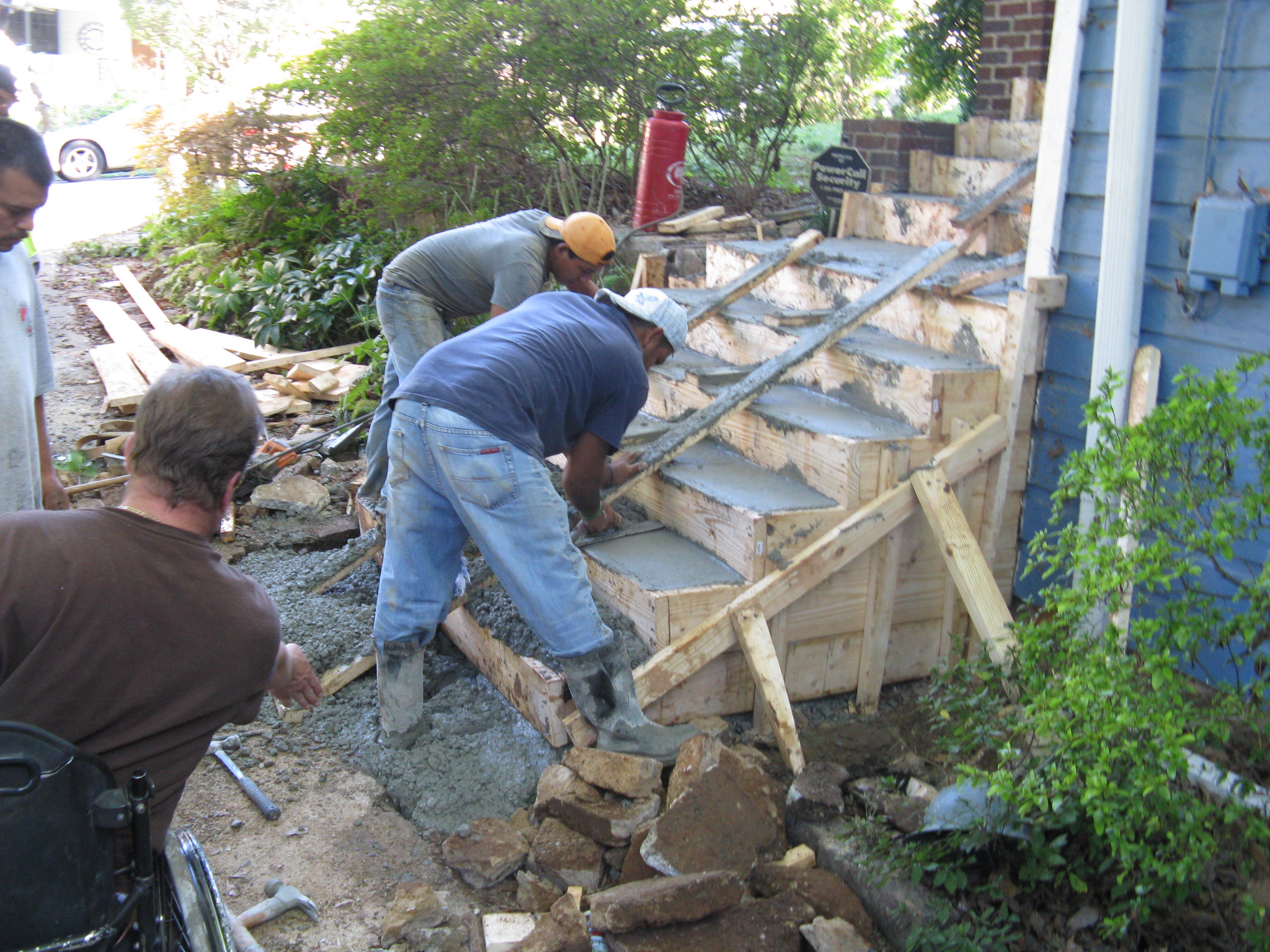
IMG_1160 When a construction project gets going, it’s really impressive how fast it can move along. The steps were demolished in a couple hours one day, and then one day later that week IMG_1161 the wooden form for the new steps was built, and on the third day there was a 4 hour period when the concrete was poured in and the steps finished off. (yes, the concrete subcontractor lead guy is in a wheelchair)
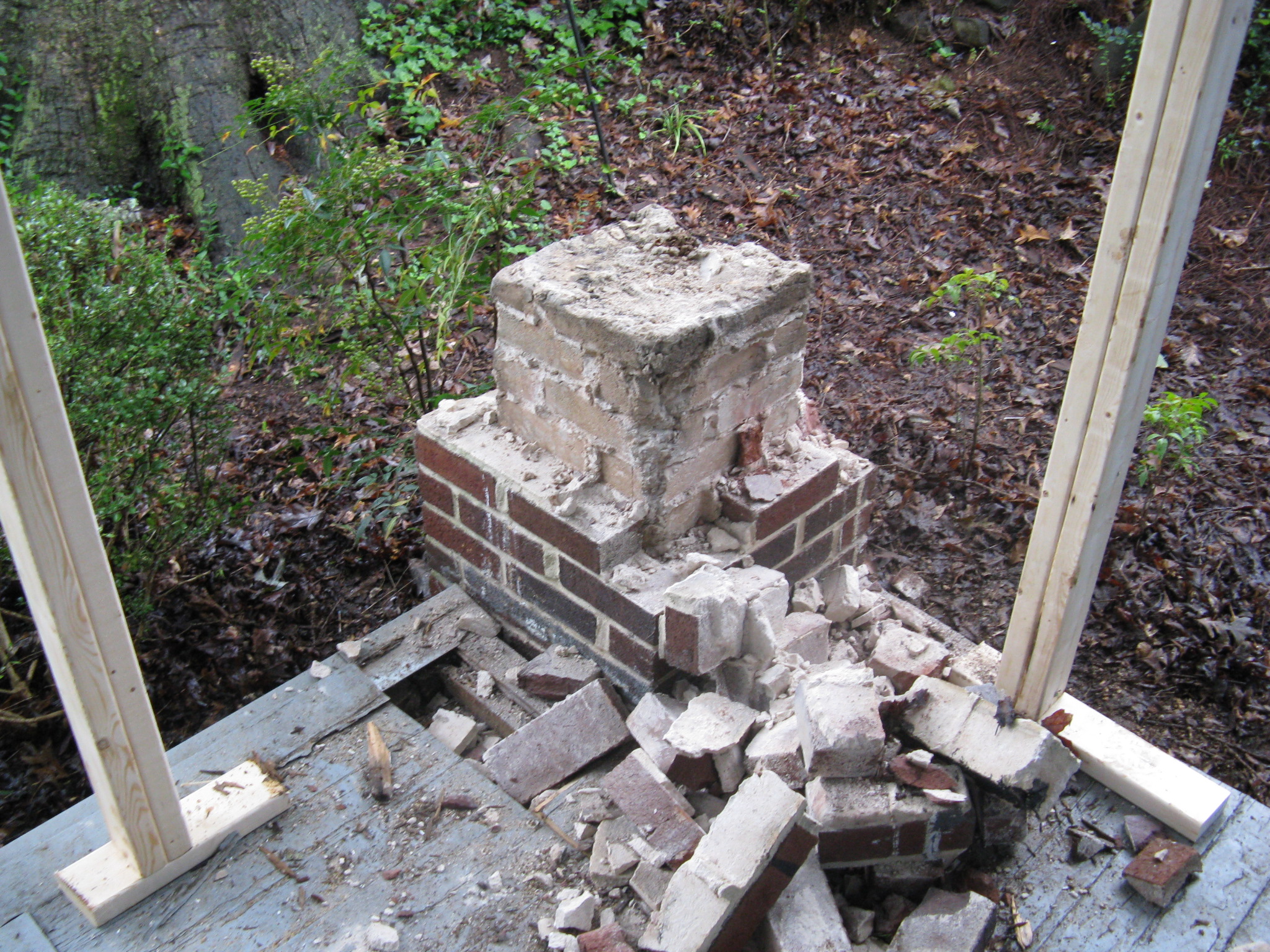
IMG_1114 Next up were the columns. We wanted to keep the old brick columns but the tops needed to come up in height a bit. It’s hard to match brick and mortar between old and new brick, so the old columns were torn down and rebuilt. In the meantime, the roof overhead was held up by a couple 2×4’s, anchored onto a floor that was completely rotten, so that pretty much scared the crap out of me. Visions of half-collapsed house dancing in my head.
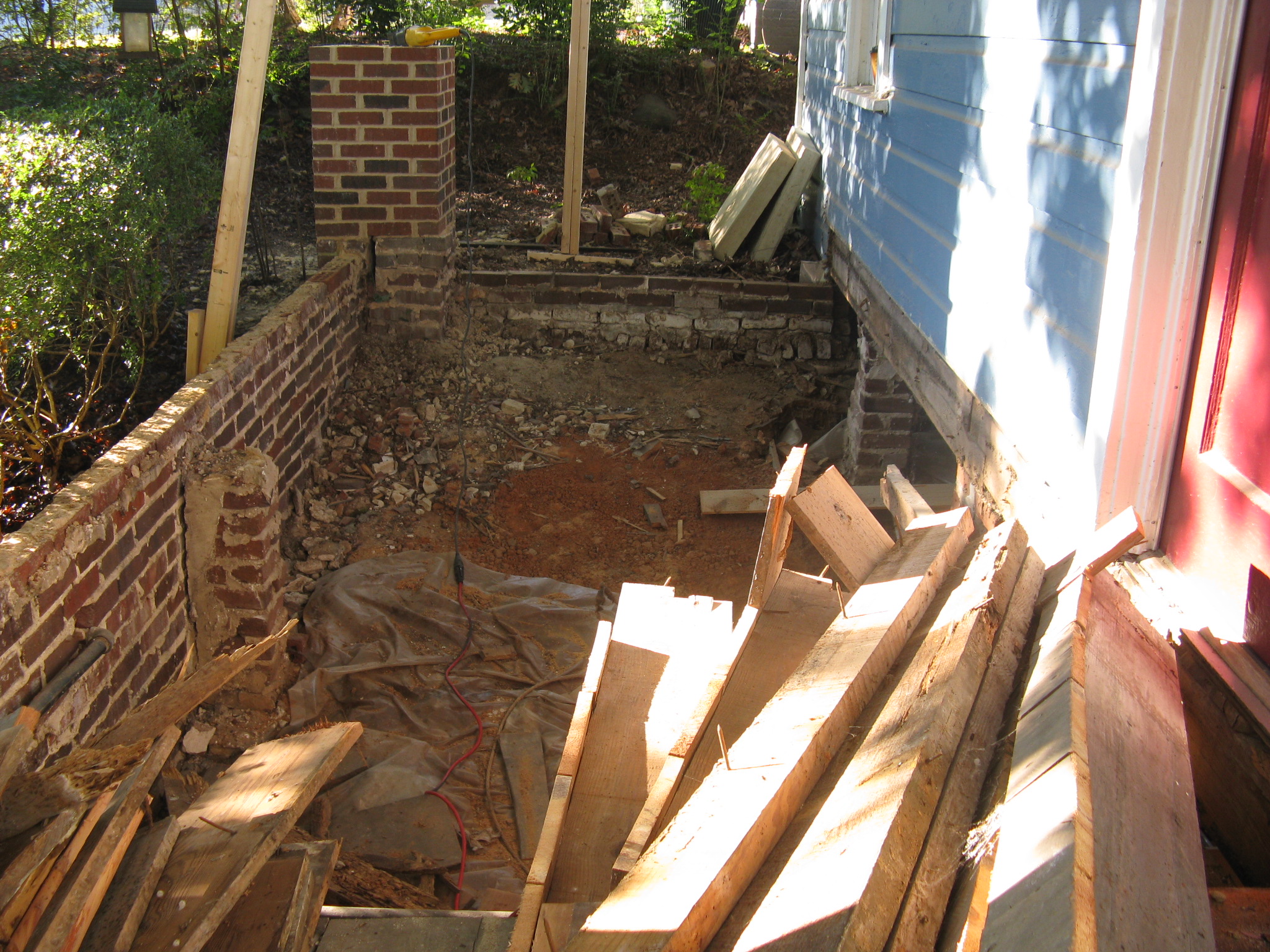
IMG_1518 The original plan for the floor had been to rip up the floorboards and replace them, but keep the joists / substructure, since they had looked fine from our inspection via the basement. But when the contractor actually got the floorboards up, we could see that the structural beams were completely rotten away in the corner where they joined into the brick columns. IMG_1539 The floorboards themselves had actually been all the structural support there was at the corners; with them removed, the porch was literally a seesaw, pivoting over the still-intact center piling. Well, OK, frankly this kind of thing is expected in a rebuild — you have surprises as you tear down the old construction, and just hope that the surprises stop at some point. Fortunately they did stop, and replacing the entire structure turned out to be fairly cheap, just a couple hundred dollars of materials and a couple hours of labor.
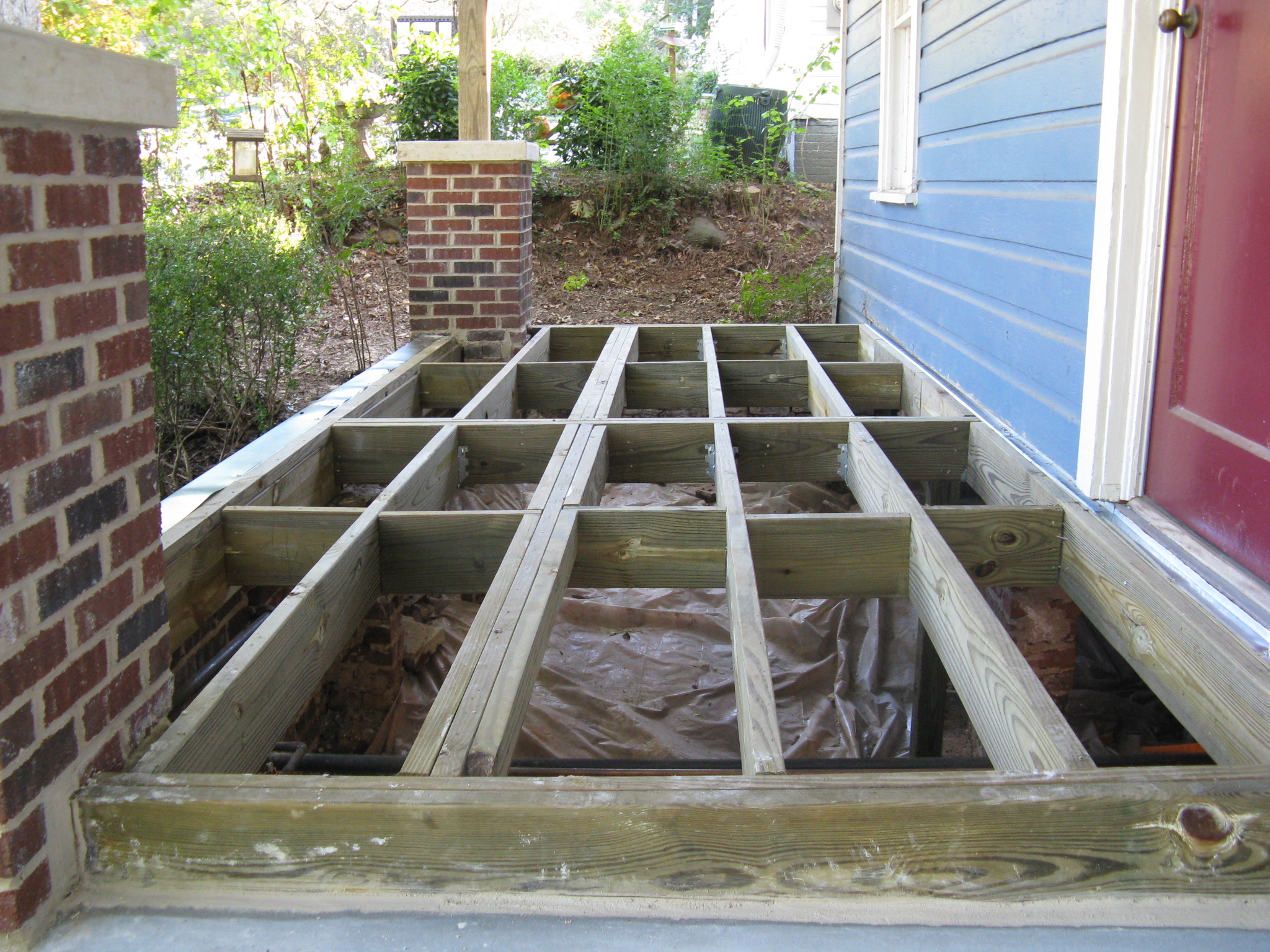
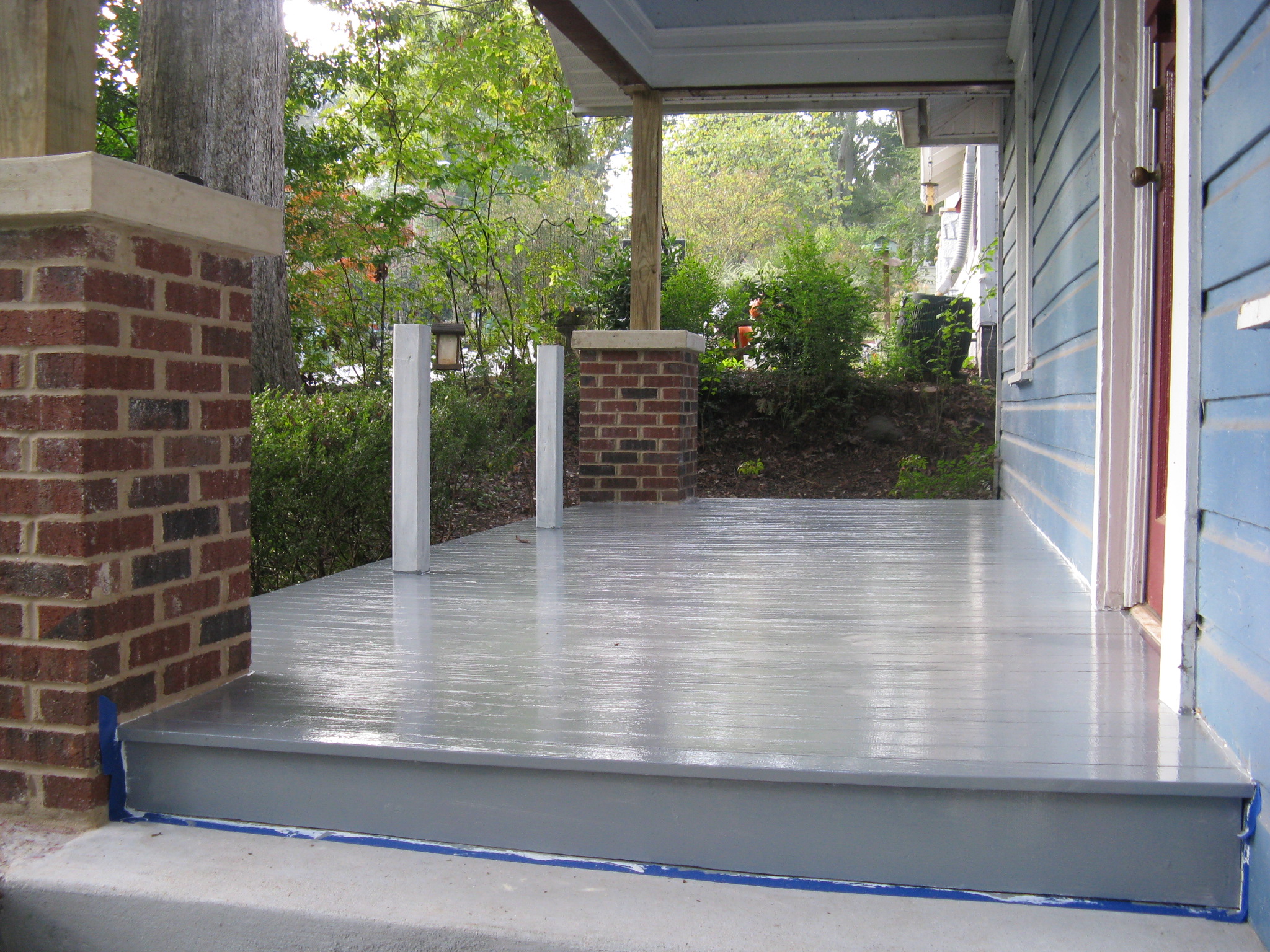
IMG_1562 Now things were rapidly approaching the finish line. The floorboards went in and were painted, and the railings were built. The previous porch had no railings at all, which made it somewhat unsafe and aesthetically … odd. I have this thing about weak railings — a railing should be able to support a LOT of horizontal load and not just be there for show. So I specified to the contractor how he was going to anchor the railing’s support posts into the beams below, with the result being a railing that any number of people could lean on and that thing ain’t goin’ nowhere!

IMG_1610_mod The new wooden columns went up last, with the taper that is characteristic of these old bungalows.

Next spring I’ll take some nice big photos, with the azaleas blooming and all, but for now here it is in its Christmas light glory.

Thomas Peake

Thomas Peake died on September 21st following a fall while hiking in the Grand Canyon. The following evening, bits flew raced around the interent as word spread of this horrible news. I first heard from Brendan Digel, who relayed Dara O’Niel’s Facebook dispatches about the search for him Monday night and Tuesday morning. Shortly thereafter Jon Kincaid sent me brief word that Thomas had passed, and mentioned a Facebook page with more info. I talked to Allan Ross in New York and he sent me the link to the Thomas Peake Memoriam Page on Facebook. The National Park Service made a press release. Check out these sobering descriptions of the Lava Falls Route that Thomas was attempting. The next morning, the world continued to wake up to this sad news. Dave Slusher had a nice post, in which he linked to the Facebook image gallery.

—————————

Thomas is one of the original Great People on this planet.

Many people knew Thomas from his involvement at WREK. In the mid-80’s Arthur Davis led WREK in a determined shift to more adventurous programming. Thomas came on board in the late 80’s and continued what Arthur had started. Through a variety of official roles, Thomas was really our philosopher king for a few years, and his energy and enthusiasm for the programming and the radio station was infectious. There are so many great little things that happened during his tenure — the WREKology “zine” program guide, shepherding of new shows and show hosts, fundraiser concerts by nationally known bands … There was a powerful DIY ethic in Thomas and it really came out beautifully during his tenure at WREK — both from him and as a result from everyone around him.

Here’s an opinion piece that Thomas wrote in the early 90’s: http://www.cyberbuzz.gatech.edu/wrek/opinions/opinion1.html

To work at WREK for any appreciable amount of time is to discover that the world of music is far more vast than you ever imagined. Another staffer of the same period, Markus DeShon, came up with the concept that Music Is Sacred, in that music (real music) fundamentally represents deeply personal human expression and should be revered appropriately. Well, not the stuff on commercial radio, that exists just to separate fools from their money! As a lot of us did, Thomas dove into WREK and discovered a huge cultural cornucopia, including music well beyond our own shores and certainly beyond rock.

Another thing that Thomas did was put out feelers to the Atlanta music community, pulling it closer to WREK, and suckering a lot of the musical talent in town into helping do WREK shows or otherwise making WREK even better. It really can’t be overstated how integral WREK was to the Atlanta music scene in the 80’s and early 90’s, and a lot of that was due to Thomas and his positive energy.

Thomas was incredibly productive. I have deep respect for people whose hearts and minds are in the right place but also manage to Get Things Done. There is so much rhetoric, especially now that the internet has given so many of us a voice, and there seems to be little action to go with it. My years at WREK taught me the DIY ethic, and Thomas was the epitome of that, because not only did it make things happen, but he did it well. Lots of people have their heads screwed on right but can’t get their ASS in gear. Thomas’ ass was moving, constantly. And always with that goofy happy style of his.

I would like to ask his parents this: how did you do that? How did you raise a young man to be that smart, that engaged in the world, that overwhelmingly positive and warm to everyone he met? It’s just so completely remarkable. For many, to be politically and culturally aware these days is frankly to be depressed. Because there is so much evil and wrong around us, it’s hard to see the joy and wonder sometimes. But Thomas was as politically and culturally alive as any of us, and he was completely happy.

Here are some great quotes about Thomas from the last few days:

Ben Davis on the Facebook page: “I learned [from Thomas] that it was very punk rock to be friendly to people.”

Dara O’Neil quoted in the AJC article: “There was definitely something wrong with you if you didn’t like Thomas.”

Jon Kincaid in a short tribute during his Personality Crisis show on WREK: “Thomas always had a smile on his face, and after you met him, you always left with a smile on yours.” (stream link, tribute starts 5:15 into the third segment)

—————————————————

Probably half of the people who know Thomas know him through his tenure at WREK as a Georgia Tech student. He was one of a handful of people (I would argue two, with Arthur Davis) who really elevated WREK into the awesomenews stratosphere. During that time, Thomas produced countless radio shows, from his early weekly shows on punk rock early in his career, to the occasional Sunday Specials in which he would focus on a particular artist or genre.

A lot of those radio shows got taped by you Thomas fans out there, and you probably still have them. I want you to help us share them with the world.

Dave Slusher and I have created The Thomas Peake Podcast, found at www.PeakeCast.org. We will take everything we can find, digitize the audio into MP3 form, and make it available on the internet as a podcast. You can subscribe to the podcast, or download and listen on your computer, or download and burn your own CDs.

We already have the first show up. The one thing we could dig up right away was Thomas’ appearance on WREK just 5 years ago. In 2004, WREK moved from its old Coliseum studios to new digs in the center of Georgia Tech campus. To celebrate the 27 years that WREK had been at the old location, and give alumni one last chance to see the joint, I put together “alumni weekend” at WREK, where we took over the station and I invited past WREK staff to come in and spin records. Thomas had a one hour segment … and I totally knew he would play the Colorblind James Experience! Go to www.peakecast.org to hear it and subscribe.

That’s just a sample of what we hope to provide in the PeakeCast. But we need your help. If you know that you taped some of Thomas’ radio shows, GO FIND THOSE RECORDINGS NOW PLEASE. Go to www.peakecast.org and follow the instructions for submitting them to us. Dave and I will be collecting them and will then take care of digitizing and relaying all this musical goodness out to everyone else in the Thomas-o-sphere.

We realize that Thomas himself probably had the best collection of these tapes, but we’re certainly not going to bother Dena and family just yet. However, if Dena or any of Thomas’ family are reading this, know that we are ready to receive whatever you find when you are ready.

Thanks for reading, and stay righteous.

————————————————————–

Update Oct 2010: it’s been a year now. The PeakeCast has published eight episodes and we have lots more to come. This weekend we will remember Thomas with a day of hard work on the Beltline, improving a segment that starts just north of Memorial Drive. We miss him.

Soaring over Monroe GA

August is birthday month around here, and I usually splurge on some presents to myself. In August 2006 I started planning this but then “things happened” and it fell off my radar. This year I remembered it, let my family know about it, and my sister got it for me as her birthday present to me. (thanks Julienne!)

Flying in a glider, more correctly known as soaring, is something I’ve always wanted to do. The aircraft are incredibly sleek, and the sight of one curving lazily in the sky is really beautiful. There are soaring clubs all over the country that offer introductory rides, costing about $100 for about an hour. There are two operations in the Atlanta area — one in Lagrange and one in Monroe, both within an hour of city. The Lagrange one actually shut down at some point in the past year or two, so now it’s just the Monroe operation, aka the Mid-Georgia Soaring Association.

STA_0300-STD_0303

Run by volunteers, it’s a bunch of guys, mostly older, who get together on weekends to go soaring out of the Walton County field in Monroe. Some of the members have their own private gliders, which they keep in trailers at the field or take home, but most of them use the four club-owned aircraft that they’ve invested in over the years. Almost without exception these are German-made aircraft, as the Germans developed world-class gliders in the wake of World War I — following which they were prohibited from developing powered aircraft as part of the Treaty of Versailles.

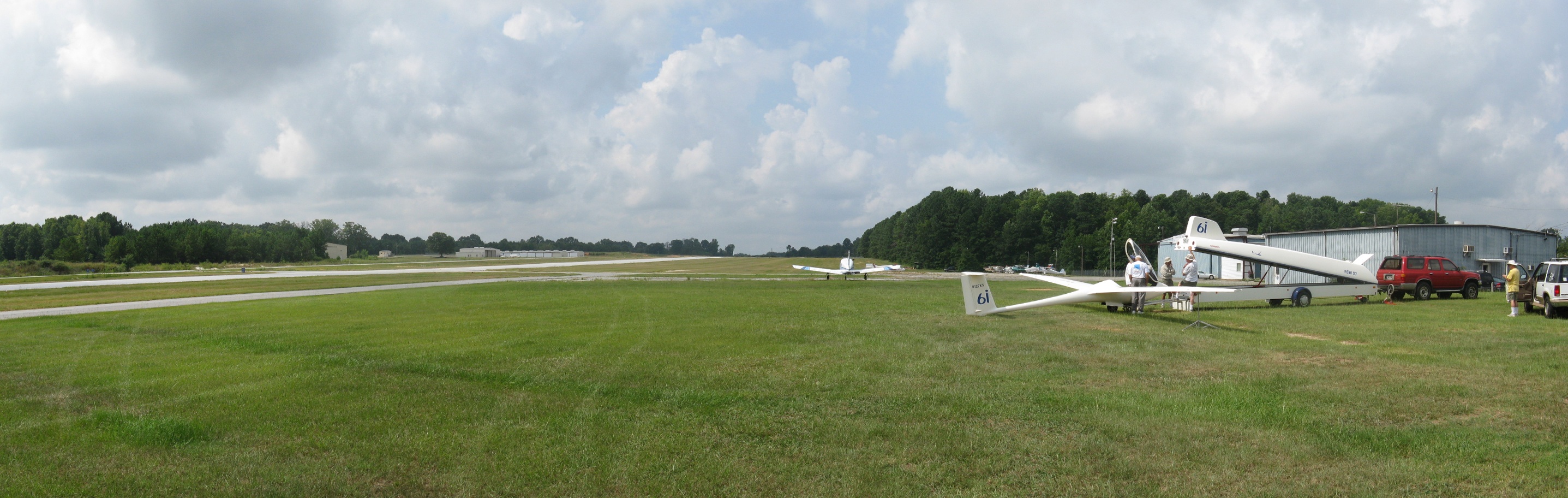
IMG_0306 The club has a small hanger near the airstrip with the four communal aircraft jammed in there. It was fun watching them slowly untangle the delicate knot of 4 gliders that they’d managed to fit inside. Two of them are single-seat models, and two are tandem models used for “discovery” flights like the one I was to take.
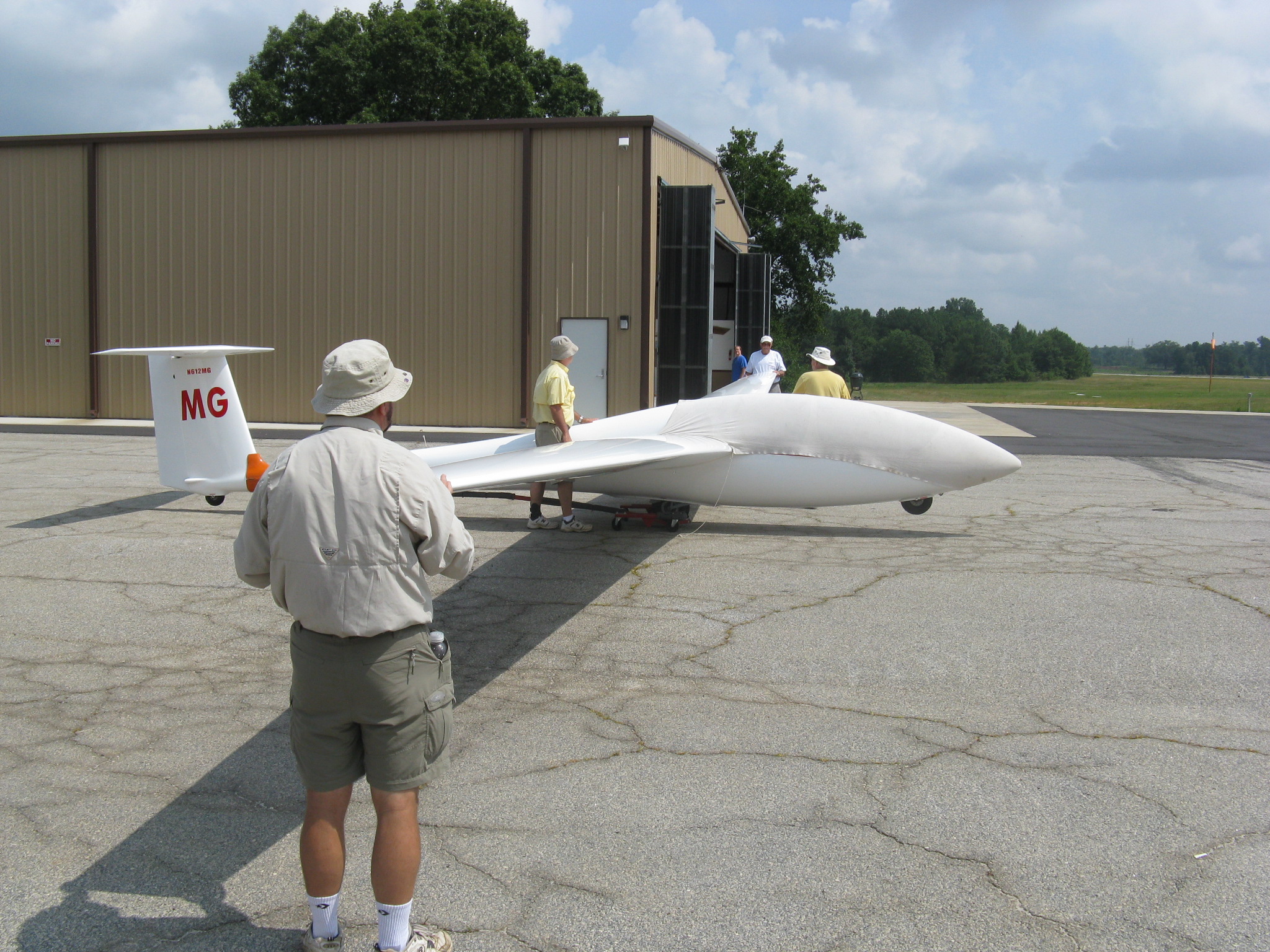
The Schleicher ASK 21 is the model that I flew in. As you see fromIMG_0315 these photos, these gliders are light enough to be moved around by a couple of guys. After some basic checkout of the controls and flight surfaces, each glider got hooked up to a IMG_0336 tow vehicle (e.g. golf cart) and the long walk out to the end of the airstrip began.
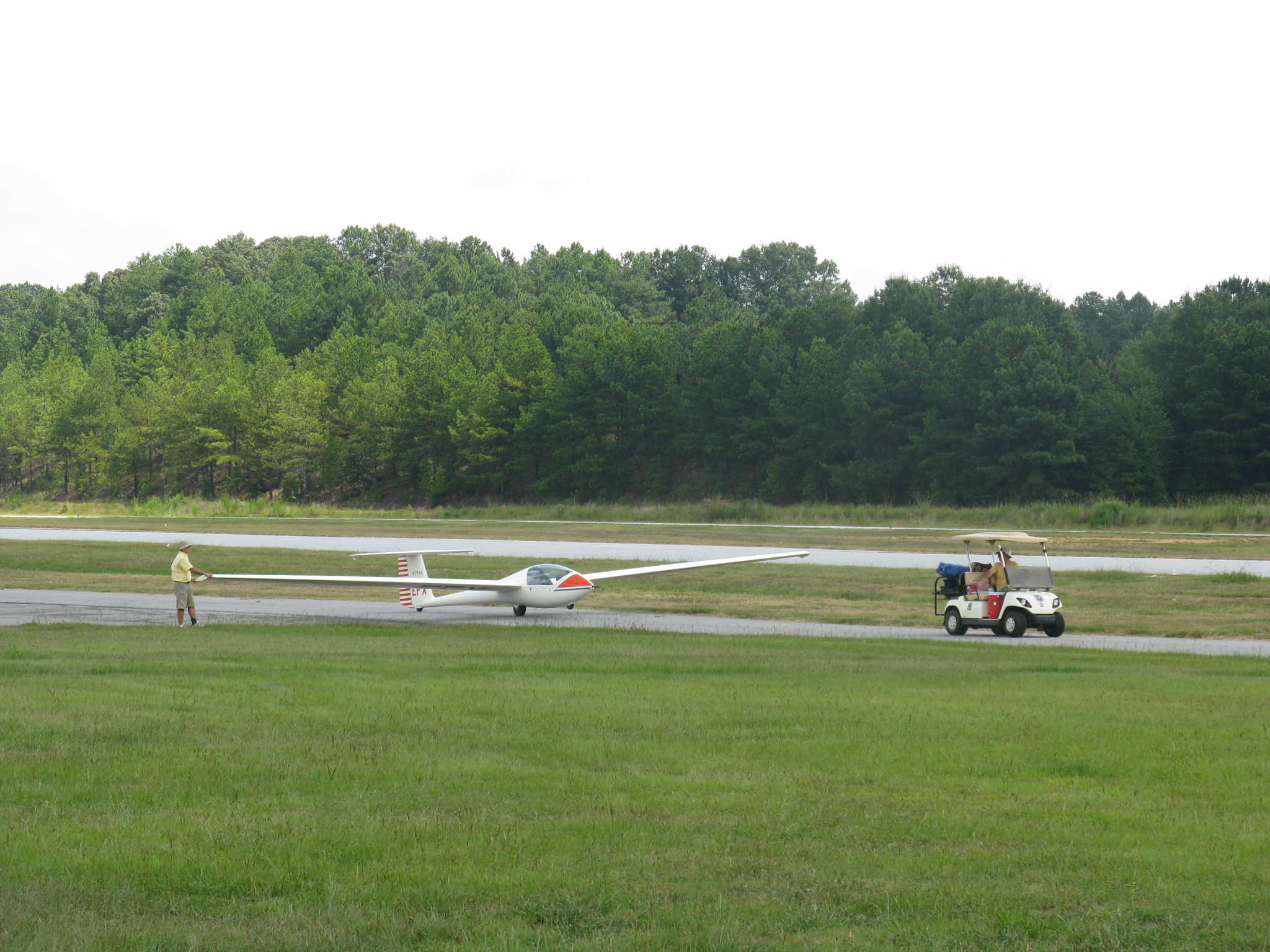
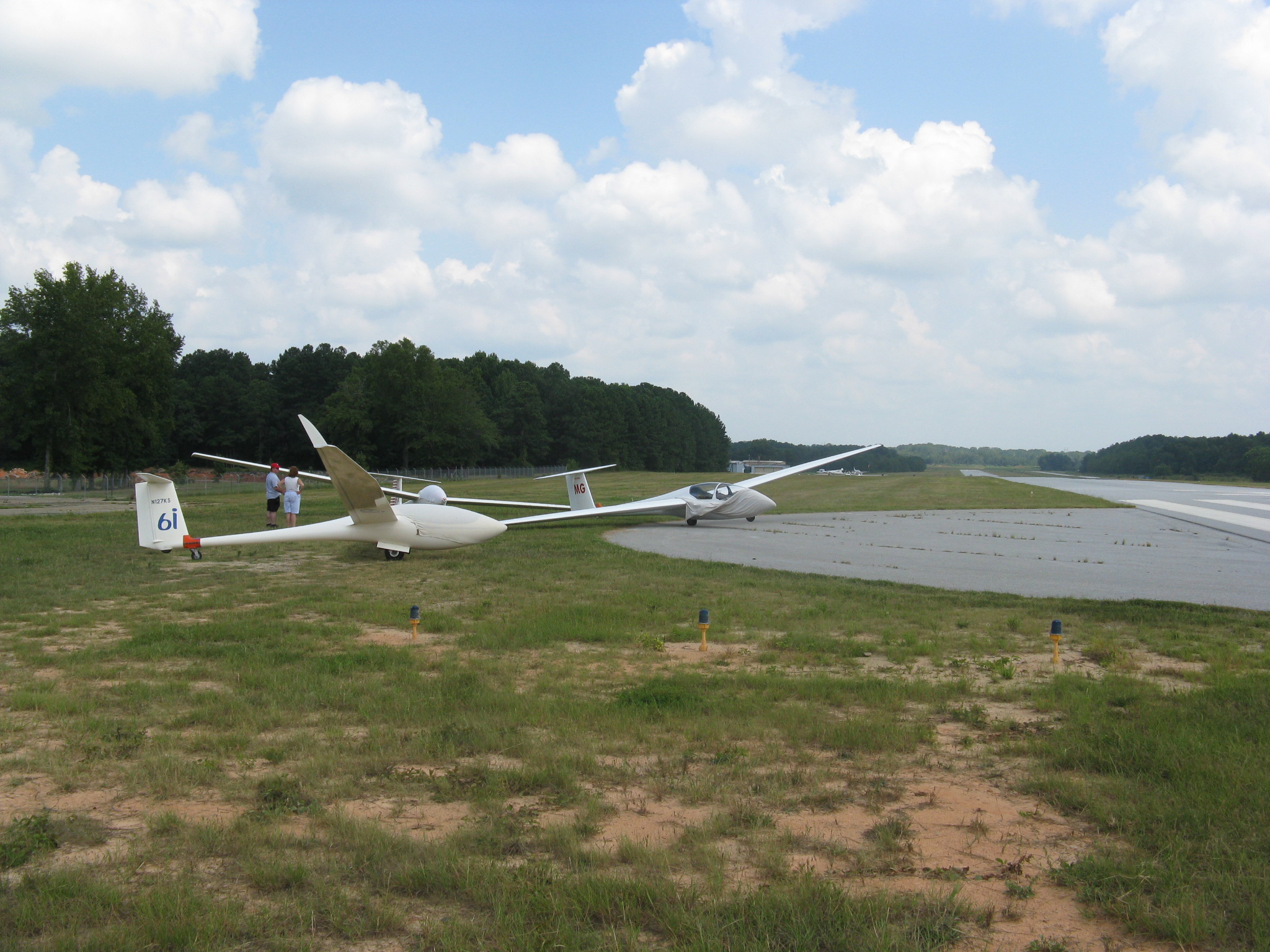
Also operating from that airstrip was the local skydiving operation and the occasional private aircraft. Otherwise it was quiet, with all of IMG_0349 the glider guys assembled at their little place to the side of the airstrip, and the tow plane waiting on the other side. As gliders were ready to go, the tow plane would fire up, a tow cable would be latched onto the nose of the glider, and off they’d go.
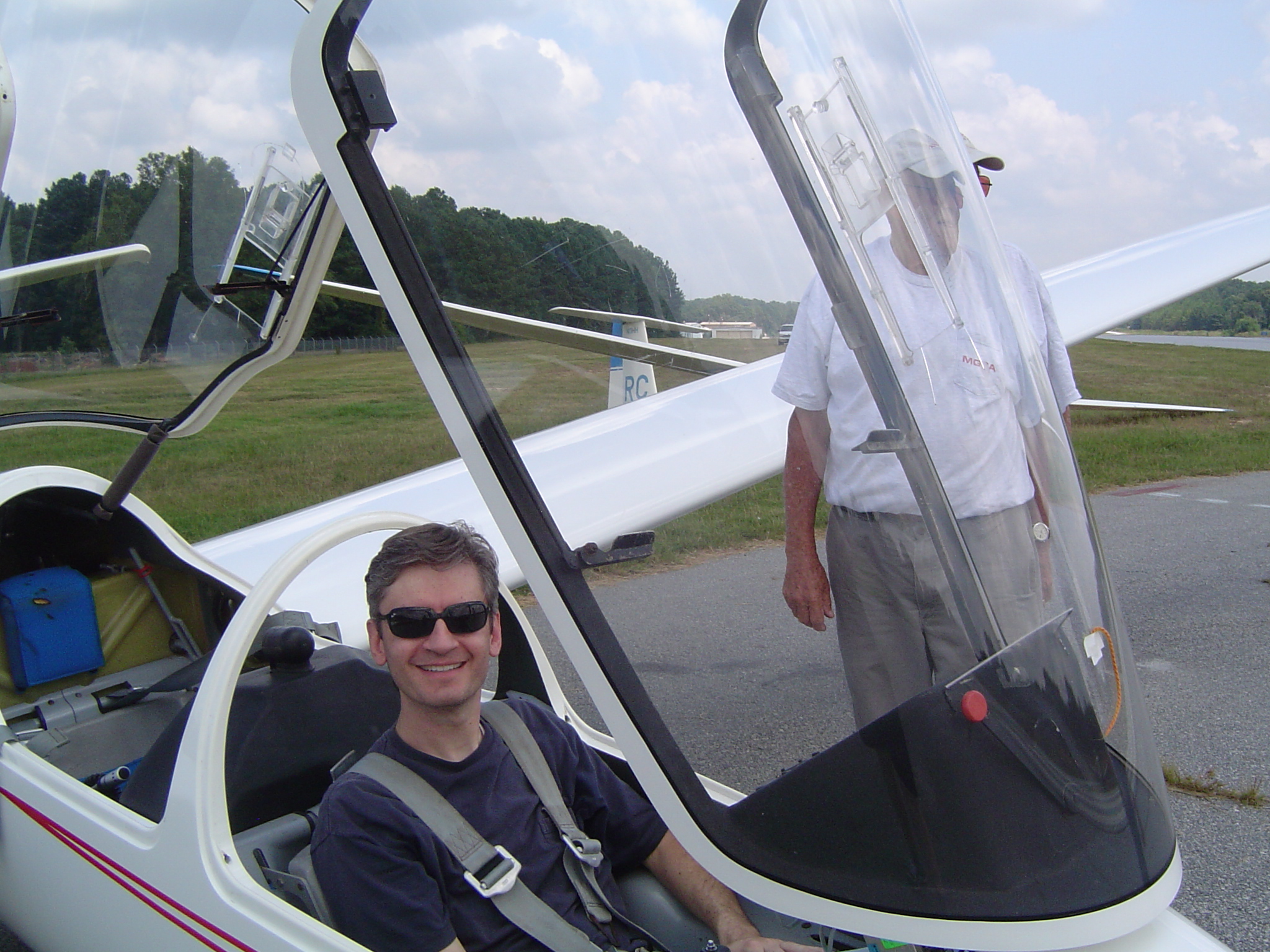
Gliders are not allowed to sail through clouds. On a cloudy day, this means they have to glide below the cloud deck (bottom of the clouds). DSC00945 When we showed up at 11am, the guys were standing around looking at the sky and muttering about the low deck (around 2500 feet), but they expected it to rise as the day wore on, and it did.

There were two other people there renting flights but I got to go first. I managed to cram myself into the cockpit (barely), got a VERY quick introduction to the cockpit (mostly how to get ventilation and get out later on), got introduced to the pilot (Walter, retired from Delta Airlines) and got underway!

IMG_0389 After some brief radio chatter, the tow plane fired up and pulled us down the runway and up into the air. We actually lifted off the ground well before the tow plane did, rising up a few feet before the tow plane had reached a speed where it could take off itself.
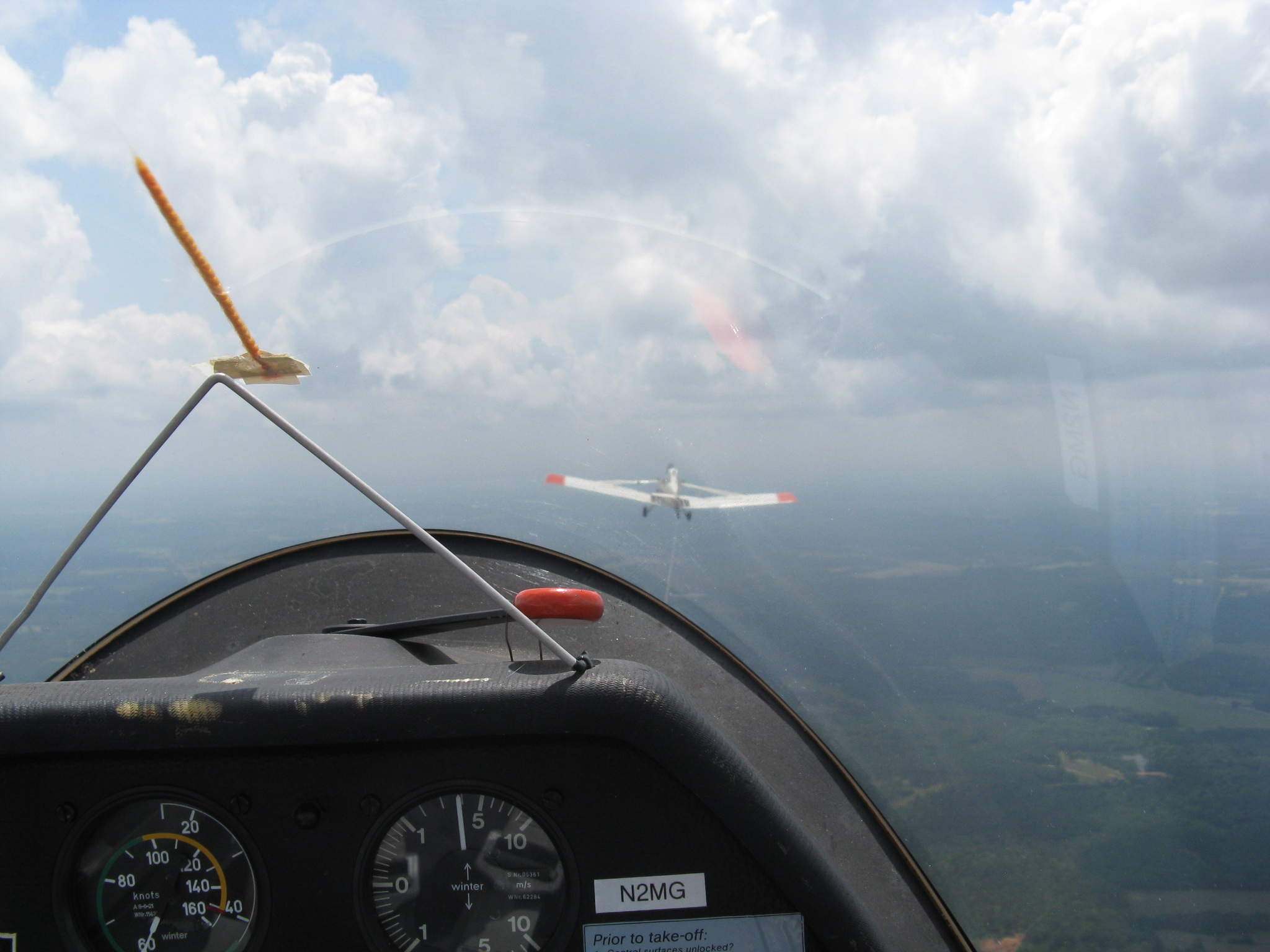
These tow planes are “all engine”, as the tow pilot described to me. They’re typically crop dusters, designed for low speed flight (like gliders) and with very powerful engines. IMG_0360 They’re not particularly pretty to look at, but they get the job done. We slowly circled up into the sky, gaining altitude until we’d reached the cloud deck, at which point the glider pilot (sitting behind me) pulled the release on the tow cable and we were free.

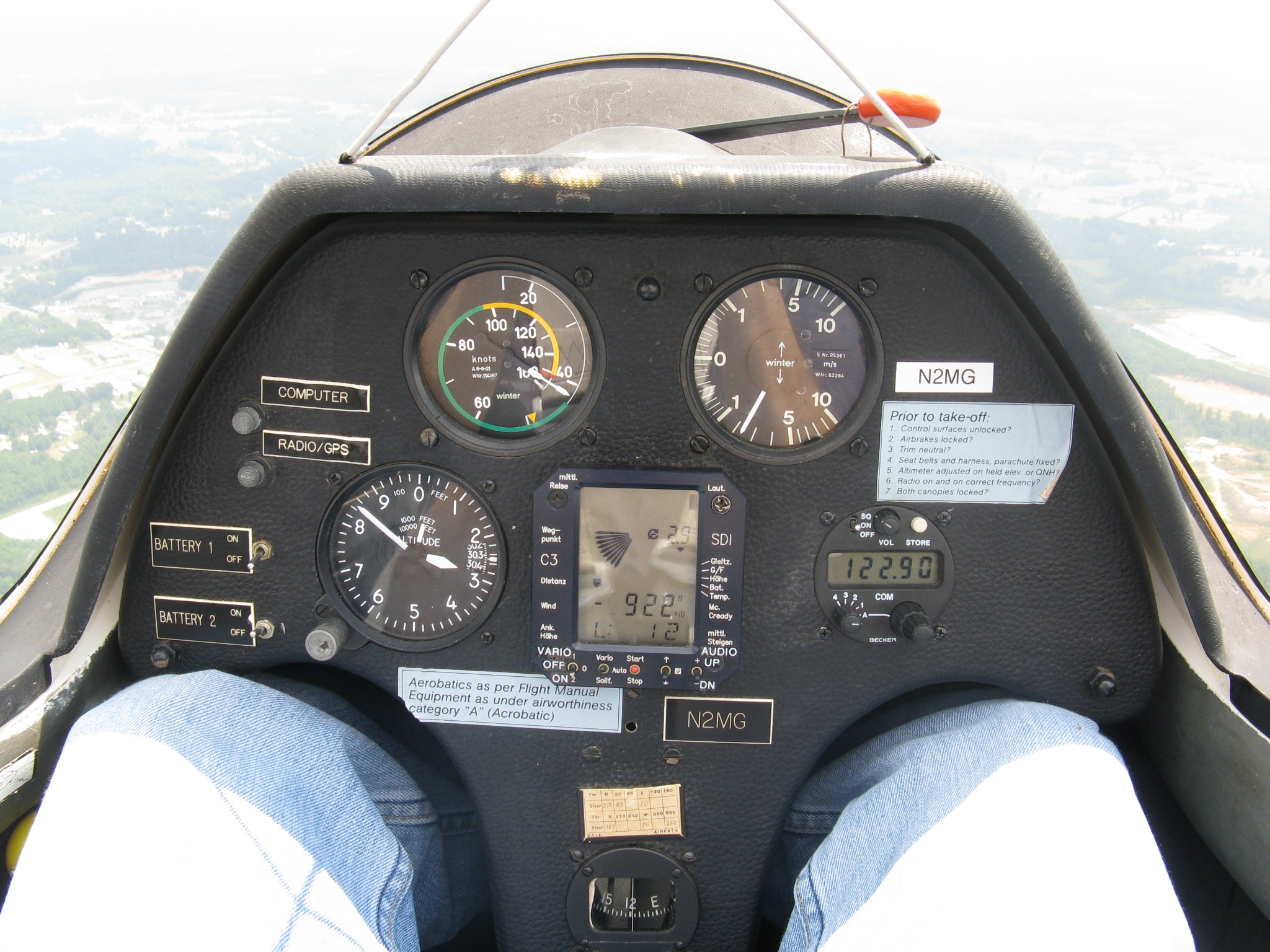
Gliding is all about energy management. Mostly that means trying to maintain altitude (potential energy), but if you want you can go into a dive and get up to a high speed (kinetic energy). Mostly though you quietly sail around, looking for updrafts of air (thermals) that will give you a free boost in altitude and thus extend your flight.

It actually wasn’t as quiet as I expected. These are, by necessity, extremely aerodynamic aircraft, but there is still quite a bit of wind noise. I’m sure, though, that it’s far less than the unholy racket you are subjected to in a small motorized aircraft like a Piper Cub or a Cessna.

The view is, of course, right there. In four directions (forward, up, left and right) you have only the clear glass canopy separating you from outside. In fact, I had a better view than the pilot, whose view forward was blocked by my big fat head. The aforementioned skydivers actually appeared in front of us (still far away) at one point and we had to steer away from them. Having to worry about decapitating some hotdogging frat boy was detracting from my flight, bastards!

STA_0368-STF_0373

Back to the thermals … Once we found one, we would go into a tight left or right turn, spiraling slowly to stay inside that invisible column of rising air. Glider pilots learn to look for certain things that indicate a likely thermal updraft: birds soaring in circles, large warehouses with their expanses of hot roof, cumulus clouds popping up. We’d spiral up, watching the gauge that told us if we were indeed still climbing (you can’t otherwise tell, really), and once we started dropping again we’d pull out of the turn and head off straight for something else.

IMG_0375 Apparently you can stay up forever this way, riding thermals indefinitely, until you run out of daylight. My ride was supposed to be only 30 minutes, but I guess that’s just a minimum that they promise you in case they don’t find any thermals, because we were up for nearly an hour. No, wait, I just checked the time stamps on the camera and I was up for 38 minutes! IMG_0366 I thought it was quite a bit longer than that … I guess because after spiraling up the third or fourth thermal, my stomach was starting to get a little weary of it. Fortunately I didn’t commit the ultimate act of embarrassment, but I was glad to get back down on the ground.
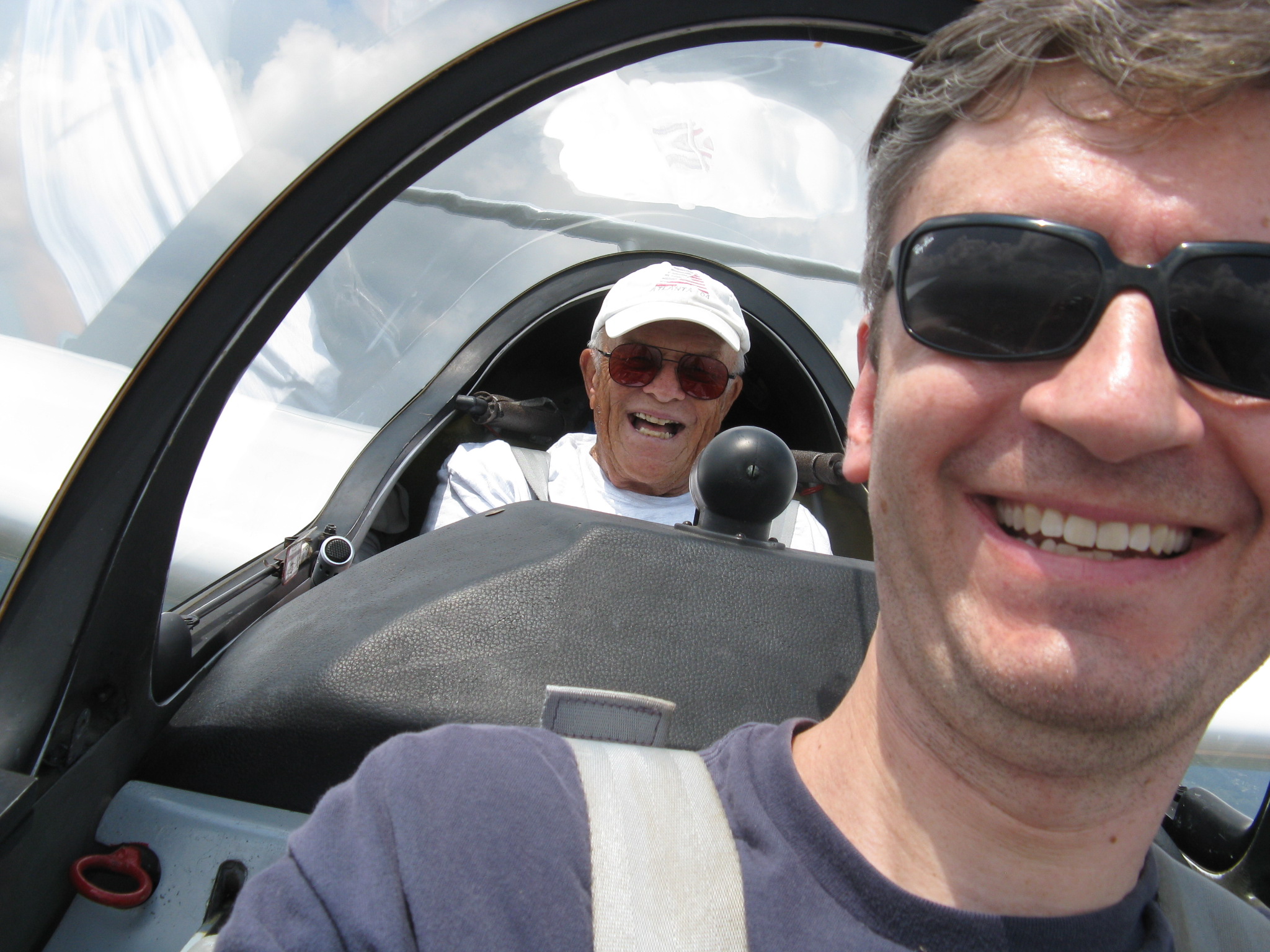
The pilot let me fly the glider a LOT, as much as I wanted, and I was really focused on trying to keep the aircraft under control, so much so that I didn’t look around as much as I would have liked to. But I think there will definitely be a “next time”!

UPDATE: I forgot to mention, I do have videos! I’m just not a Youtube-postin’ kind of guy, so if you want to see them, you have to come over to our house and see them on our TV! However this video posted on Youtube (opens in new window) by some other guy was done at the exact same airfield in the same aircraft, so you get to see what it’s like.

SETI@home and distributed computing

When I was sophomore in high school I got my first computer, a Commodore 64. It had a laughable amount of processing power by today’s standards, but as my first computer that wasn’t really an issue. Here I had a machine that would do what I told it, constantly, 24-7. After learning basic programming, I figured out an algorithm to brute force prime number calculations and set it to work. I’d watch it race through the early numbers 1 2 3 5 7 11 13 17 23 29 31 37 … 41 ……43 ……… 47 ……….. and then slowly be brought to its knees.

About 5 years later I bought my second computer, a very nice 286 (12 MHz with “zero wait state”). Probably within the first day I had it crunching prime numbers. There’s something satisfying about telling a computer to go do something and then watching it work furiously on that task. I remember being in college and instead of shutting it down at the end of the night , I would run the prime numbers program (say, starting at 1,000,000) and see what it had found in the morning.

Another 5-6 years and another computer … but by then it was 1993 and the internet was starting to crash through the doors. But in due time the internet and brute force mathematics would combine in a new way.

In 1997 the distributed.net organization (just a bunch of computer nerds) started to think seriously about distributed computing. Their idea was to take a very very large task, split it up into digestable pieces, assign those pieces to many computers (using the internet), and then watch the results come in. The very very large task they were tackling was codebreaking.

Important and sensitive data, such as in finance transactions or military communications, is encrypted using encryption algorithms. The distributed.net guys were trying to make the point that computers had gotten so fast that the old encryption algorithms were quickly becoming worthless. What good is a password if your computer can figure it out in 30 seconds?

Looking at d.net’s own history page I think I got involved in summer 1997. At that point they had started a serious attack on the RC5 algorithm, again just to show how quickly it could be broken. A few thousand people, myself included, ran software on their computers that basically crunched numbers while the computers were idle. Like a screensaver, it just kicked in when you weren’t using the computer. I definitely remember being involved in this by the summer of 1997, because I remember showing it to an engineer in Saudi Arabia, and I was there in June 1997.

As the months wore on, the project got more popular, got more participants, got more press, and eventually they partnered with the EFF and cracked a 3DES message in 22 hours, putting the nail in the coffin of the U.S. government’s venerable Data Encryption Standard and paving the way for wider acceptance of the Advanced Encryption Standard. D.net moved on to the search for Golomb rulers, Mersenne primes,and other mathematical endeavors, but I lost interest.

By that time the nerd news vine was chattering about the upcoming SETI@home effort. Berkeley scientists were going to take radio noise collected from space and see if anything interesting could be heard in that noise. They had received seed funding from The Planetary Society and Paramount Pictures, who were about to release the movie treatment of Carl Sagan’s Contact (the one with Jodie Foster). In which, by the way, prime numbers feature prominently!

And so, much like with my more recent Tesla obsession, in early 1999 I began regularly checking for word about the software release. Every day I’d check the SETI@home website to see if they’d released their software to the public yet. And so it was one day, as I was having lunch in my office, that I idly went to the SETI@home website to check on it, and they had publicly launched their software that morning!

Within minutes I had it running and was starting to benchmark the speed of my computer. It was sobering to see what a massive task each SETI@home work unit entailed. I watched the percent-complete number tick up from 0.000%, 0.001%, 0.002% … Gulp. This was going to take a looooong time.

And so the search was on for other computers to run it on. I ran a small tech demo room that had a couple terribly under-utilized Sun workstations, and within days (perhaps hours) I had them running the software too.

That was May 17th 1999, ten years ago today.

The guys at SETI@home (and they remain a very small team) are this week celebrating their decade of work. Despite their towering profile in the nerd community, they have minimal funding and it has been a constant struggle for them to keep up with the demand, especially as computers have gotten faster and faster and have placed more demands on the infrastructure they maintain to keep handing out chunks of radio noise. Recently they released software (called CUDA) that takes advantage of the graphics processor in your computer. Pretty much every computer today ships with a extremely fast graphics engine, designed for the purpose of rendering fancy 3D graphics on your screen, but which only a small percentage of people actually use The SETI@home guys are figuring out how to tap into that wasted computing power.

So this Thursday I will be watching as the SETI@home guys celebrate their 10 years of work, and look forward to their reports and presentations on their progress:

And, of course, I wait for the day that they find little green men!

120 seconds that could kill the space program

On Monday, space shuttle Atlantis is scheduled to launch STS-125, a mission to the Hubble space telescope. This is the fifth and final mission to Hubble, and is a mission that almost didn’t happen. After the Columbia accident in 2003, NASA’s top management decided it was too risky (no ISS lifeboat capability) and canceled it. That produced an uproar in the scientific community, and after a couple more years of study and contingency planning, the mission was resurrected, and here we are just hours from liftoff.

This mission is incredibly important, but just as much for the entire space program as for Hubble. This mission has been driving the space shuttle program’s planning for 5 years now. They worked to reduce the foam shedding off the tank (which is what doomed Columbia). They created new inspection techniques to be carried out in orbit, using the robot arm, so that they’d know if they’d damaged the protective skin of the shuttle during ascent. They added sensors to the wings so they could “feel” the impact of any debris during ascent. They upgraded all of their ground cameras for launch views. They developed and tested repair techniques, to be executed by spacewalking astronauts. And they figured out a way to rescue this Atlantis crew from orbit if they deemed that it was damaged beyond repair.

Which is why space shuttle Endeavor is now sitting on the other launchpad, ready to go within a few days. It’s going to sit there while Atlantis is up, and once they deem Atlantis in good shape and able to survive the fiery re-entry from orbit, Endeavor’s emergency mission (officially called STS-400) will stand down and they will resume preps for what Endeavor really has next on its plate — a mission to ISS in June.

The first 120 seconds of launch are going to be critical. During those first two minutes, any debris (such as foam coming off the tank) could hit the shuttle and punch a hole in the skin. After the first two minutes, any debris shedding doesn’t matter because they are up out of the atmosphere and there’s literally no air rushing by to slam the debris into the shuttle.

Now, the thing is, we won’t know right away. Atlantis will probably get through those 120 seconds just fine and continue all the way to main engine cut off (MECO) 8.5 minutes after liftoff. But that’s when the imagery analysis begins. Here’s what to look for in the news:

1. Immediately after the shuttle reaches orbit, amateurs on the net will start looking at the footage and pointing out possible debris events. In the first two flights after Columbia (in 2005 and 2006), there was quite a bit of debris so there was a lot to talk about. But in the past 2-3 years it’s been very good. We’ll have this amateur data within 30 minutes after launch. Update 2:45pm: launch looked good! No debris events noted in camera replays. The first 10 seconds were exciting through when a transducer (pressure gauge) failed, creating some spurious alarms.

2. About an hour after launch there will be the post-launch news briefing, and the reporters will ask the managers what they saw. I gaurantee that the managers will say make an empty statement like “we’re going to go take a look at all the data and see what we see”, but you will get a sense from them whether anything jumped out at them as a problem. Update 3:21pm: managers in press briefing also saw no debris events of note!

3. The day after launch, aka Flight Day 2, the crew on orbit will do the inspections with the robot arm and will be able to see if there’s any obvious damage. We’ll see that inspection video coming down live so we’ll see anything when they do. Update 12-May: looking good! There are some nicks in the tile but they don’t think it’s serious enough to trigger any actions. However, an important part of the flight control electronics failed during the launch, and while they can continue the mission for now, if they take another failure while in orbit the flight rules dictate that they must come down immediately — like within hours. So everyone has their fingers crossed that nothing further will fail.

4. On Flight Day 3 or 4 we’ll start to hear officially about any serious problems. And that is when they make the decision whether to proceed normally with the mission (capture Hubble and get to work) or whether they literally shut down the lights and start saving power so that they can survive long enough for Endeavor to get up there. Update 17-May: the “Thermal Protection System” has been officially declared fit for entry; they still have to do late inspection at the end of the mission but it’s looking very good. Meanwhile there’s been day after day of nail-biter spacewalks and I’m exhausted just from watching 🙂

I will update this post with the status of each of the 4 stages above as they are cleared.

If they end up having to rescue Atlantis, that means we will be down to just two shuttles, and NASA has said that they can’t run the program with just two. They certainly wouldn’t build another one, as these orbiters are 30+ year old designs and about to be retired anyway. So triggering the rescue would be the implied end of the shuttle program, forever.

Regarding the actual mission, I wrote back in September about the mission and pointed to Dr. Heidi Hammel’s speech in particular. Of course, this was 7 months ago, just before the anomaly on Hubble that forced them to scrub the Oct 10th launch. The equipment to repair that latest failure is now on the shuttle and they’re ready to go up and fix that too.

As I said back in September, I would encourage anyone with even a fleeting interest in science or astronomy to take the time to download and watch the entire briefing, as it is truly fantastic stuff they’re talking about, and these guys do a great job of explaining it to regular people. If you don’t have time to watch the entire 90-minute briefing, at least watch her 10 minutes. Links are in the post I made back in September.

Update 13-May-2009: Sadly, I see that the links to the Hammel speech in the old post no longer work. I have not been able to find the briefing on Youtube, and the repeat briefings from a couple weeks ago did not include Dr. Hammel. FORTUNATELY, I did find most of Dr. Hammel’s speech incorporated into a nice 5 minute video right here. Please check it out!

Update 16-Jun-2009: And with the “Houston, wheels stop” call from the commander on May 24th, Atlantic completed her mission and everyone involved breathed a huge sigh of relief. And later that week, a Soyuz launched three men to ISS, finally bringing the space station crew up to 6 people for the first time ever. We’ve been anticipating the Hubble mission for 5 years, but the 6-man crew on ISS has been anticipated for nearly two decades! It didn’t make headlines, because it all went so smoothly, but this is the heyday of space flight, RIGHT NOW. That last week in May, with the completion of the Hubble servicing mission and the beginning of serious science operations on the space station, represents perhaps the biggest milestone in the US manned space program since the first launch of the space shuttle in 1981. Congratulations NASA!

Cheap High-Def TV

or

Chris’s Guide To Getting Free Digital TV

or

How To Flip Off The Cable Company

This guide is intended primarily for people I know who are having to tighten their belts, and are looking at that big expensive cable bill every month and wondering … do we really need this?

It really comes down to this: do you really care about all the basic cable stations (like Bravo, USA, ESPN, TNT) and their crappy programming to pay all that money? Do you really need access to 50 different mind-numbing reality shows or 30 channels of procedural drama repeats? Because if you think you’ll be happy with about 15 stations (the 4 major networks plus your local independents), I can show you how to get them all in high definition for free. HIGH DEFINITION FOR FREE.

If this sounds intriguing to you, then by all means read the rest of this guide, but please do the first step right away. Do not delay one day — do it right now.

Here’s how to cut the cable, save a ton of money, and get gorgeous digital television.

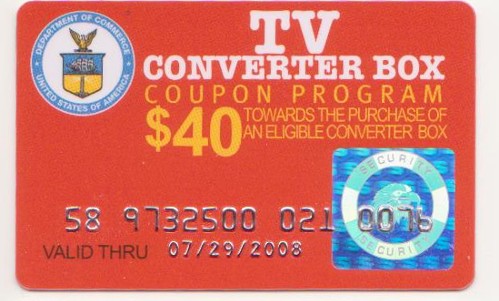
Tv_converter_box_coupon Step 1: Get your $40 DTV coupon. By act of Congress 3 years ago, every household in the country is entitled to two $40 coupons to pay for a little converter box. Don’t worry about what the box does (I’ll explain later). Don’t wonder if you really need it (you might, might not). Don’t worry about getting on some mailing list (you won’t). DO GET IT RIGHT NOW, because the deadline is approaching and there’s going to be a mad crush for them again. You may have heard about a June 12th deadline; well, if you wait until then, you’re too late. Go to www.dtv2009.gov right now and take 60 seconds to fill out the form.

Update June 13th: Well, the analog shutdown happened yesterday and now you’re really going to be in a crush of procrastinators who are trying to get their coupon and converter box. The funding for this program isn’t going to last long, so you still need to get your request in ASAP. Next week might be too late!

Step 2: Evaluate your existing TV. If you have a newer “digital” TV, the kind that’s big and flat and probably expensive, then you do not actually need the converter box, and you could skip the next step but you shouldn’t. If you have an older “analog” TV, the kind with a big glass curved front surface, then it will work fine but you will need a converter box, per the next step.

Apex-cecb Step 3: Get a converter box. These are officially called “coupon eligible converter boxes“, and what they do is convert the new digital signals that are now on the air into the old analog signal that your old TV understands. Even if you have a digital TV and shouldn’t need a converter box, you should go ahead and get at least one coupon and buy a converter box, because you might find out later that you need one. And you won’t be able to buy them later — the $40 coupon program is only available this year. So, apply for the coupon, receive it in the mail in a week or two, and go to any electronics store and buy a converter box. It’s OK to buy this online, but not the antenna (more on this below). Which one? Eh, it doesn’t matter much. Look for a feature called “analog bypass”, but I think they all pretty much have that now. If you really want to get the best one, ask me and I’ll explain about analog bypass, AFD, smart antenna control and EPG passthrough (or plow through the data yourself).

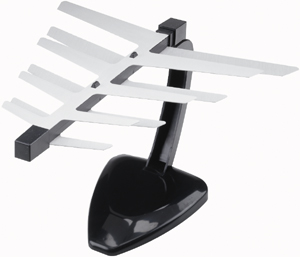
Rca-antenna Step 4: Get an antenna. This is going to be the trickiest part, but hang in there. Most likely you will be able to get by with just a simple indoor antenna near your TV, like the old rabbit ears. But it’s not quite rabbit ears you need — those work best in VHF, and you need an antenna that works in UHF. The big metal loop part of most indoor antennas is what’s actually important for digital TV. So go to any electronics store and look for a small TV antenna. Zenith-antenna Don’t buy a big one yet — you probably won’t need it! A couple examples are the RCA ANT111 and the Zenith Silver Sensor. DO NOT buy online, because you might need to return it if it doesn’t work for you, and doing that by mail sucks. Just go to a real brick-and-mortar store and buy whatever small TV antenna they have.
Step 5: Set up the antenna and connect it to the converter box per the instructions that came with the box. Connect it to your TV. Follow the instructions to do a “scan” of the airwaves. This means the box finds the stations that are on the air. In the new digital TV world, it’s not as simple as just going to Channel 2 and watching — the first time you set this up, you have to let it scan and find what channels are out there.

Step 6: Enjoy free digital television! You’ll quickly discover that there’s a lot more on the air than just the big networks that you expect. Most stations have their primary channel and then also have subchannels. So for example, WXIA/11 has their NBC programming on 11.1, but a weather forecast channel on 11.2 and a sports channel on 11.3! WGTV/8, one of the two PBS stations in Atlanta, has three simultaneous programs running, including GPB Knowledge on 8.3 which runs documentary-style material 24-7. Nerd heaven!

And that’s it! You’re now set up with a free digital TV signal. If you’re not able to get all of the local stations, DON’T GIVE UP. You just need to be patient and fiddle with the antenna a bit.

But you’ve got to do the first step right away. Scroll up to Step 1 and do it, even if you’re not sure. Time’s running out.

Here are a few more things you can do:

Optional Step 7: Get a better antenna. The new digital picture should be absolutely perfect, even when it’s raining or windy. If the picture is breaking up at all, then you need to get a better antenna than the cheap little guy that I had you buy in Step 4. So return that one to the store, and step up to an attic-mounted panel antenna like the Antennas Direct DB2 or the ChannelMaster 4220; two places to find these in Atlanta are Fry’s Electronics and Dow Electronics, both in Duluth. If you don’t have an attic to put these in, or don’t want to run the cable, try getting a “smart antenna“, like the Apex SM550 or the RCA ANT2000; however for these you will need a TV or converter box that has smart antenna capability. Ask me about that if you get this far.

Optional Step 8: Get your VCR working again. Got a VCR for taping shows off the air? It won’t work after June 12th. If you want to keep using it, you’ll need a converter box for it. Now you see why I said get the box even if you didn’t need it? You might need TWO! But the truth is that setting this up to work with your VCR is going to be a monster pain in the ass. You really should just upgrade to a DVR …

Optional Step 9: Get a Digital Video Recorder (DVR). And this is where you reach Free TV Nirvana. If you’ve got some money to spend, please do spend it on a Tivo HD ($250) and the service ($12/month); you won’t regret it and in the end it’s still far cheaper than cable. The only other device on the market worth considering is Echostar’s DTVpal DVR; it has no monthly cost but is much more expensive, and further is actually buggy and compares horribly with a real Tivo. And a real Tivo will quickly learn what kinds of things you like, and start recording shows that you’ll probably enjoy — and suddenly it’s like you’ve got an On Demand system, with a box full of shows at your fingertips, ready to play at any time. Oh, and Tivo’s do Netflix and Youtube too. All in HD.

Optional Step 10: Change your internet service to DSL. If you’re doing all this to be able cancel your cable bill, but you’ve also been getting your internet service via cable, then you’re going to have to change that too before you can completely cut the cable service. DSL via your phone line works great, but there will definitely be a hassle in store for you as you migrate from one ISP to the other (e.g. new email address, if been using a comcast.net address or similar). Just something to brace for if you’re getting your internet via cable.

Electric Vehicles, part 2

In September 2008 I first wrote here about electric vehicles and my plans to make my next car an EV. After over a decade of pining for one that was good enough, the market is finally coming around and within a year or two there should be lots of choices.

The 800-pound gorilla is Tesla Motors. They are a pure EV company, which really isn’t quite what I’m looking for — the systems engineer in me really likes the redundancy aspect of having a gasoline generator in a hybrid vehicle (aka an REEV), so that I can plug-in normally but in a pinch I can gas up. Especially for long trips. On the other hand, it’s kind of silly to make a purchasing decision based on the 2% usage scenario. For long trips, rent a car! Anyway, this is all kind of pointless handwringing right now.

IMG_0165The Tesla Roadster is a slick, beautiful machine, and after 3+ years of salivating it is f i n a l l y reaching the streets. In the last few months they’ve finally started delivering units to their long-suffering customers, and they’re now up to about a 100 deliveries per month. With each unit getting them over $100K in revenue when they deliver, that’s going to very quickly get them in the black, and suddenly Detroit will have a real problem developing for them in sunny California.
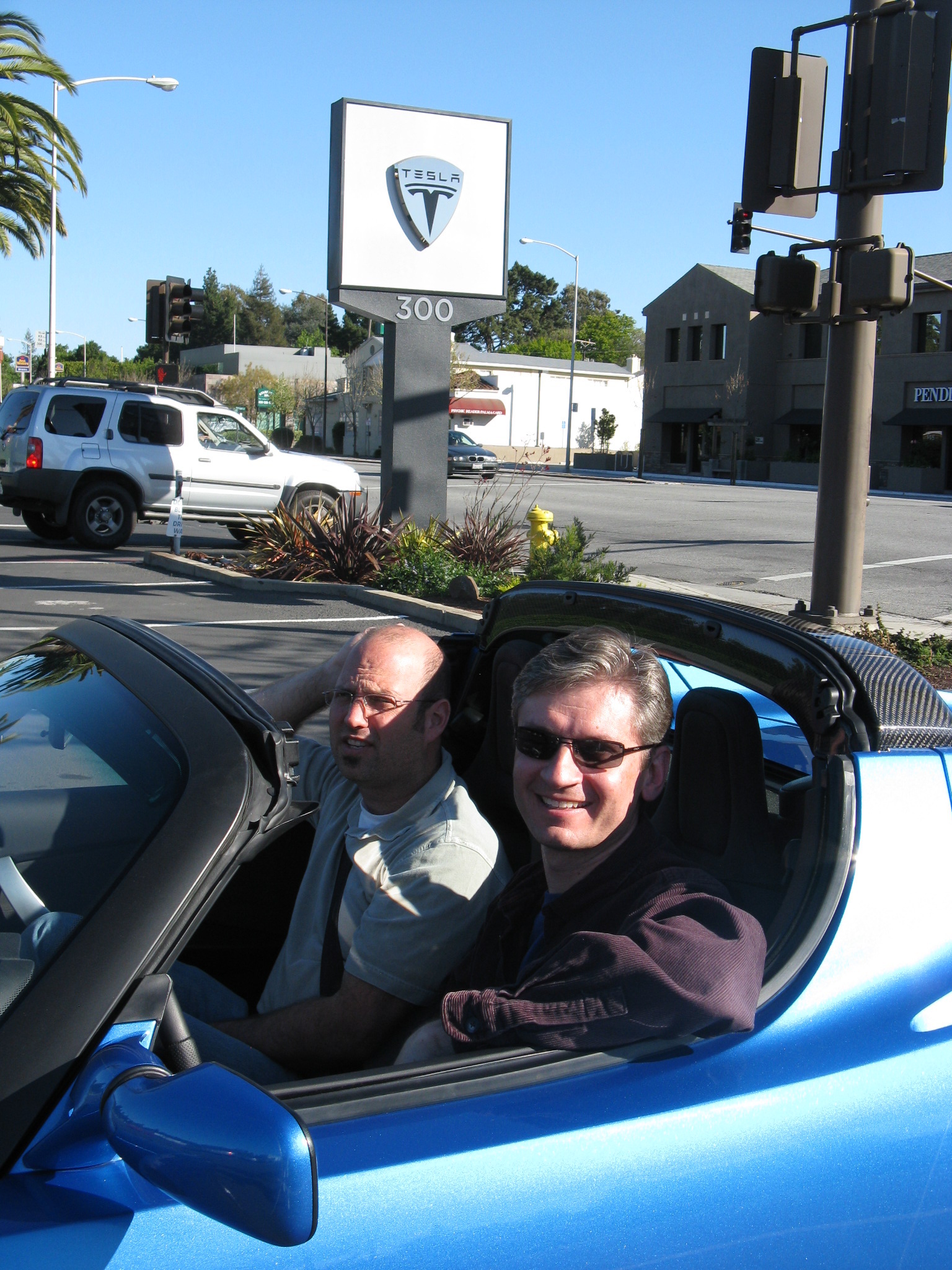
IMG_0162_rotated Earlier this month I visited family in the San Francisco area and I decided to try to get down to the Tesla dealership (in Menlo Park) to get a look in person. Actually I wanted to see the Model S (more on that below) but I knew they wouldn’t have any so I settled on just looking at a Roadster. Since they’ve finally cranked up the volume on production, they have more units to set aside for sales ops so there was a chance I’d be able to actually sit in one and maybe drive it around the block.
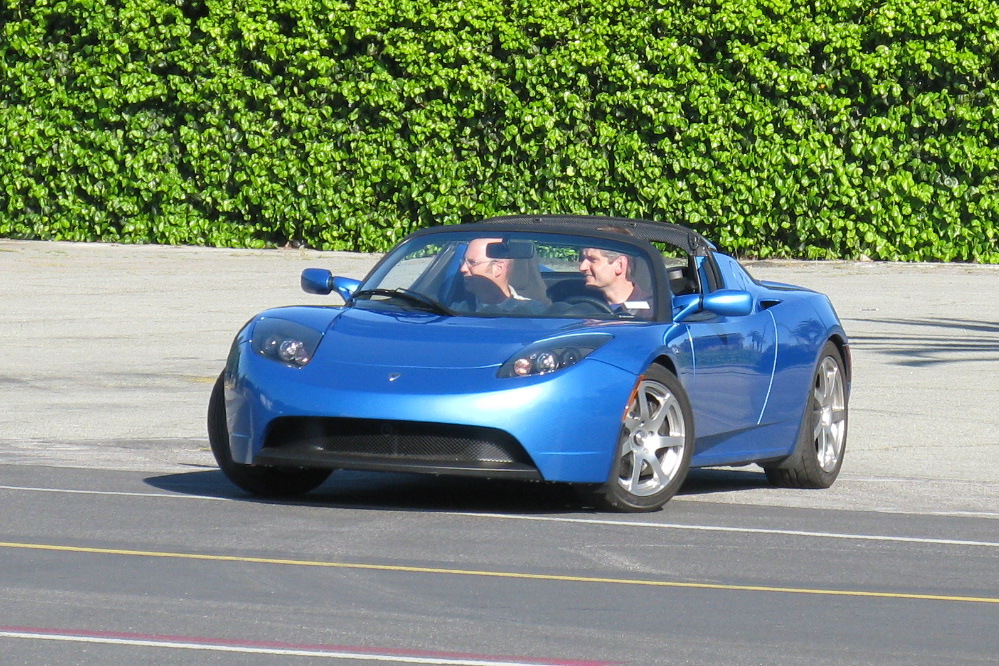
So I gave them a call and made an appointment. We showed up (thank you family 🙂 ) right on time, the salesman had me sign a waiver, gave me a map and the keys, and said “have fun”. Wait, what? Yes, he was letting me just take it out on the road by myself. Uhhhhhh … OK!

IMG_0158_crop I quickly snagged my brother-in-law for passenger seat ballast (kidding!) and we got familiar with the vehicle. You can read all about it everywhere else, but it definitely is a pocket rocket. Bolting from 0 to 60 MPH in four seconds, it’s like acceleration isn’t an issue anymore — you just decide on a speed and BOOM you are there. One thing I had wondered was how annoying the braking feel woiuld be, since it uses regenerative braking for light to medium braking effort, and it was suprisingly unobtrusive. It just didn’t bug me. What was noticeable was the coasting behavioir, because they have it dialed in to brake slightly when you take your foot off the accelerator.

I actually fit in it, too, (I’m 6′ 2″) which was a nice surprise. But visibility was pretty rotten — I kept having to duck to see traffic lights. Anyway, at $109K it’s not like I am seriously considering one of these, but it was really nice to get actual experience. Because I am quite serious now about making my next car an EV.

3387753757_f5ab39dcc5_b Which Tesla will be happy to supply. On March 26th they announced their second design, the Model S. Instead of a tiny sports car, this will be a sports sedan that can carry 4-5 adults, basically competing with luxury sports sedans like the BMW 5-series. It’s also priced in that category at $57K, a number which will certainly get “refined” as they get closer to production. It got lots of attention:

on LeftLaneNews

on Jalopnik

on Metafilter

on Slashdot

3388610604_9df7ac2587_b But what was unveiled was just a prototype — literally, there is ONE of these on the planet. Really what they are doing is getting the prototype out there so that the federal government will be unable to ignore it and will have to release some funds from the advanced car tech program that Congress approved last fall. I mean, if Tesla doesn’t qualify for this, I don’t know what does. Update 23-Jun-2009: Tesla has indeed today received the ATVM funding, all of the funding they requested! See press releases from DOE and Tesla. I love Steven Chu.

New Roadster owner Scott Painter wrote recently about Tesla’s distribution model:

“[Tesla] also shirks all the traditional industry baggage by deciding to sell directly to buyers, rather than through independent dealers. Tesla owns its stores in Menlo Park and West Los Angeles, and everyone who works in the stores is a Tesla employee – no one works on commission. Although this doesn’t allow Tesla to open locations as fast as through a franchise dealership, it does allow Tesla to own 100 percent of the customer experience. This is one of the biggest frustration of traditional auto industry executives – they can build great products, but if customers have a bad experience at their local dealer, they often blame the automaker.”

Very true! This is the #1 reason why I’ve ignored GM/Ford/Chrysler for all of my car purchases up to now. No matter how good the car is, I’m still going to have to deal with the local dealership, at least through the warranty period, and that’s a deal breaker right there.

And it’ll be a major hurdle for me to get over if I’m faced with choosing a domestic model (e.g. the Volt). I wonder if GM might try to handle the Volt at the corporate level like they did with the EV1 a decade ago, bypassing the dealers …

Here’s an interesting blog post by a Tesla VP summarizing all of the tax incentives in place (from both the federal and state governments) for people considering purchase of EV/hybrid vehicles. And here’s a Georgia EPD page detailing one particular tax credit for ZEV’s, including contact info for the guy at EPD who probably knows the most about that and any other tax credits available.

219d1240697133-first-public-tesla-charging-station-woodland-ca-woodland20090425_a This past weekend the very first public charging station for Tesla opened up in Northern California. Here’s a local newpaper article about it. It’s probably going to take a decade before this is widespread, but it’s a start.

If anyone here lives in the New York area, the Model S prototype is debuting in Manhattan on Thursday morning April 30th at the Plaza hotel (5th Ave and Central Park South). And Elon Musk is appearing on David Letterman on Wednesday night!

In the end, though, I’m still not sure if I want to go with a pure EV. I really wanted my next car to be a hybrid, so that I can gas up if needed and won’t have problems with a long road trip a couple times a year. In another few years I think the technology will be there to support pure EV for long haul trips (better battery tech, battery swapout standards and stations, public charging stations, high voltage fast charging, etc.) but we’re far from that right now. So I’m still going to be looking at the other hybrid options that start coming to market late this year and next. But I’ll probably continue to spend far too much time keeping up with the news at the TeslaMotorsClub forum.

I leave you with two entertaining little nuggets:

Tesla vanity plate ideas

Hitler gets angry about his Tesla Roadster order

Space Links

Here’s my master collection of space links. You wouldn’t believe how often I refer back to this page.

NASA TV and TV schedules

NASA TV direct links for online viewing: Windows Media / Real Media / Quicktime

NASA TV breaking news schedule and the TV schedule during shuttle missions

NASA TV Media Channel — caters towards the media, so it contains more video “packages” and less fluffy historical programs. During missions it’s the same as the public channel. Rarely it’ll have exclusive live coverage of something because there’s two things happening at the same time. (Windows Media only, NASA drank the Microsoft Kool Aid)

Alternative feeds of NASA TV if NASA/Yahoo goes down.

Here’s NASA’s collection of HD videos for download. An HD version of NASA TV’s live 24-7 channel is now on the air but sadly not yet carried by any cable or satellite companies. However you should be able to watch NASA TV HD online via the links here.

Countdown clocks

Flight Data Files (e.g. checklists for ascent, entry, EVAs, etc.)

NASA’s online countdown clock (Java) and another, better clock for ELV rockets

NASA’s countdown clock in simple flash form

All of these clocks from NASA automatically transition to mission elapsed time (MET) after launch. A guy in the Czech Republic also runs this cool 9-pane configurable status page that is great for monitoring several sources at once during critical periods, like a launch attempt.

Space Shuttle reference:

International Space Station links:

Trackers / Overflight Visibility:

This space.com article from 2006 had a nice graphic showing the visibility of each launch all the way up the east coast of the US. But it’s really only visible for nighttime or dusk launches. If you’re in the NY/NJ area, you’ll need to look towards the south/southeast starting around 6 minutes after launch.

Status and discussion

SpaceFlightNow is good for getting basic news and status; they have the best launch calendar on the web. They have a premium service that I used to subscribe to for downloable video packages, but they pissed me off with their retarded billing so I stopped renewing. John44’s Netherlands site (link below) satisfies the video requirement.

NASAspaceflight.com’s front page and discussion forums are for serious fans; for each shuttle mission, the respective Discovery / Atlantis / Endeavor forum will be of most interest and will include daily threads with minute by minute updates of the mission. Truly hardcore fans pay for NSF’s Level2 premium service, which apparently offers an insane amount of information. I don’t subscribe to L2 for the same reason I don’t have cable TV: I would never stop looking at it.

The NSF forums led me to an incredible resource for catching NASA TV events after the fact: www.space-multimedia.nl.eu.org is a site in the Netherlands apparently run by one guy (John44 on the NSF forums). He captures the NASA TV events and makes them available for download. For free!

Bill Harwood is a reporter at CBS who has been covering the space program for years, and whose website provides a tres aure trove of rapid-access information, including launch windows, mission timelines, historical events (e.g. launch abort history) and even some killer Excel spreadsheets that further collate all this data.

CollectSpace and Unmanned Spaceflight are two excellent sites that serve respective niche audiences. Actually, UMSF isn’t really a niche audience, as it covers all of the unmanned probes currently (or soon to be) zipping around the solar system, including Cassini, New Horizons, Messenger and the fleet of Mars probes.

Watching a launch at Kennedy Space Center

Photographer Ben Cooper has a great writeup about what your viewing options are, both paid and free.

If you’re making the trip, consider staying at the Surf Studio in Cocoa Beach. It’s a nice little beach front motel, owned and operated by the Greenwald family since 1948. It’s down at the south end of Cocoa Beach, thus a little bit further from Kennedy, but it’s only a 5 minute extra drive and gets you down to a more quiet stretch of beach.

WMMB is a local AM station (AM 1240 and AM 1350) that has launch coverage starting at about 3 hours before launch, and supposedly does not talk over the NASA commentary once the countdown gets close and then during the 8 minute launch phase.

SCANNER INFO

If you have a radio scanner (i.e. for police radio), here are some frequencies of interest: NASA TV audio on 146.94 MHz (from ~3 hours before liftoff to landing) NASA (TV?) audio on 442.6 MHz Both (?) operated by local ham club http://www.lisats.org

http://www.milaircomms.com/uhf_ksc.html Some highlights: 121.750 KSC NASA Ground 126.650 KSC Weather / STA 128.550 KSC NASA Tower

Here are the really good frequencies, but you need a scanner that can pick up the military bands: 296.800 MHz – Air-to-ground, or orbiter-to-suit 259.700 MHz – Air-to-ground, or suit-to-orbiter 279.000 MHz – Suit-to-orbiter, or suit-to-suit 243.000 MHz – Standard military aircraft emergency frequency

http://home.cfl.rr.com/scanner/launch.htm

Ham radio repeaters all over the country that “carry shuttle audio during missions”: http://www.amsat.org/amsat/sarex/shutfreq.html (probably outdated) http://shuttleaudio.info/ (somewhat more up to date)

NASA press release from 2000 detailing how to listen