 Second day of sailing! I rose at dawn and cleaned up in the marina shower. Going into this trip, one of the unknowns for me was whether we’d be on the water around the clock, never showering, or stoppin at marinas occasionally, or what. I had no idea what I was in for, and was prepared to a slimy, smelly sailor for the full week. As it turned out, every night we’d sail into the marina of the nearest coastal town and dock the ship. All of these marinas have pay showers, so we stayed relatively clean. I say “relatively”, because after only a few hours in the sunshine on the open water, you are pretty nasty. The metamorphosis before and after shower was pretty remarkable, and lord knows I do love a long hot shower (ask my family, I’m notorious for it).
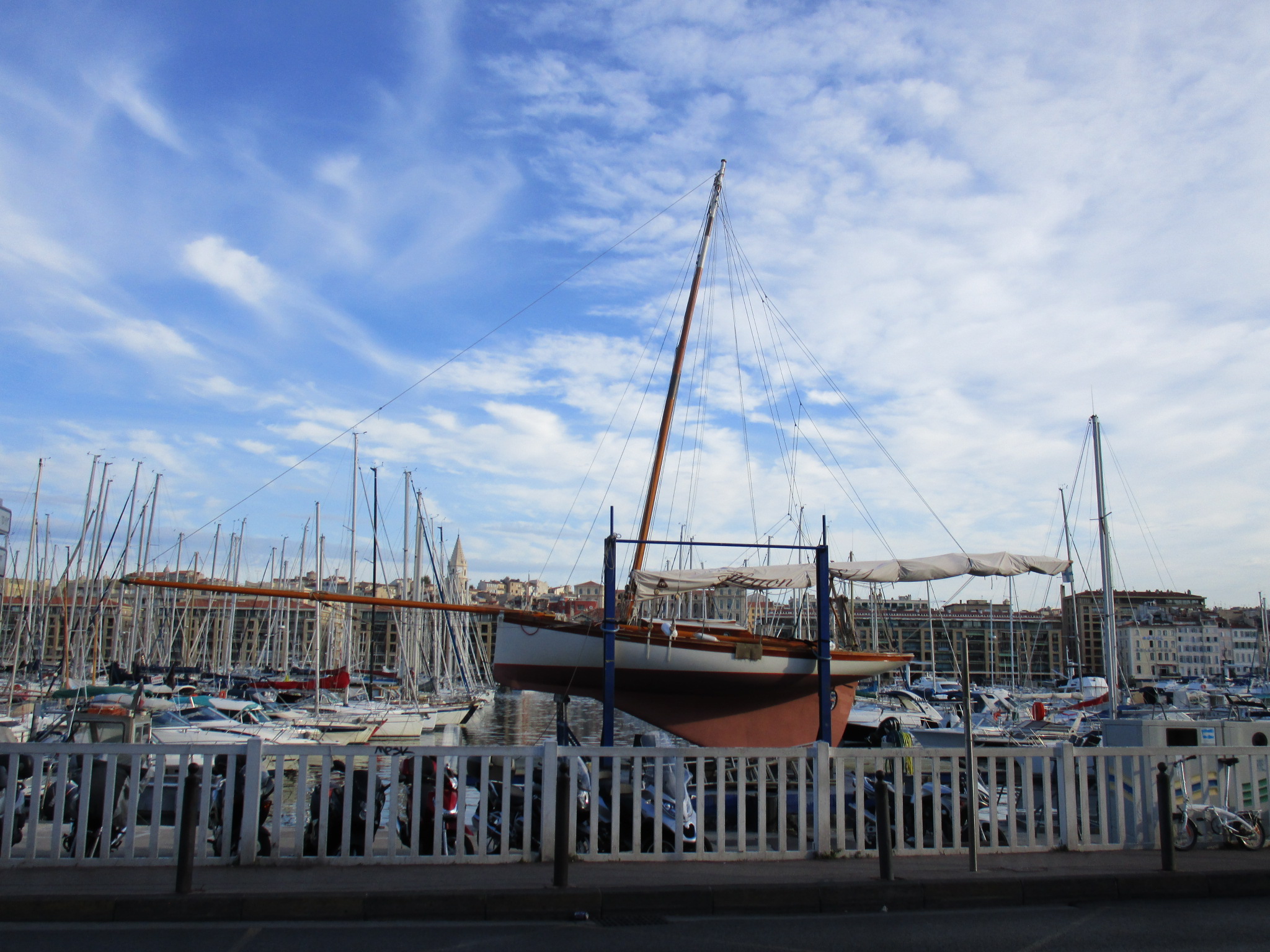
 After shower, while Andreas et al were getting ready for departure, I hoofed down the marina to get a picture of this exotic old sailboat that was undergoing a restoration. All along the marina were these boats being worked on by contractors, and this one was obvious historic and a labor of love for someone. I’m sure the comically long boom off the front identifies the type of sailboat, but I don’t know what it is.
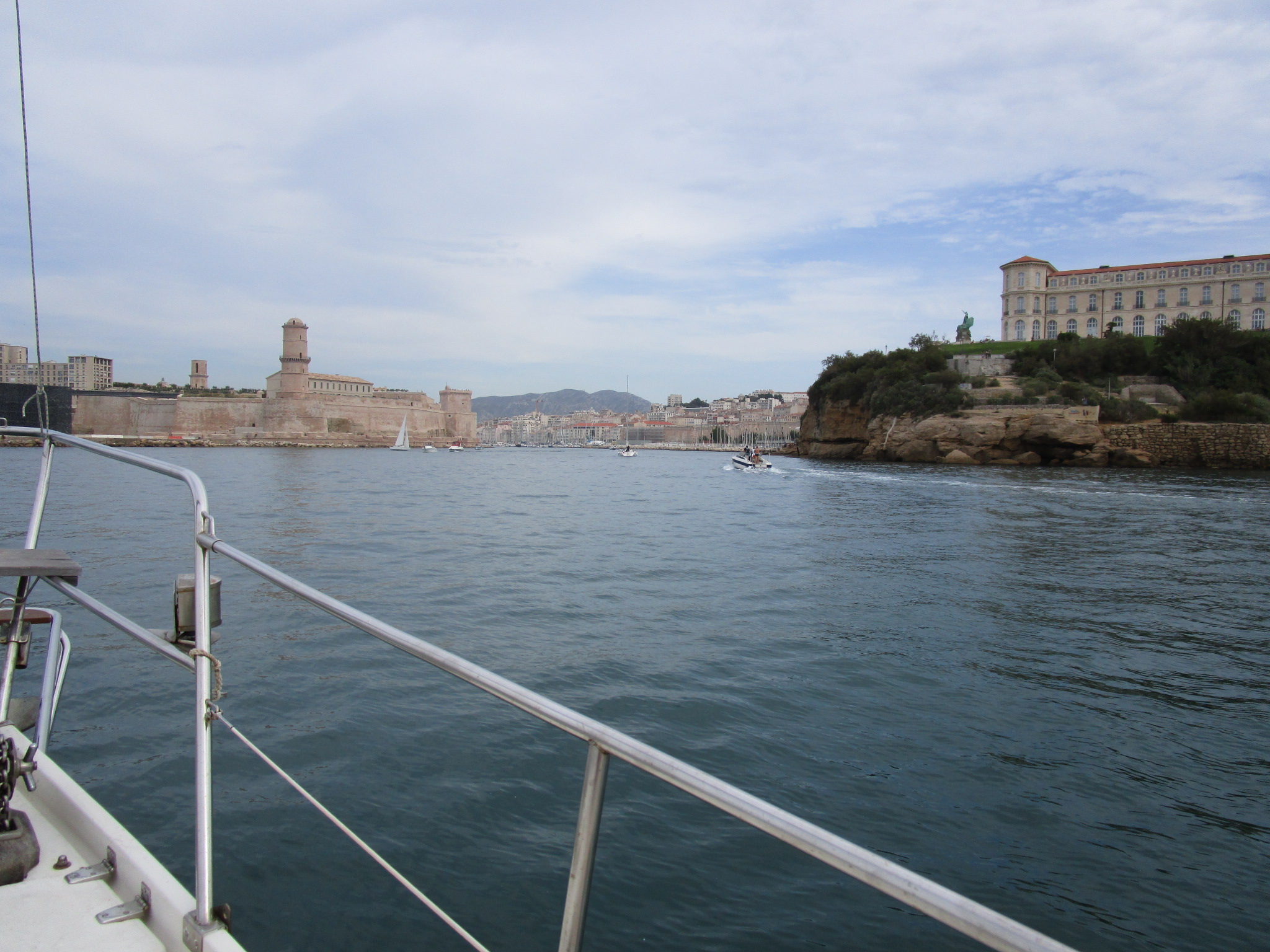
After preparing the boat for departure, Andreas once again ceded the captain’s chair to Andy and enjoyed the view with me up front as we slowly eased out of the Marseille harbor. The castle on the right is Fort Saint-Jean, a 17th-century fort built by Louis XIV to protect the governor from the local people — the cannons were aimed not out towards the sea, but in towards town!
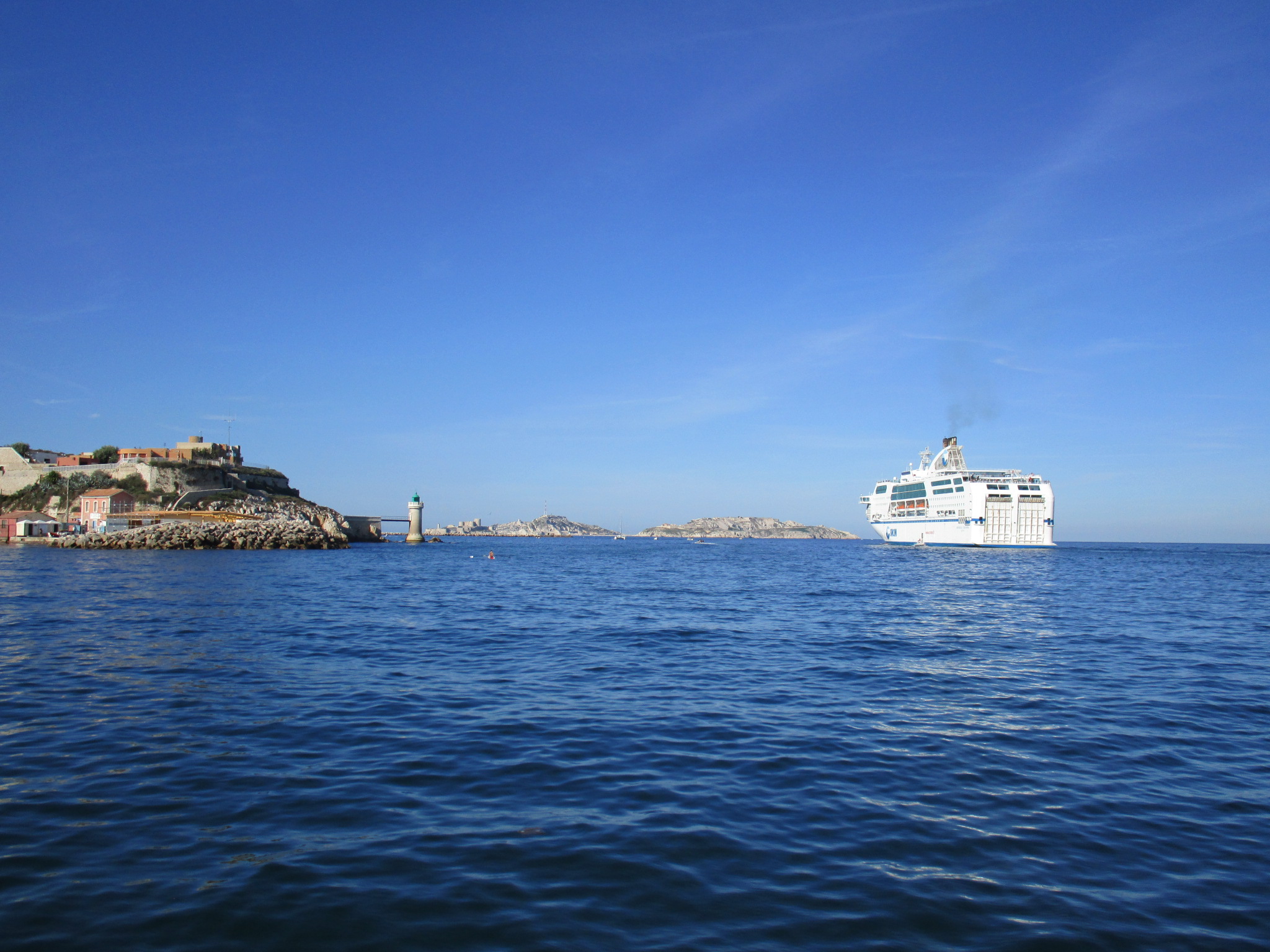 As we headed into the open water, we started to encounter more serious traffic. Marseille is the main ferry transit point for this part of the Mediterranean, and there is constant activity with both small pleasure boats going in and out of the old city harbor and huge commercial crafts accessing the big industrial harbor. Many of these big ships are ferry boats heading to Sardinia and Algiers, carrying both tourist traffic and regular commercial traffic. You do not want to be surprised to see one of these bearing down on your tiny little sailboat.
Once we cleared the harbor traffic, we put the boat onto autopilot (still on gas engines) and settled down for a nice late breakfast. German breakfasts are serious undertakings, with breads, meats, cheeses, juices, all sort of wonderful things. I devoured it all.
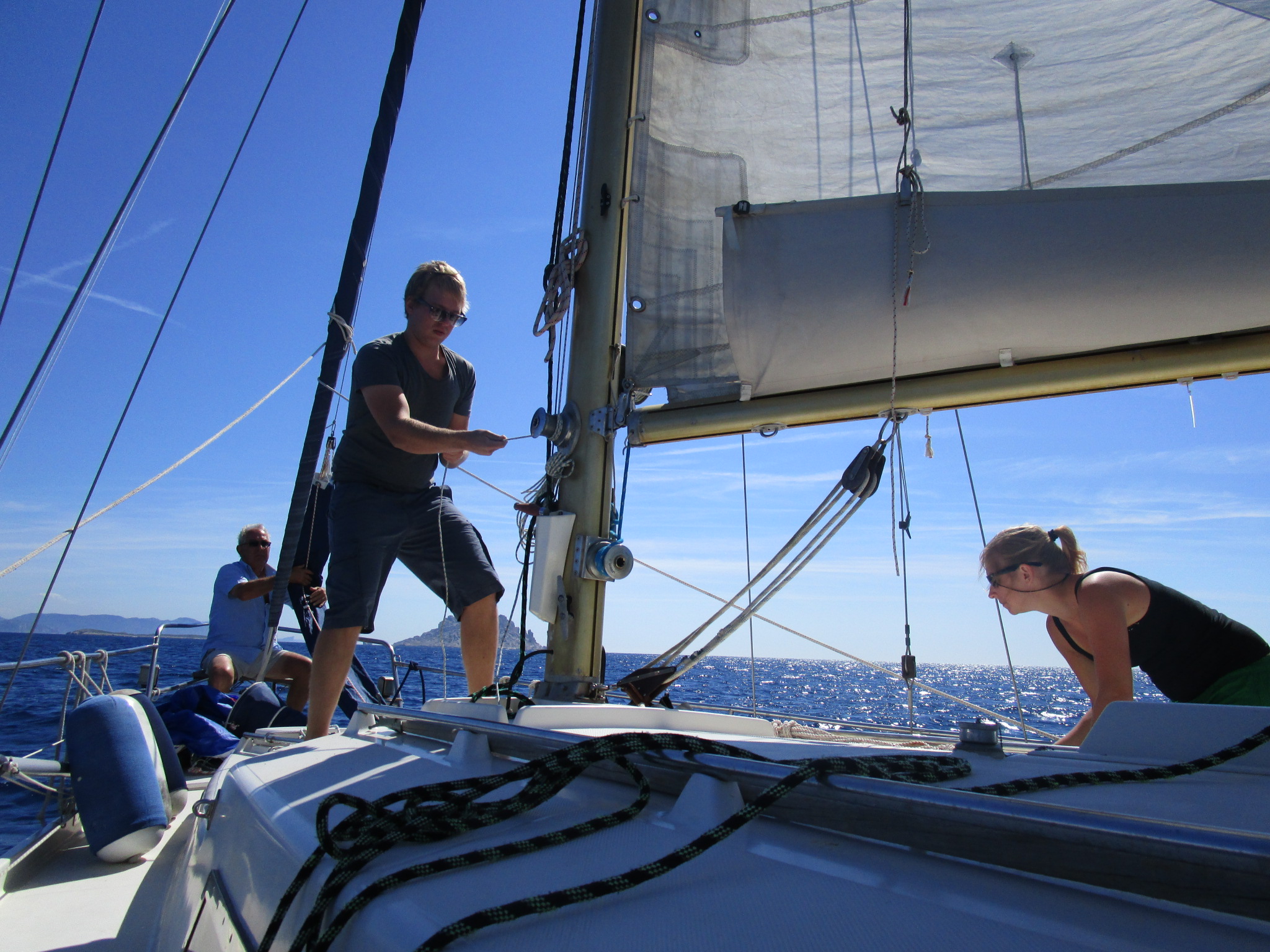 Finally, some sailing! Andreas, Andy and Nora got to unfurling the sails — I’d be helpful whereever I could, and whenever so ordered, but otherwise I stayed out of the way and watched them work. This type of sailboat (a ketch) has three sails, the big one in the middle of the boat called the mainsail, one at the front (bow) called a jib, and one at the back (stern) called a mizzen.
  So when setting sail, you’ve got three different sails and booms to deal with, and so enough to keep three people very busy for a couple minutes. But the ropes (“sheets”) that raise and control those sails all come back to the cockpit, so in theory at least ONE person could do the whole thing. Not likely though.
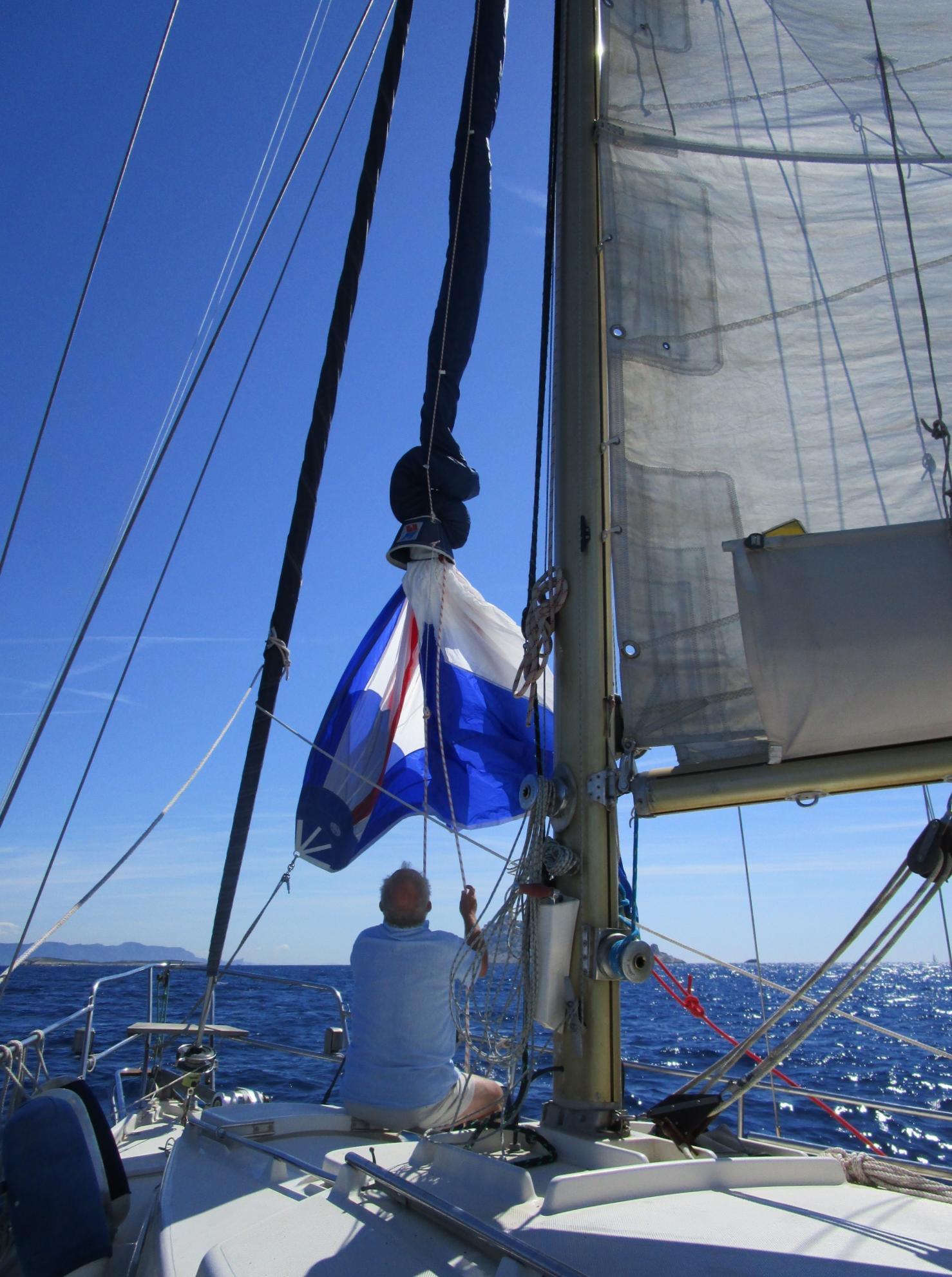
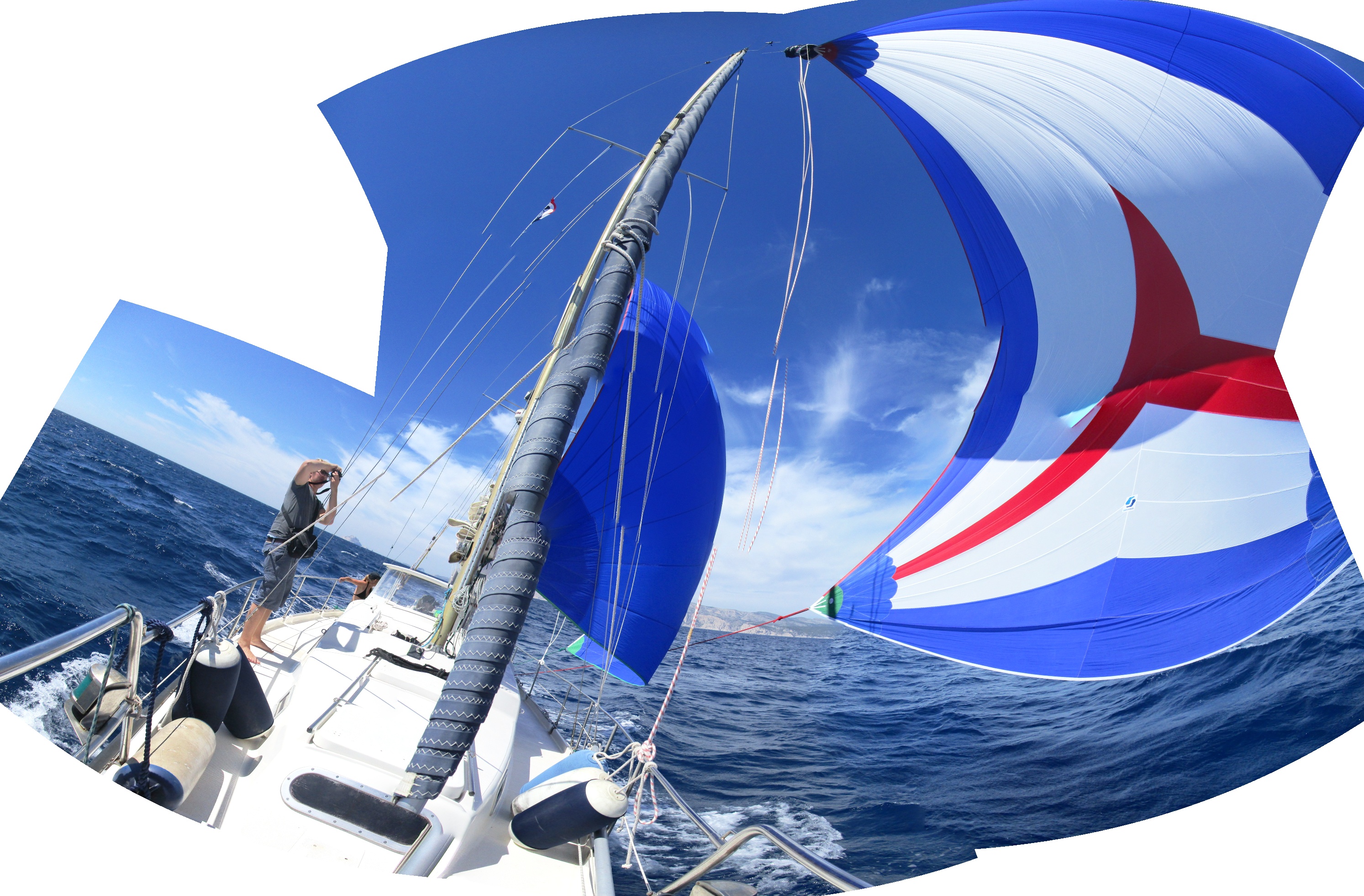
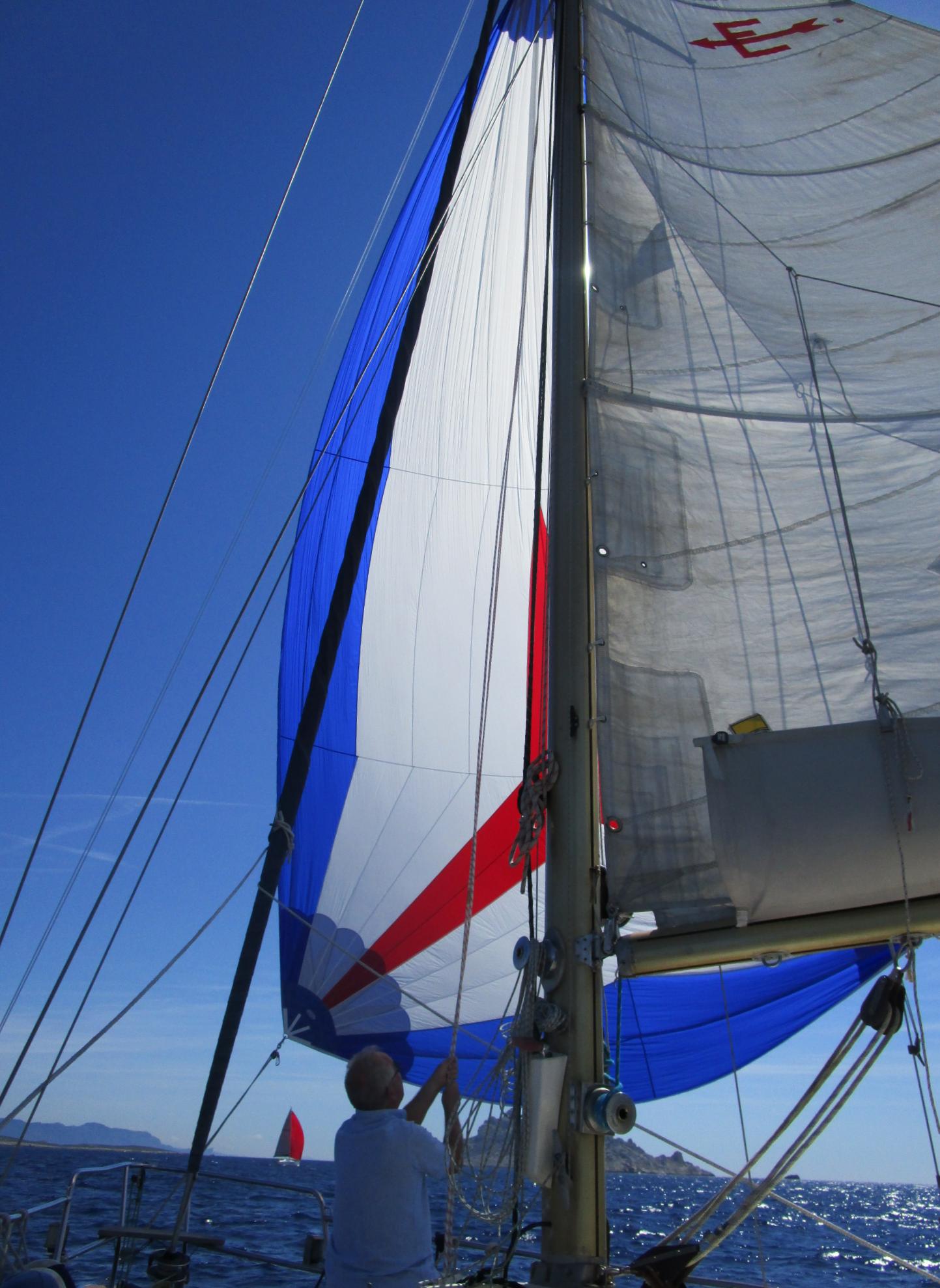 We had great wind, at our backs actually, and in that case you can bust out the king of the sails, the spinnaker. Instead of the smaller, triangular jib sail that is designed to work with crosswinds, the spinnaker simply blows up to huge size and grabs all of the wind to pull you straight ahead. In the photo at right you can see how the sail is kept furled inside a tube, and unfurled by pulling the tube up (via ropes and pullies, naturally) to release the sail inside. At left you see it fully unfurled for the first time — note the sailboat in the distance that is also running its spinnaker. Actually, our sail was a modified form of spinnaker called a gennaker, sort of a hybrid between a genoa sail and a spinnaker sail.
 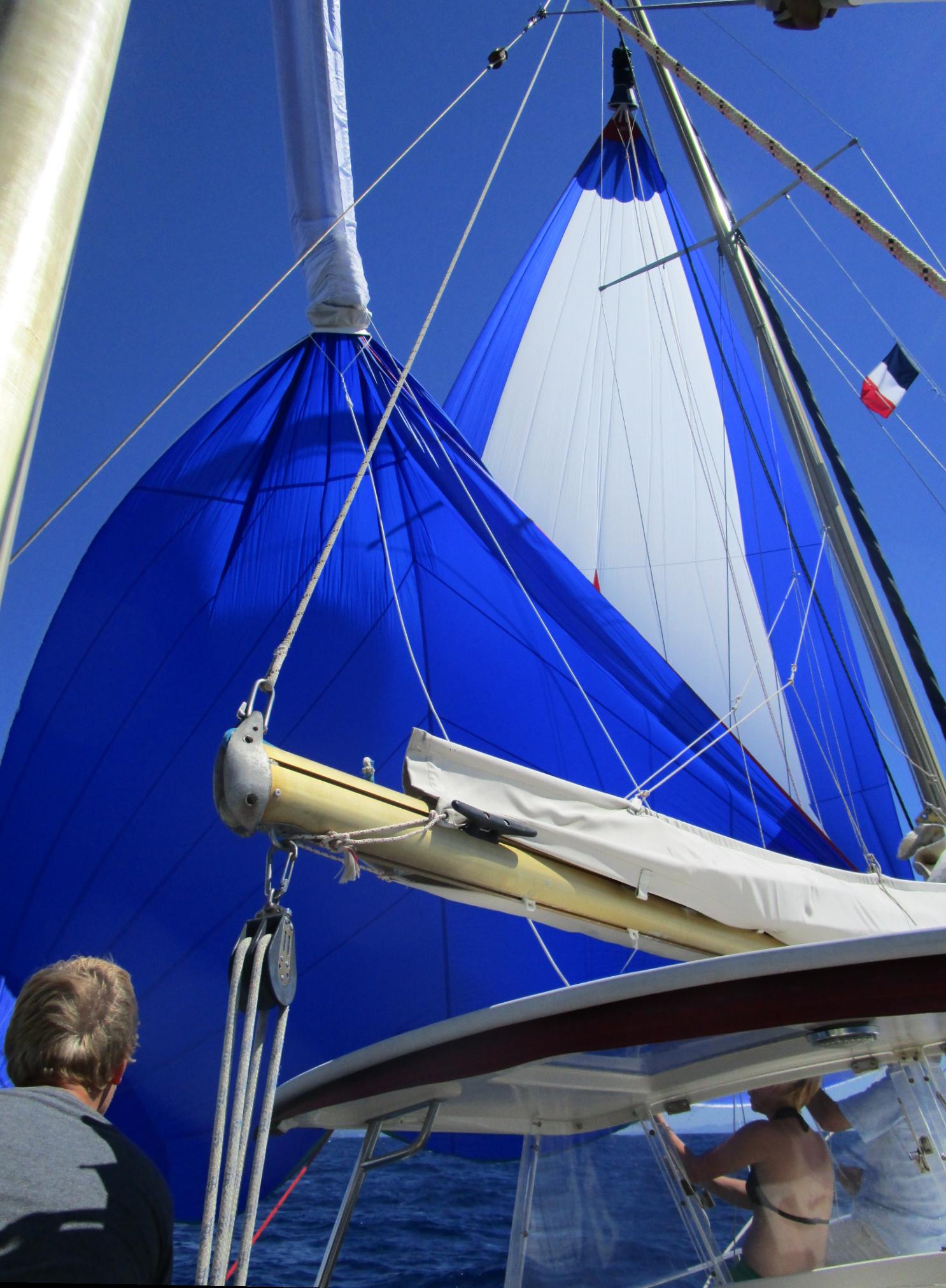 Instead of both bottom corners flying free, held back only by ropes, in the gennaker one corner is held to the bow of the ship and the other corner is flying free. This way it’s off to one side of the boat, and actually catching slightly more wind than a spinnaker would, because you then sail with the wind slightly off your rear — the mainsail (in the middle of the boat) doesn’t “shadow” the gennaker and you get more total wind power driving the boat.
But wait, there’s more! One gennaker wasn’t enough, Andreas had to bring out two! Heck, we had them on board, might as well use them. In the photo to the right, you can see the mainsail (in the middle of the boat) brought down and bagged on top of the main boom, the fore/jib gennaker flying at the front of the boatd upper right of picture) and finally the second gennaker being let out by Andreas (in the extreme lower right corner of the picture, behind Nora).
All of these different sails and sail configurations are designed to extract as much power out of the wind and get you moving as fast as you can in the direction that you want to go. In this case, with all these sails running, we were pushing 12 knots, which I will tell you now is SERIOUSLY HAULING ASS. We were really flying, pounding through the waves at what seemed like breakneck speed.
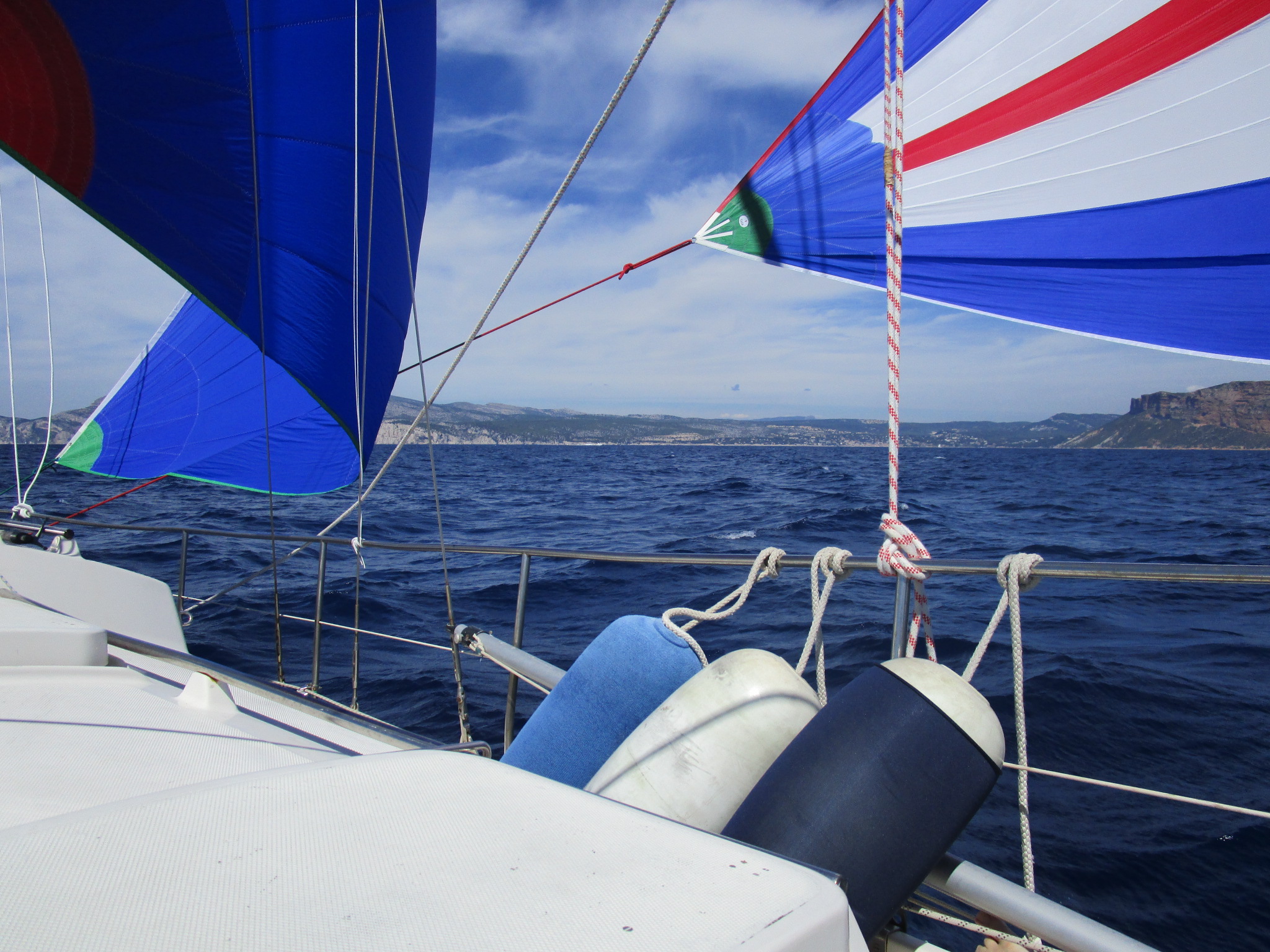
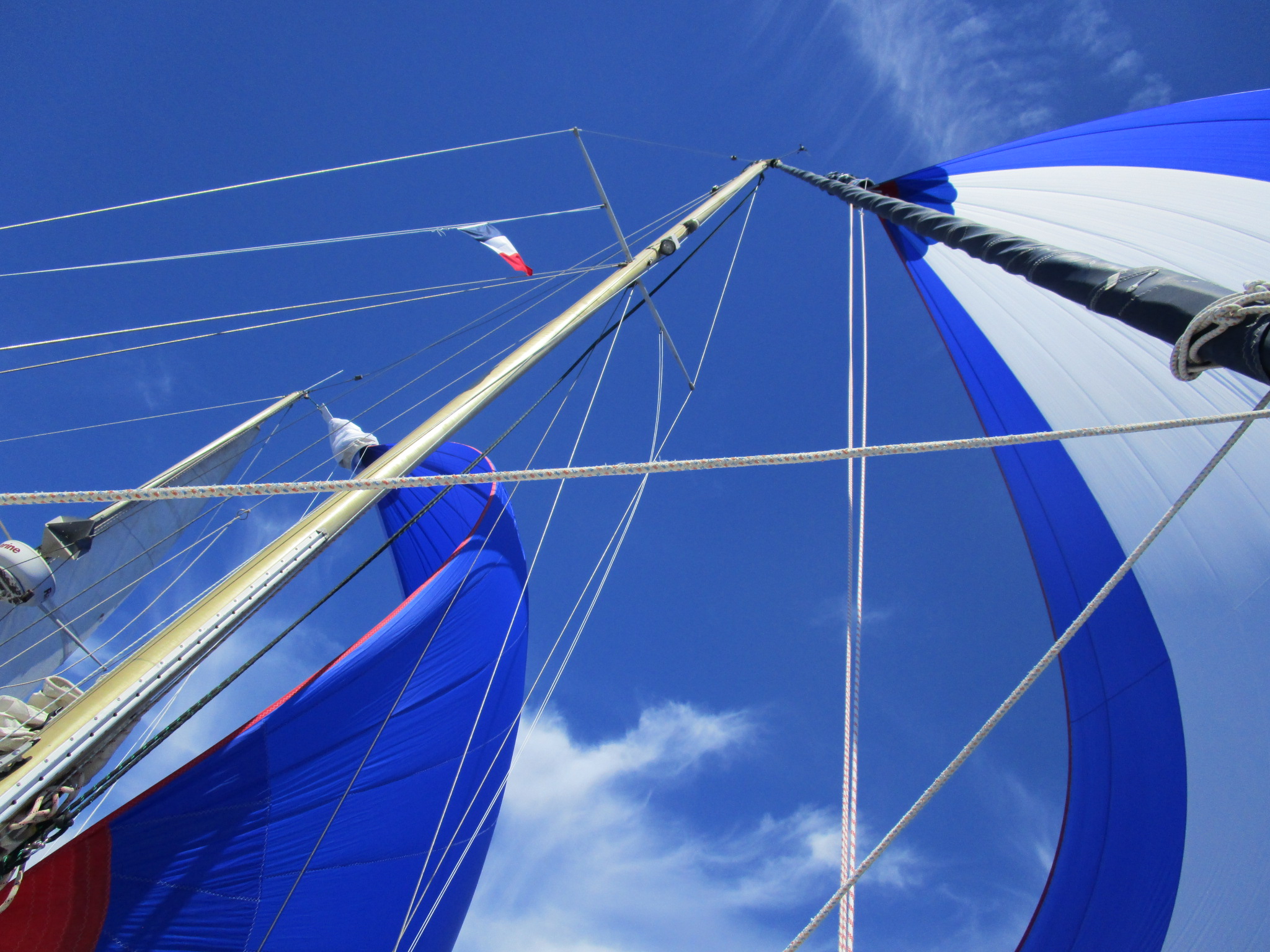
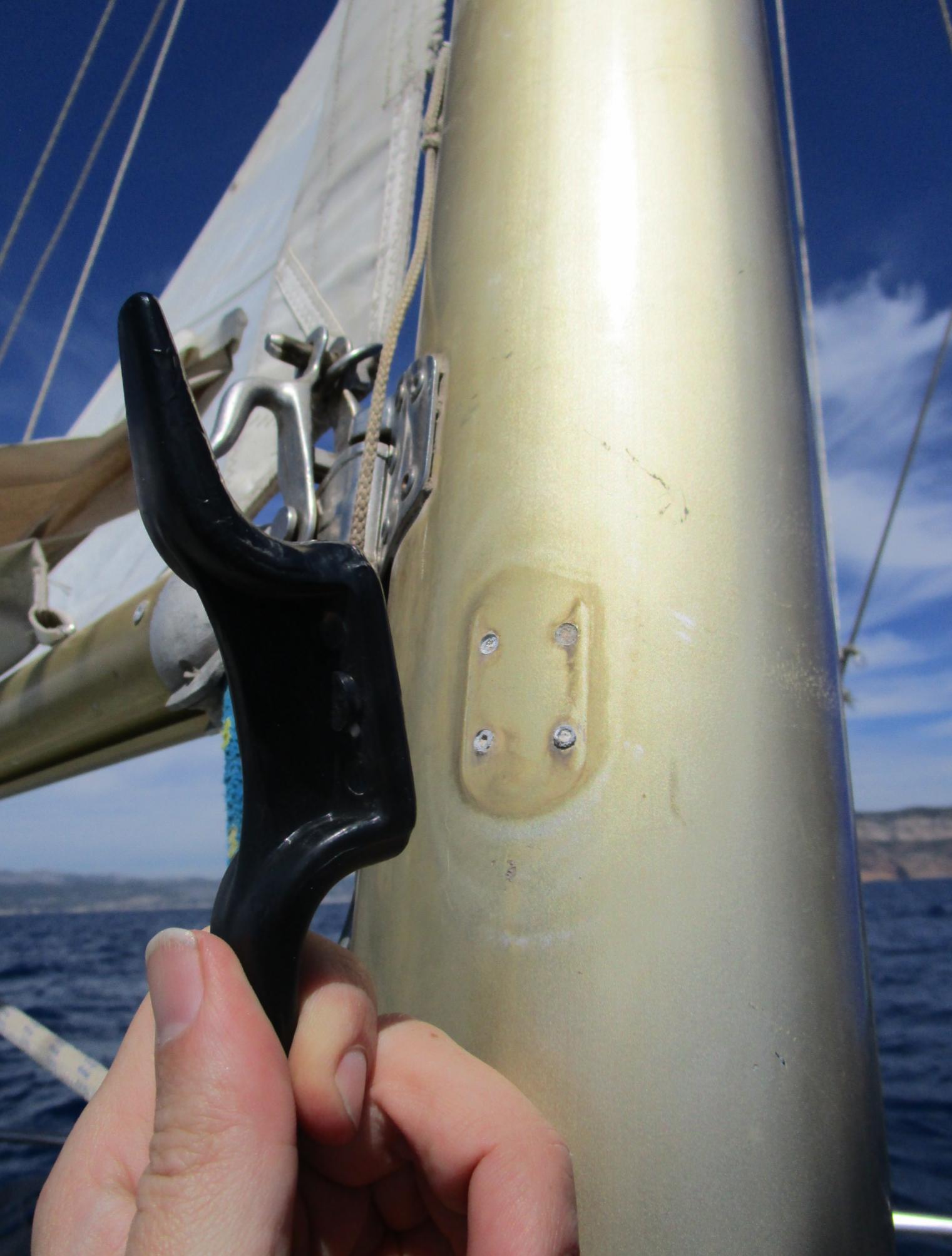 After about an hour of fast running with the sails set like this, suddenly we had to spring into action. One of the cleats had popped off the main mast and a sail went flying. Andreas said that it was not one of the original cleats, rather one that a local worker had added for him. Poor quality work, but we also had too much rope tied off on that one little cleat — there are bigger cleats designed to handle bigger loads. Anyway, that’s actually really dangerous, and certainly things got real exciting for a minute there.
At some point, not long into this serious sailing, I started to realize that I didn’t feel so good. Uh oh. I settled into a corner and tried to keep my eyes up and on the horizon, but it wasn’t helping. That great big breakfast was coming back. I quietly signaled to Nora that I was about to become a, uh, unuseful crew member, took up a post on the side of the boat away from everyone, and … yeah, I got seasick.
Nora dug up some anti-nausea medication for me. It felt like a sleeping pill (which I hate) but it did the job. Along with generally taking it easy for the rest of the day, I didn’t get sick again. In future days, as long as I went easy on the breakfast (especially not loading up on orange juice, duh), I felt fine. I guess it just takes the body a couple days to adapt. Hey, I’m just like a good percentage of NASA astronauts!
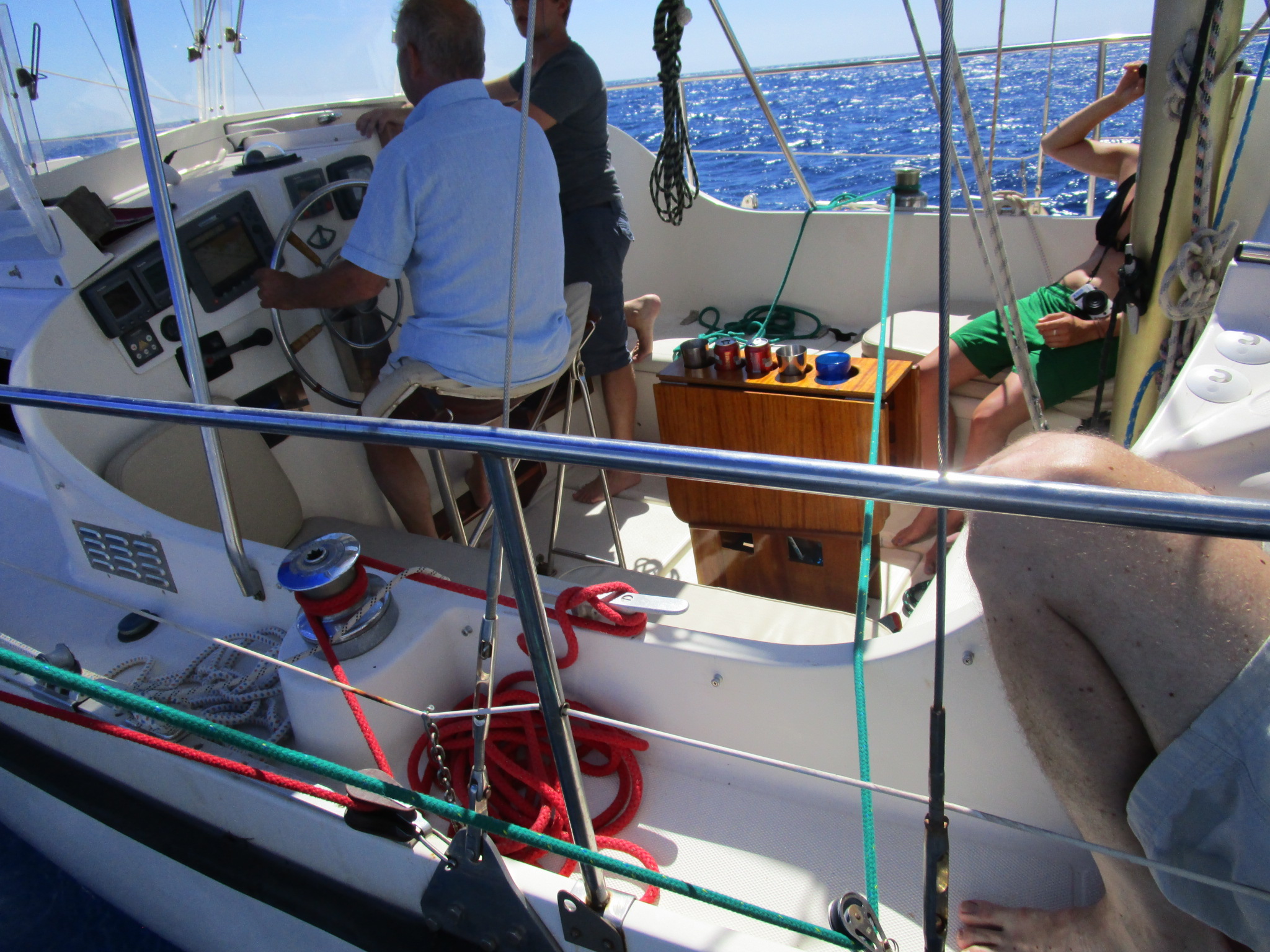 Here’s a good view of the cockpit, the main seating area (I actually forget now what the right term is for it). It’s where the captain mans the controls, and where all the ropes end up. Close to us in this view is the red rope going around the port winch, a one-way ratcheting device that helps to pull the rope in and keep it tight. In this dual-gennaker configuration, Andreas decided to run the other rope (the green one) across the cabin — that’s not normal, but what we improvised that day. Then at the rear of the cabin (to the right in this picture) you see the main mast with quite a few ropes cleated off there.
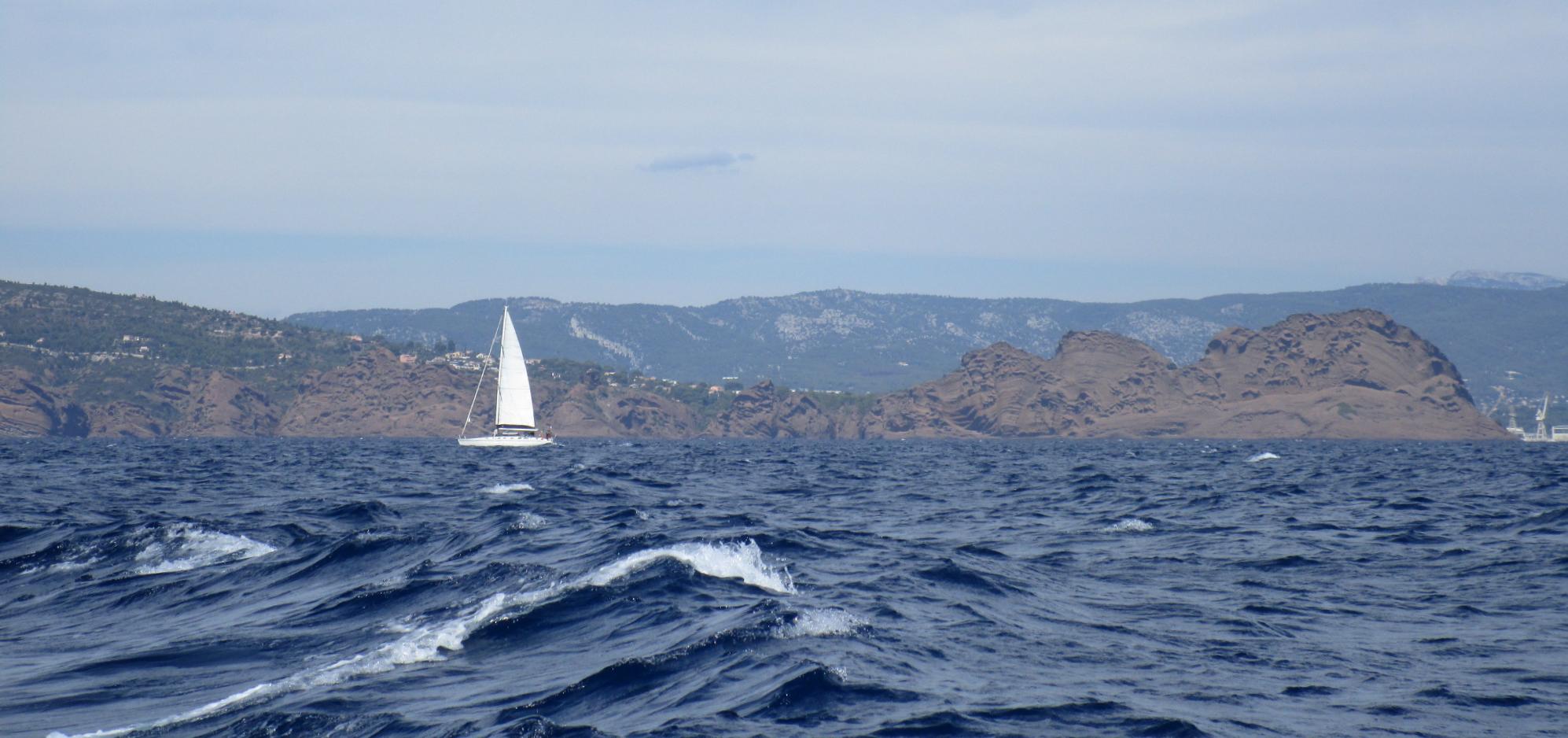
We made our way along the French coast, east of Marseille, passing starkly beautiful geological formations along the way.
Our destination for the evening would be the town of Porquerolles, on the island of Iles d’Hyeres. We got in pretty late, and as I recall, Andreas had to sweet-talk someone into getting a berth — I think we got the private berth of someone who was out of town (with their boat).
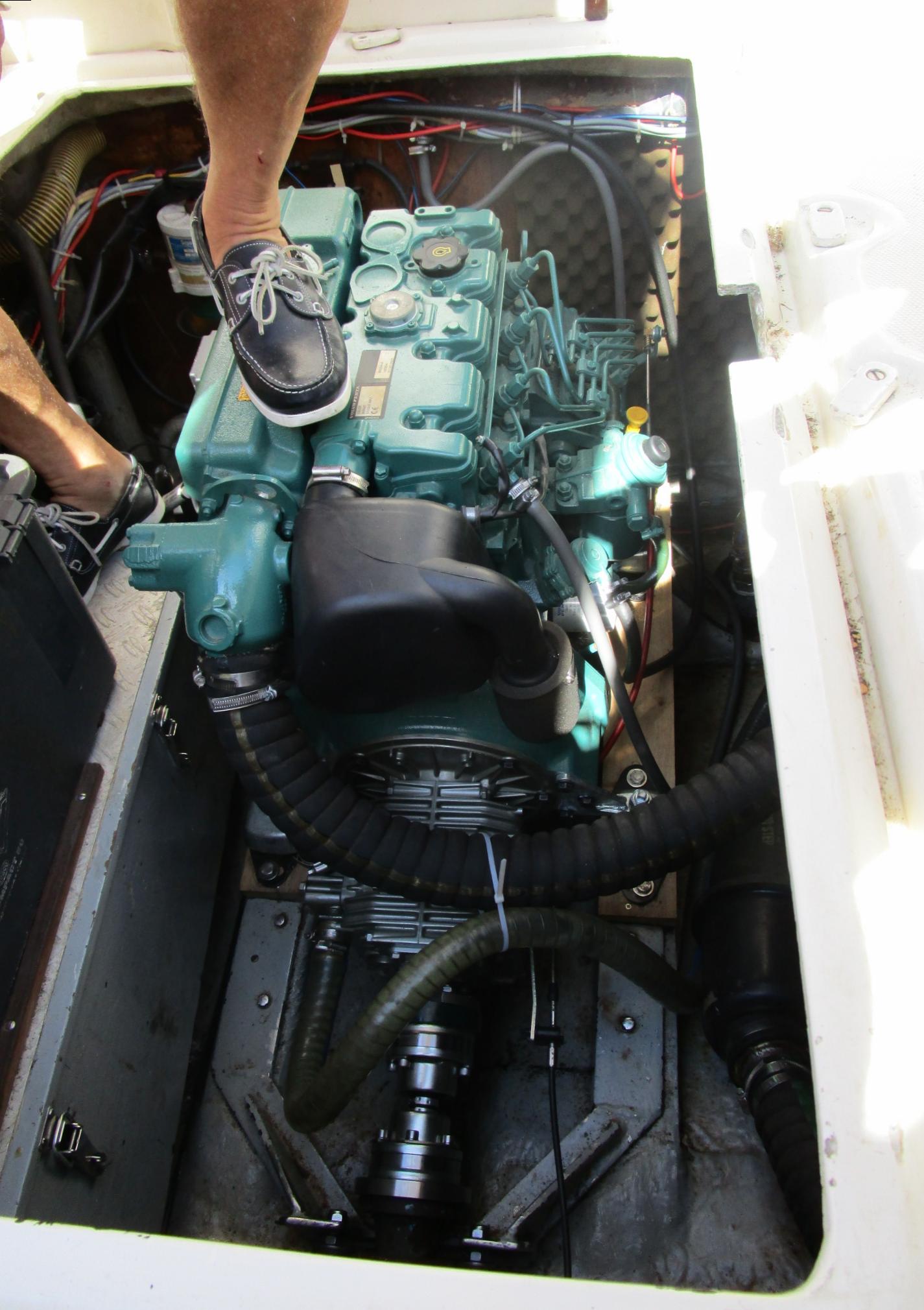 Now finally Andreas would get a look at the transmission. As I wrote earlier, this was a brand new engine, mated to the old transmission. I had already heard about how matching those up had caused some drama in the past year as they were doing the engine upgrade. But while we had been on the water today, in particular while maneuvering in close quarters in the harbors, Andreas became concerned about strange sounds that were coming from the transmission when the thing was put into reverse. So we popped the lid off the engine compartment, Andreas got down in there to take a look, and generally grumbled about the situation.
We washed up and headed to dinner at a little restaurant in the town that was recommended by my cousin (and Andreas’ daughter) Cornelia. But we were all quite exhausted, me especially due to my bout of seasickness, and honestly we just wanted to get through dinner and to sleep. But after dinner we did wander round a bit. This town has a central square surrounded by little shops including groceries, so we were able to load up on perishables and the occasional toiletry. I believe I added once again to my growing collection of suntan lotion bottles. Walked around, watched a bocce game (actually here it’s called boule or petanque), and headed back to the sailboat and finally some rest.
 I have been planning this sailing trip for about two years. Two summers ago, Andreas went on two-month trip around the Mediterranean, and was joined by friends and family at various times during the trip. I heard about this and declared my intent to join him someday, and we quickly made plans to target this summer for the trip.
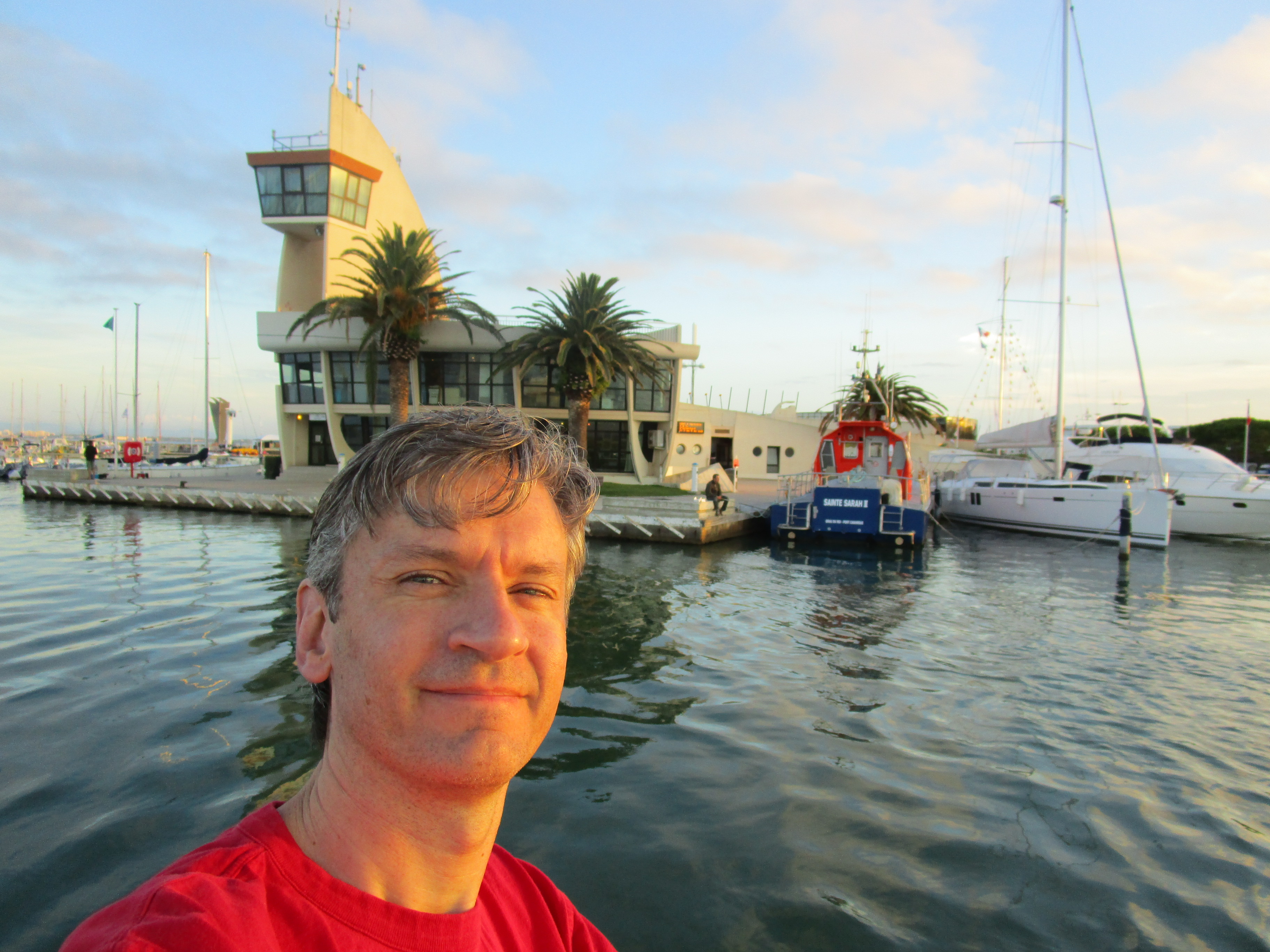 So here I am, on a sailboat at dawn, heading out into the Mediterranean Sea. Besides Andreas and me, also on board are my cousin Andy and his girlfriend Nora. Andy (Andreas’ son) has lots of experience sailing as well, and so between the two of them we’d always have someone at the helm who knew what they were doing. The rest of us were “crew”, meaning it was our job to make sail adjustments per the captain’s orders. Most of the time, we would just be executing a simple turn (usually a “tack” into the wind), which is just about the most basic sailing maneuver there is, so in theory we all knew what we had to do.
 The tentative plan, shown to the right, is to disembark from our home port (Port Camargue) and spend eight days working our way around towards Corsica and back. At the end of the sailing voyage (or at least my part of it) we will arrive in Marseille, where I will catch a train back to Paris, straight to the airport and back to Atlanta.
 So we went back to motoring. Which Andreas was happy to do, since this was the first time he got to see his new engine in operation. The sailboat had been in drydock for over a year (maybe two) to get the engine replaced, and it now had a brand new
 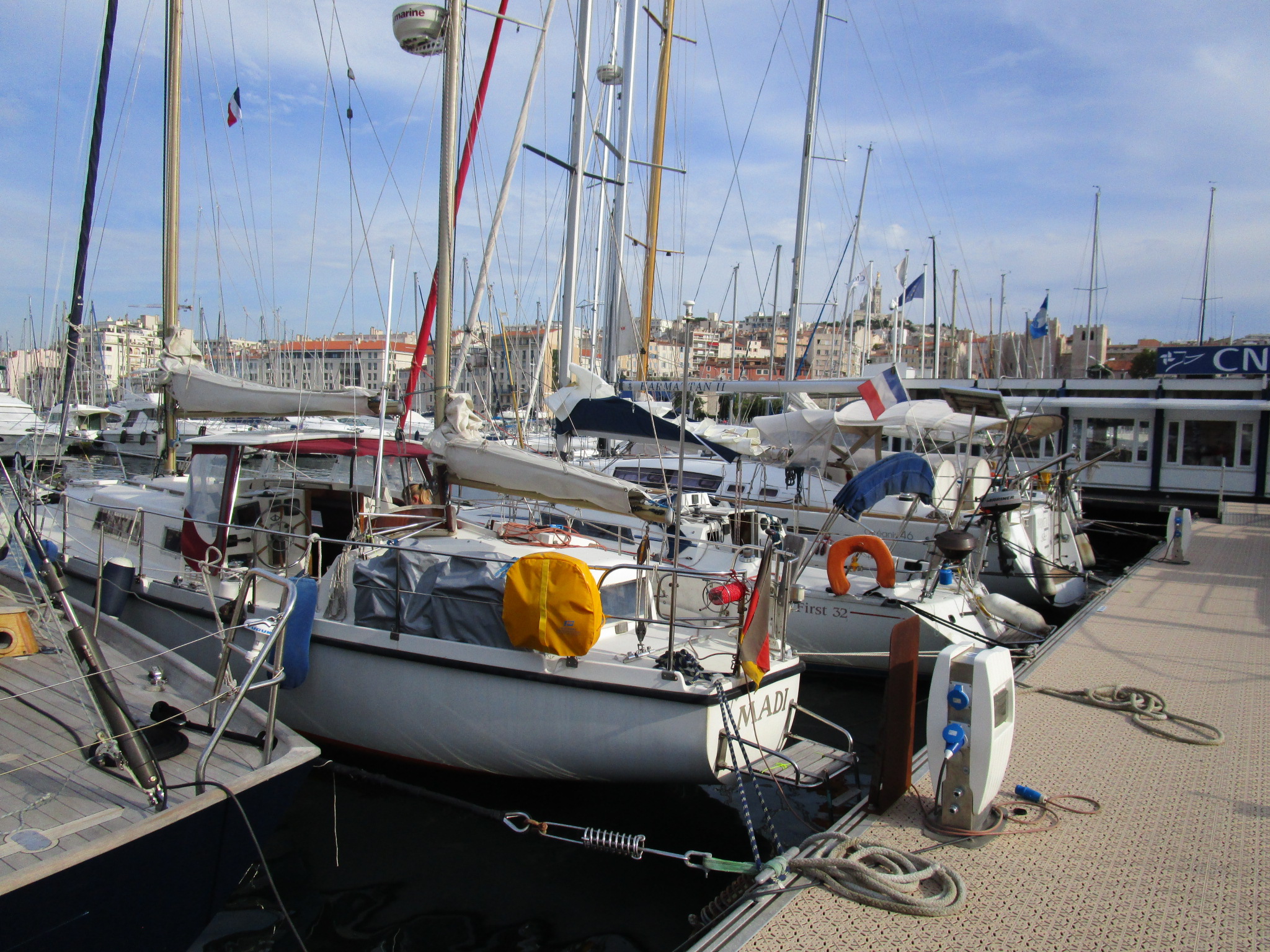 After a whole day of sailing (driving, really), we approached the busy harbor of Marseille. The old harbor in the city center was utterly jammed with a variety of pleasure boats, both sailboats and motor yachts, and it took us a while to find our berth.
 Packed up and headed to the train station! Well, first to just leave my bags in a locker and do a little more sightseeing, as the train wouldn’t be leaving until the afternoon. After dropping off the load, I wandered around the city center a bit, took a mouette across the lake again (to get from point A to point B, really!), saw an interesting outdoor exhibition about world poverty along the lake, and made my way to the science museum.
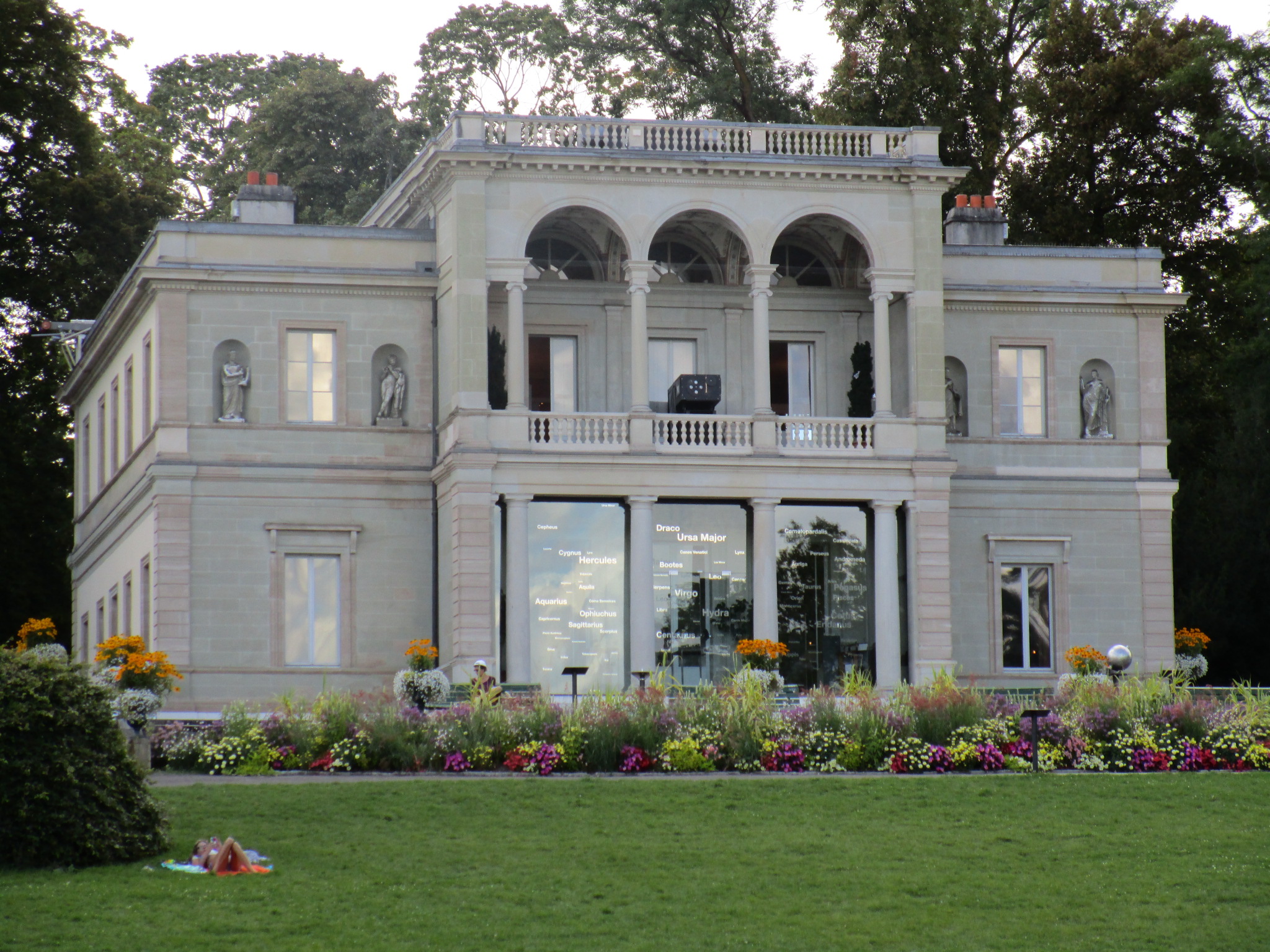 Geneva’s science museum is actually a
  Relaxed for a while on the lawn in front of the science museum, and then headed to the train station for my departure. Happily, there was a train that went direct from Geneva to Montpelier (France), which is where my uncle Andreas would be picking me up. I had booked all of the trains on this trip ahead of time, except for this one, because I originally wasn’t sure of when I’d get access to CERN and wanted to be flexible. So once the CERN situation was set up, I booked this train and was relieved that there was a direct connection and that there was space on it!
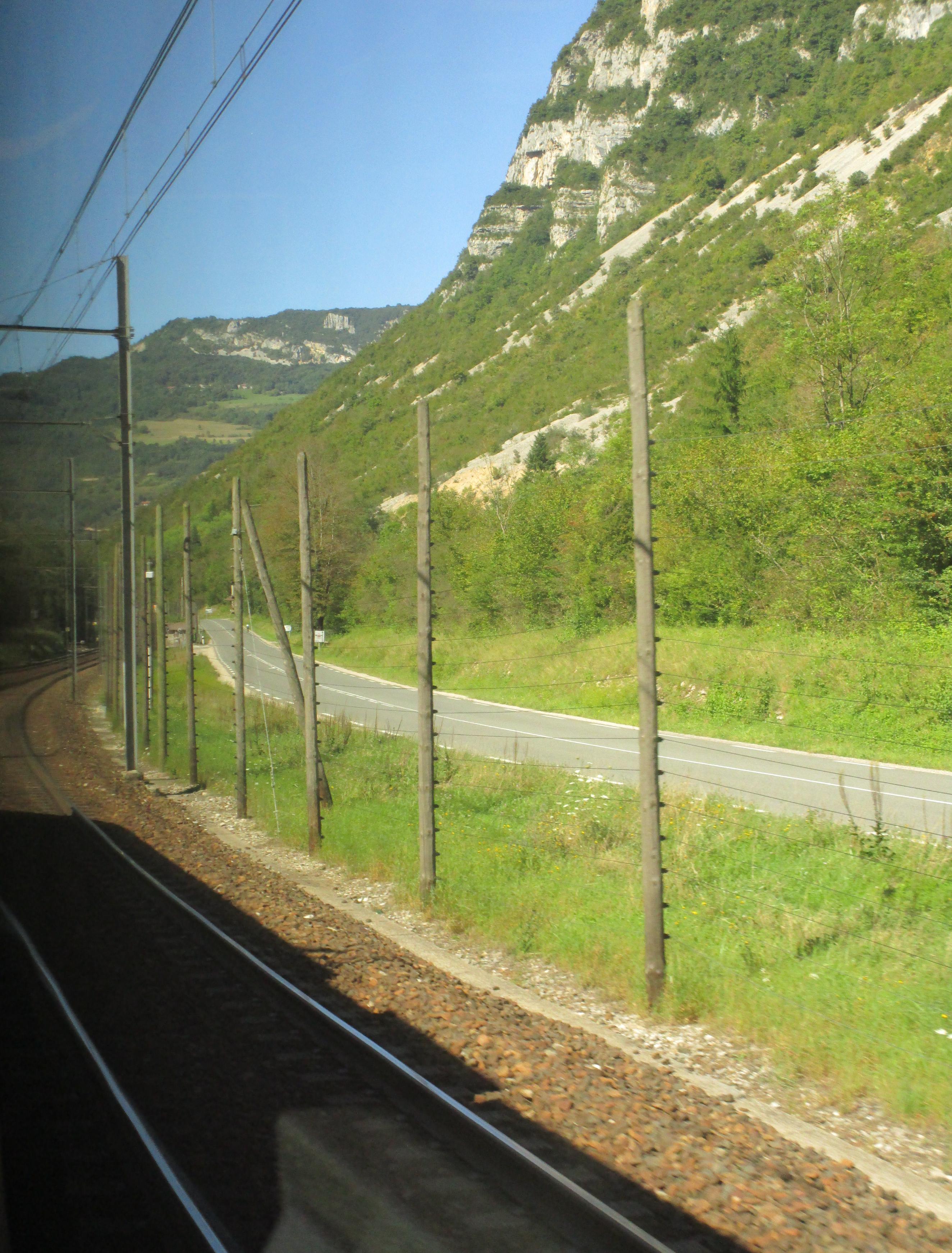

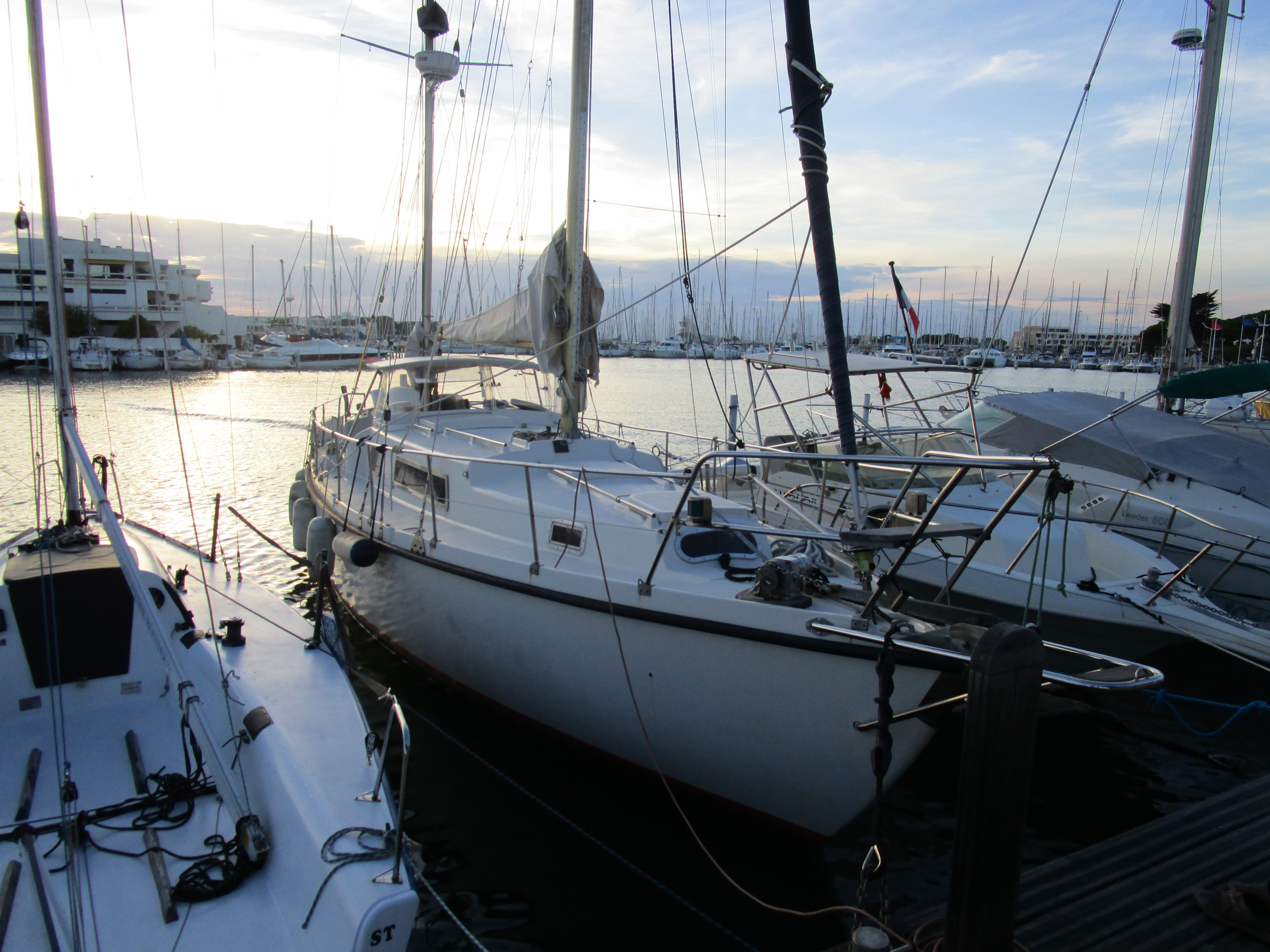
 Having thoroughly explored CERN and the LHC, it was finally time to see the rest of the city. Geneva is a fabulously wealthy city in a gorgeous lakeside setting. Visitors to the city get to ride the transit system for free, so I was able to zip all over the place without really having to worry about anything other than which streetcar to get onto.
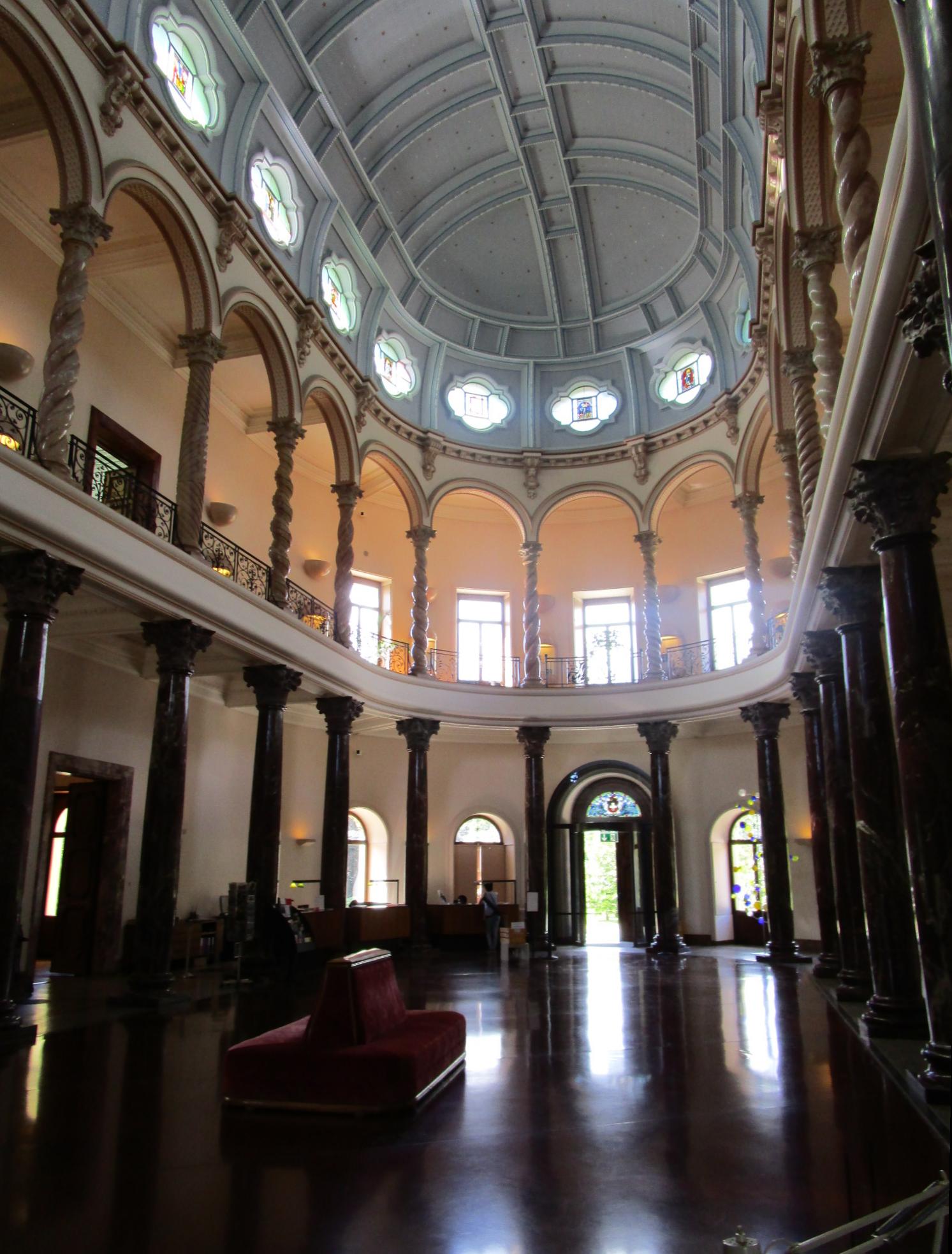 I headed over to the northeast part of town, where the United Nations campus was. Aside from the UN buildings themselves, there are a number of old mansions scattered around that have been repurposed as museums of one sort or another. First stop was the
 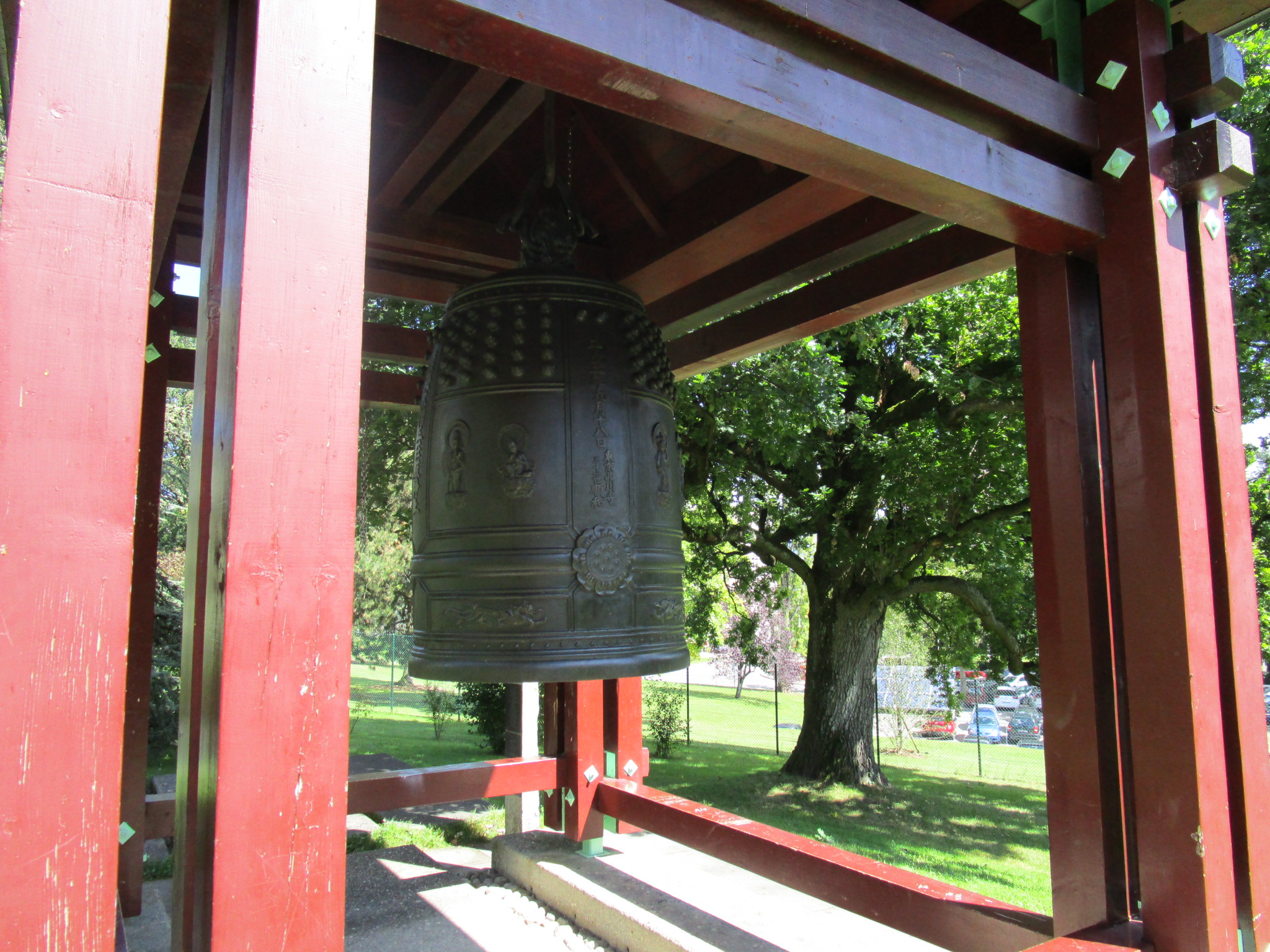 Inside is the Swiss Museum of Ceramics and Glass, but I really just went inside to be amazed by the decor. Other than the polite and welcoming staff, I think I was the only person in the building.
 Arriving at the United Nations proper, I found that I would not have time to properly tour the complex. A few snapshots would have to do.
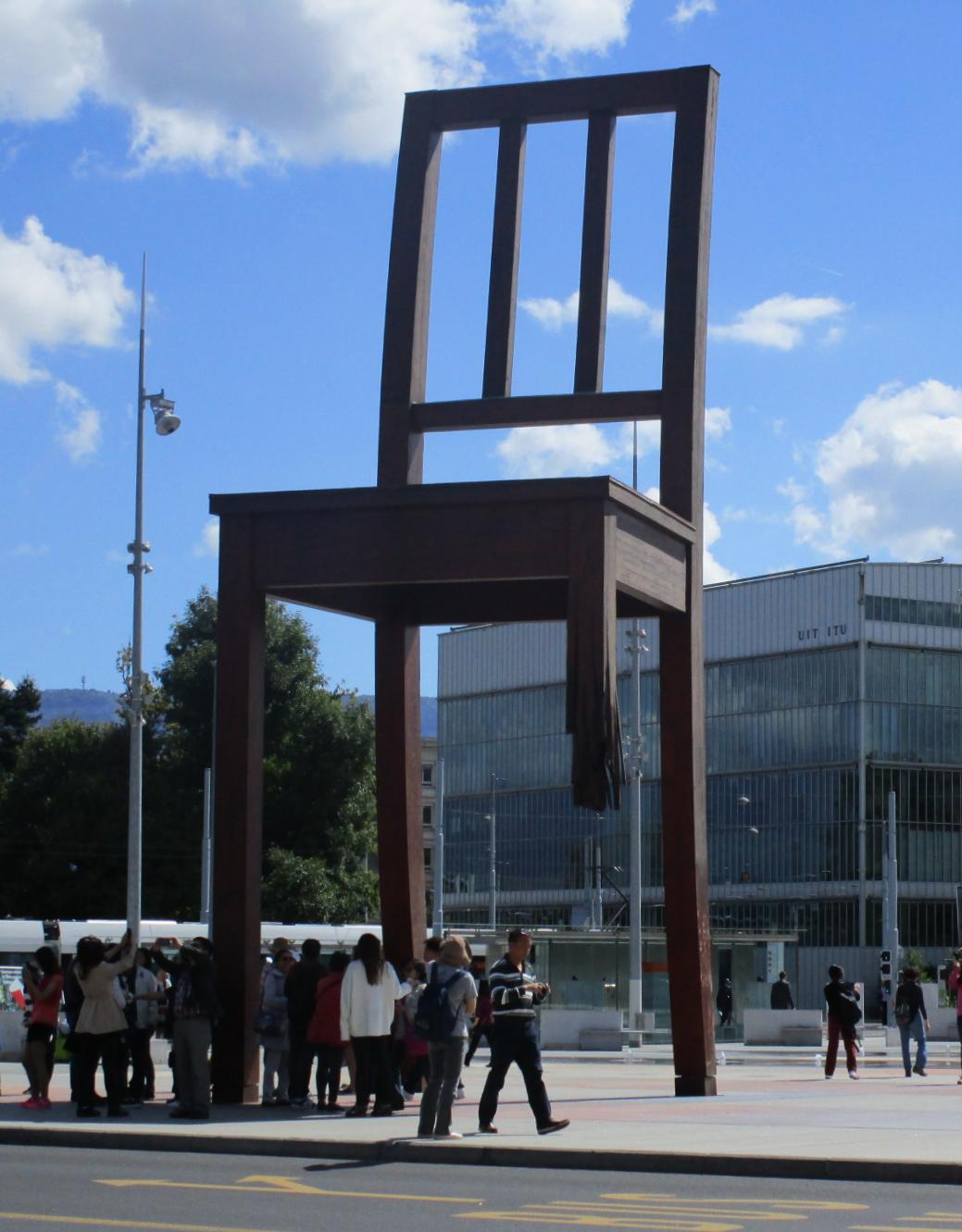 Across the street from the UN entrance, the monumental
 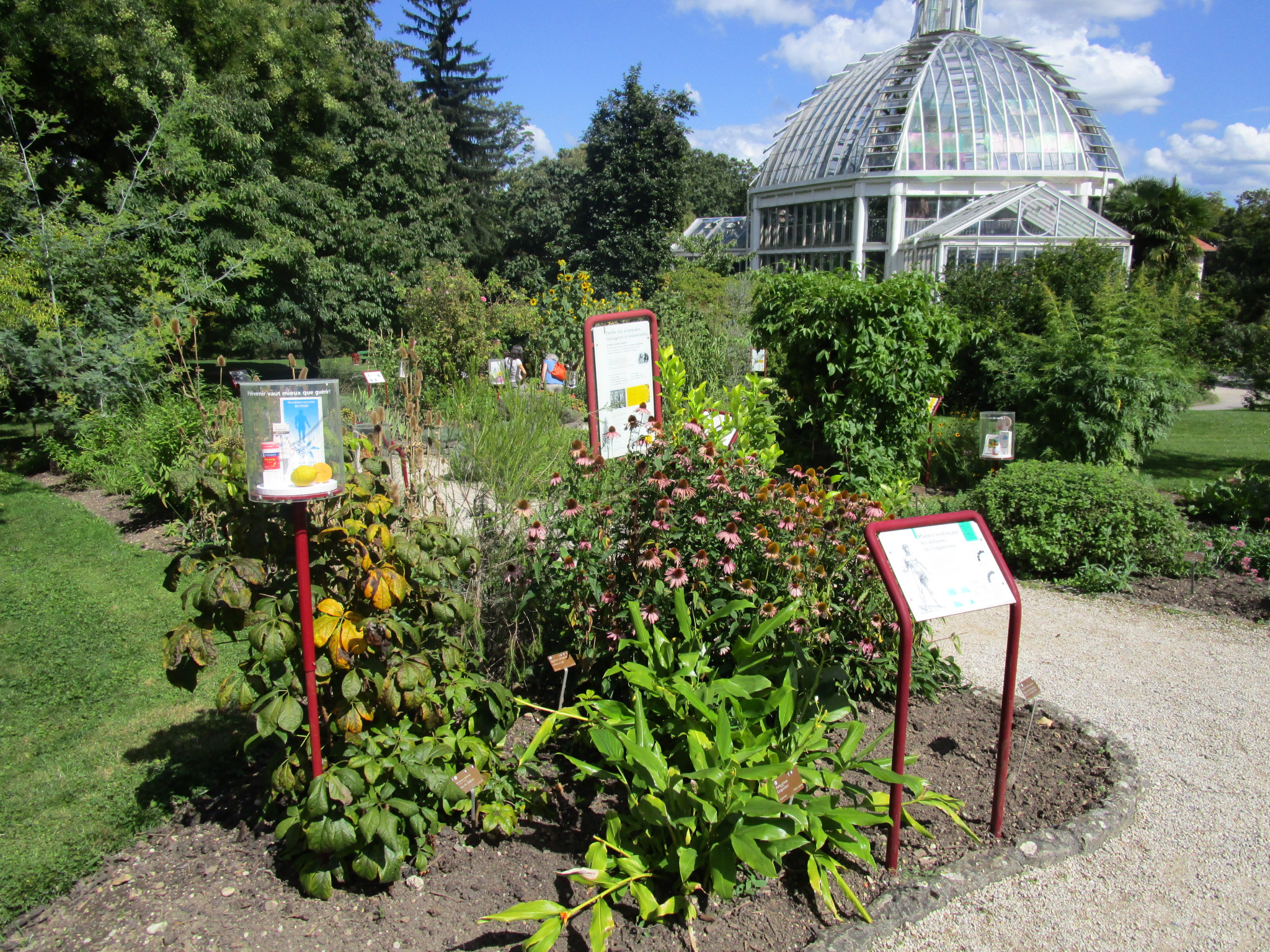 Onwards, through the adjacent Botanical Gardens, which were truly great and resulted in lots of photos to show Sharon later. One memorable part was the educational but somewhat kooky display they had showing the various materials and substances that derive from the plant world — fibers, foodstuffs, pharmaceuticals. Hey, alliteration!
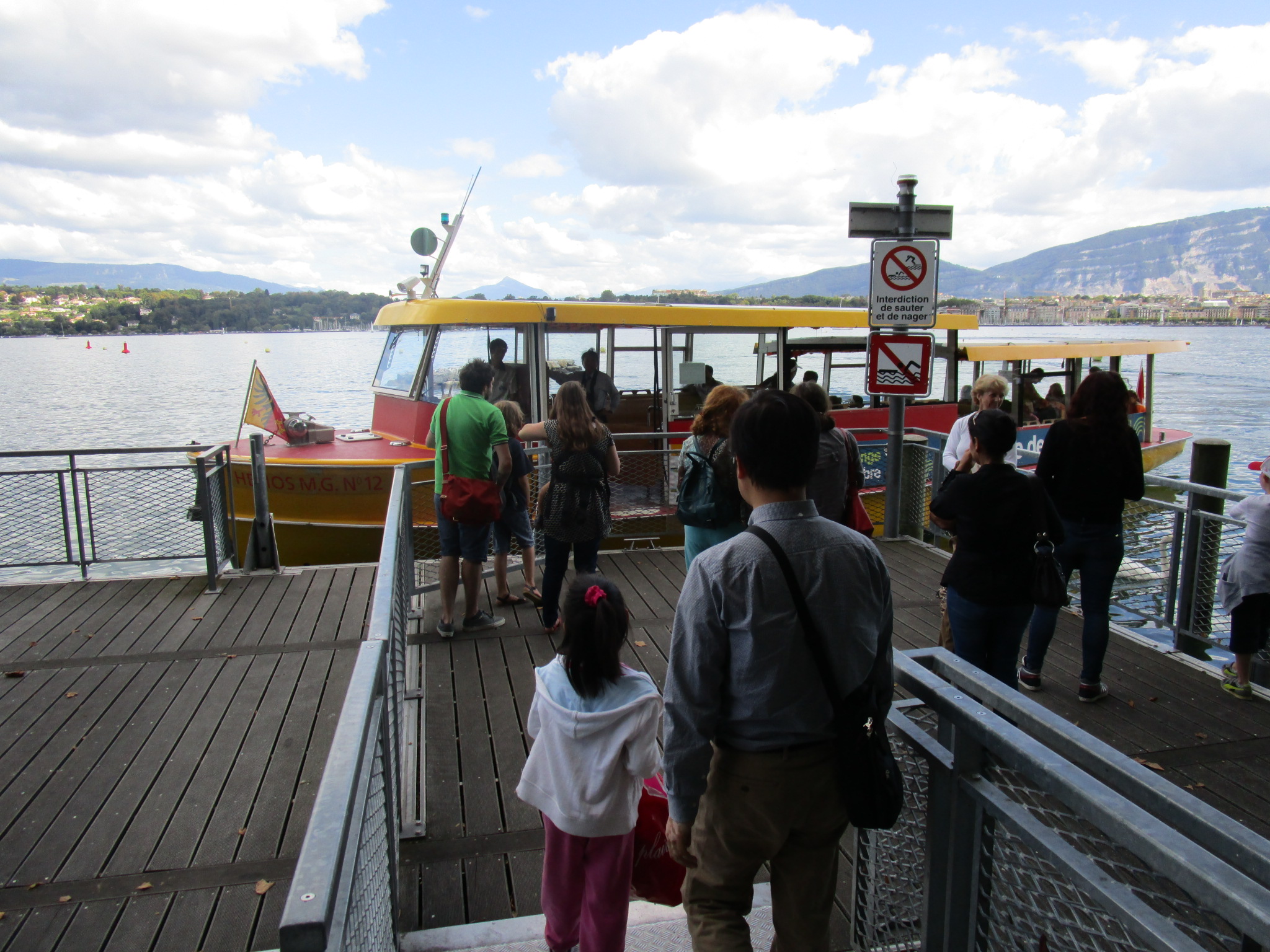 The Geneva transit system (free to tourists as I’ve mentioned) includes little ferry boats across the lake called “
 … After getting a good look at the
 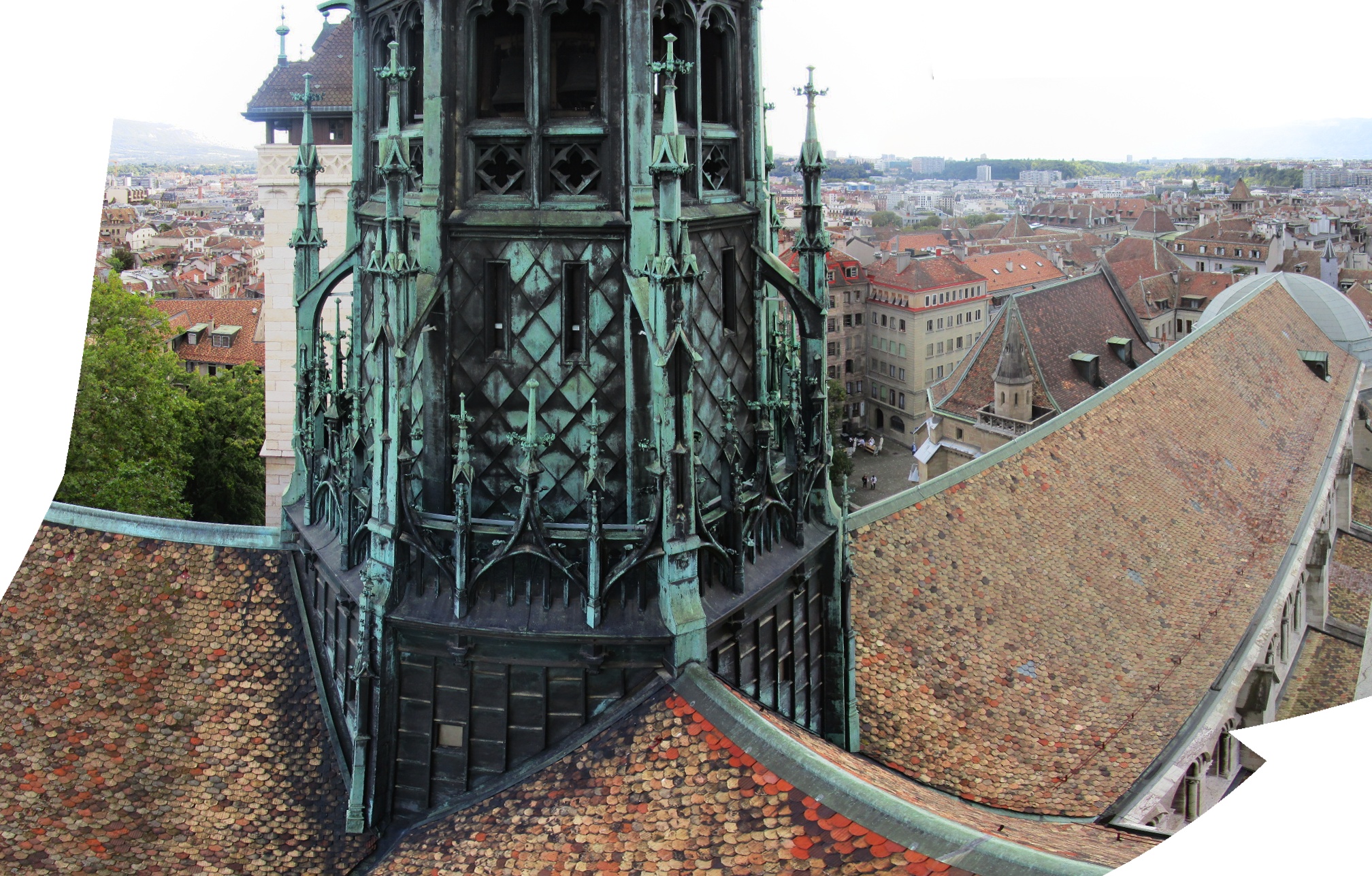 Making my way through the old city center, I toured the
 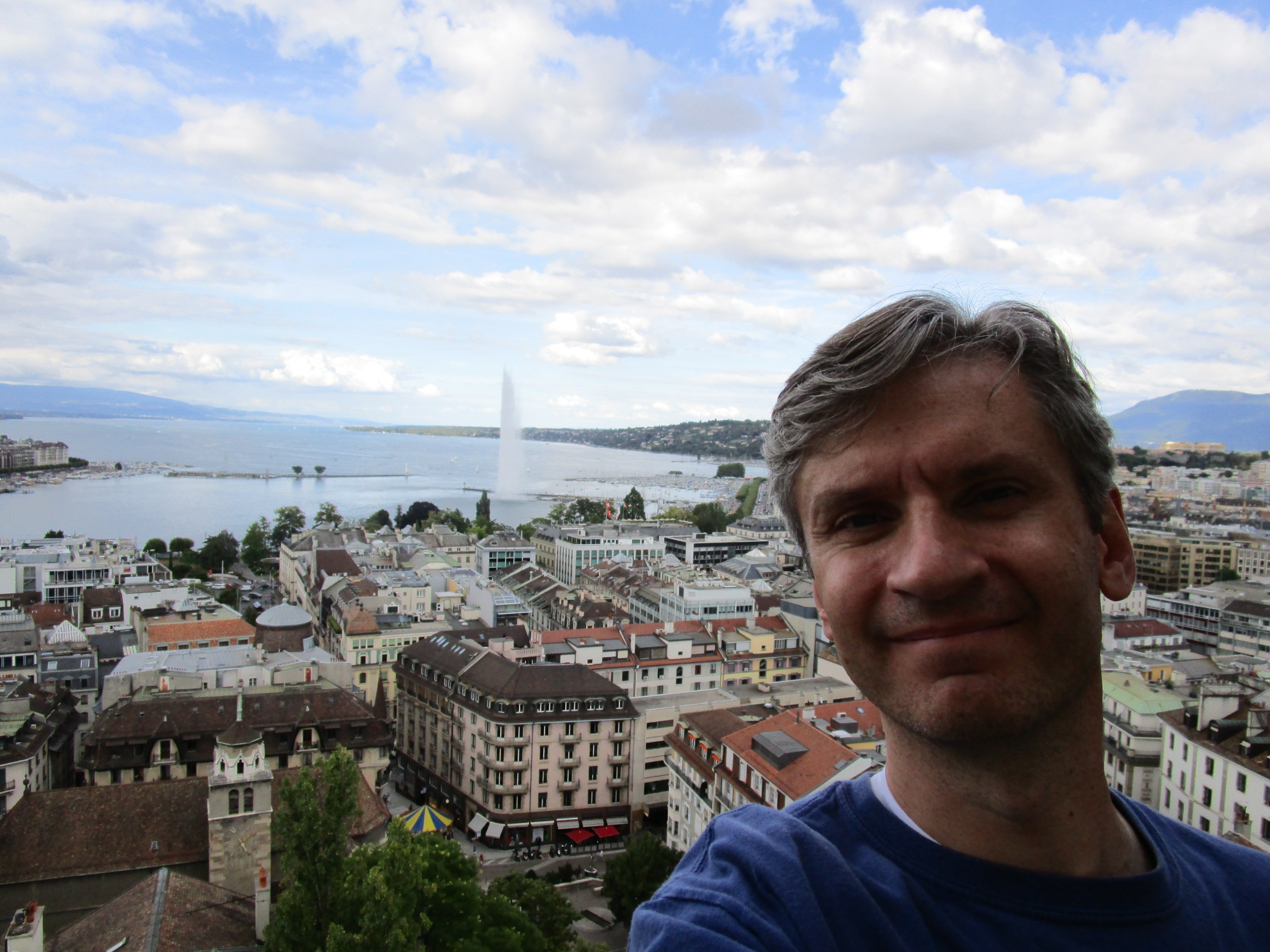 I spent quite a while up there, actually, taking pictures, visually wandering the city, and snapping a few photos of myself as proof of my existence in all this.
 As described in the previous post, I had managed to sweet-talk my way into another tour. This second tour would go to some other locations in the complex that I hadn’t seen.
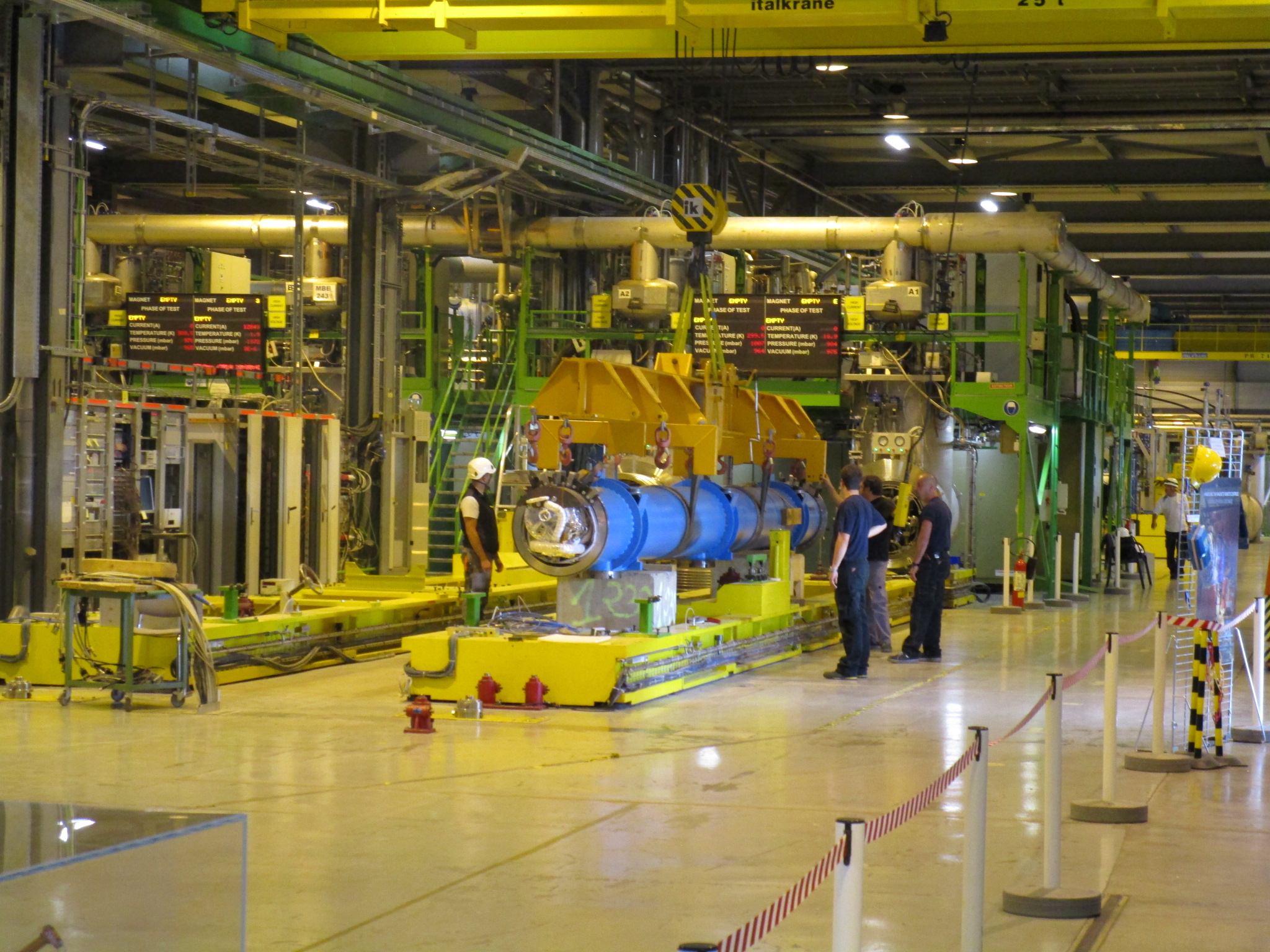 SM18 is the main testing facility for the magnets that are used in the LHC ring. I have no idea what “SM18” stands for — maybe “superconducting magnet” something. As I explained in the previous post, the accelerator ring uses extremely powerful magnets to bend the beam into a circle 27 km around. Even though the construction was completed in 2008, there are about 1600 magnet sections and there is bound to be repair and repalcement activity. This is especially true during a shutdown period such as 2013-2014, which is when they have their one chance to really take the thing apart and service it.
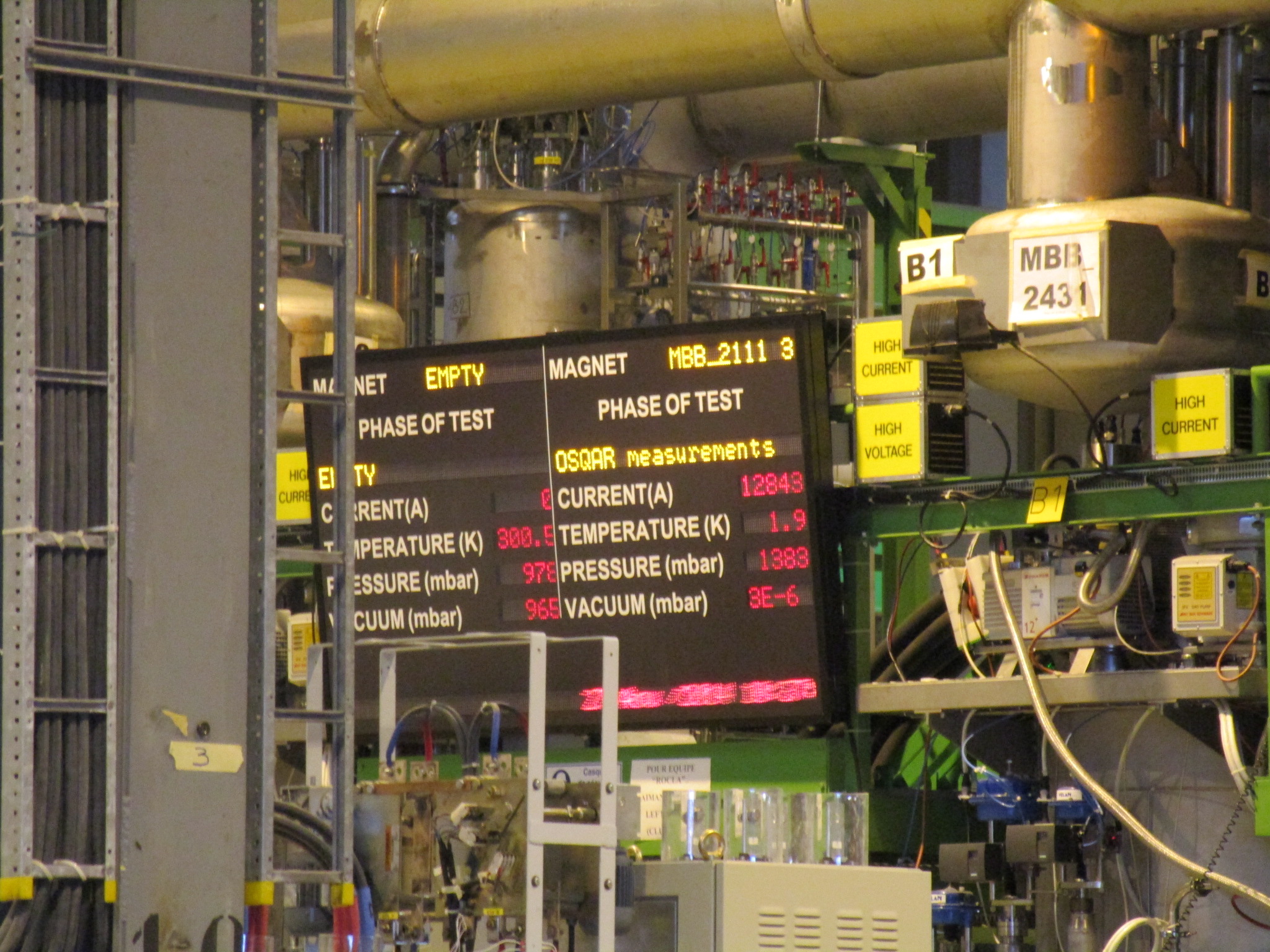 So what we got a glimpse of was a huge industrial space where they loaded in the dipole magnet sections, each about 15 meters long and weighing multiple tons, and ran them through a series of tests. I can’t tell you how excited I was to see them actually moving the sections around, actually testing them, showing actual results on the large aerial displays. If you look closely at the numbers in this picture, on the display you will see:
 We were only allowed into a little corner of the building, but they had all sorts of cool models and hardware on display for us. Models of the building with little trucks showing how gear moved in and out. Models of the tube with all of the magnets and superconducting wires packed around it. Various hardware like an actual dipole section with the side cut out of it so you could get a view of the innrds. A cryogenic valve. Dipole magnets, quadrupole magnets, sextupole magnets, oh my!
 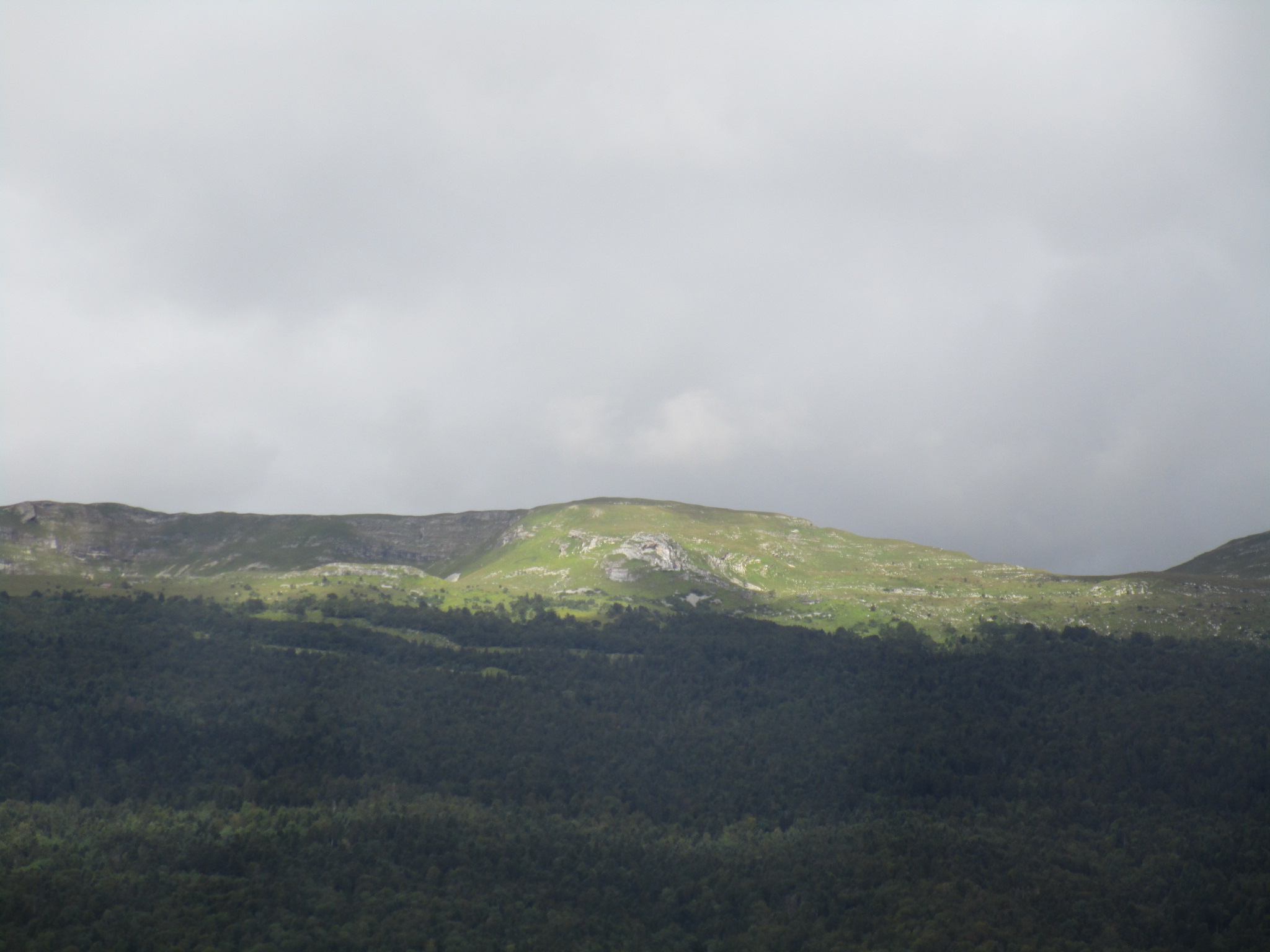 Back onto the bus and onwards through the French / Swiss countryside, with beautiful views of the Jura mountains.
 However CMS is contained within a gigantic cavern, much bigger than LHCb’s — only the ATLAS cavern matches it in size. And ATLAS was already sealed up getting ready for operations, so CMS would be my one chance to see one of the big LHC experiments.
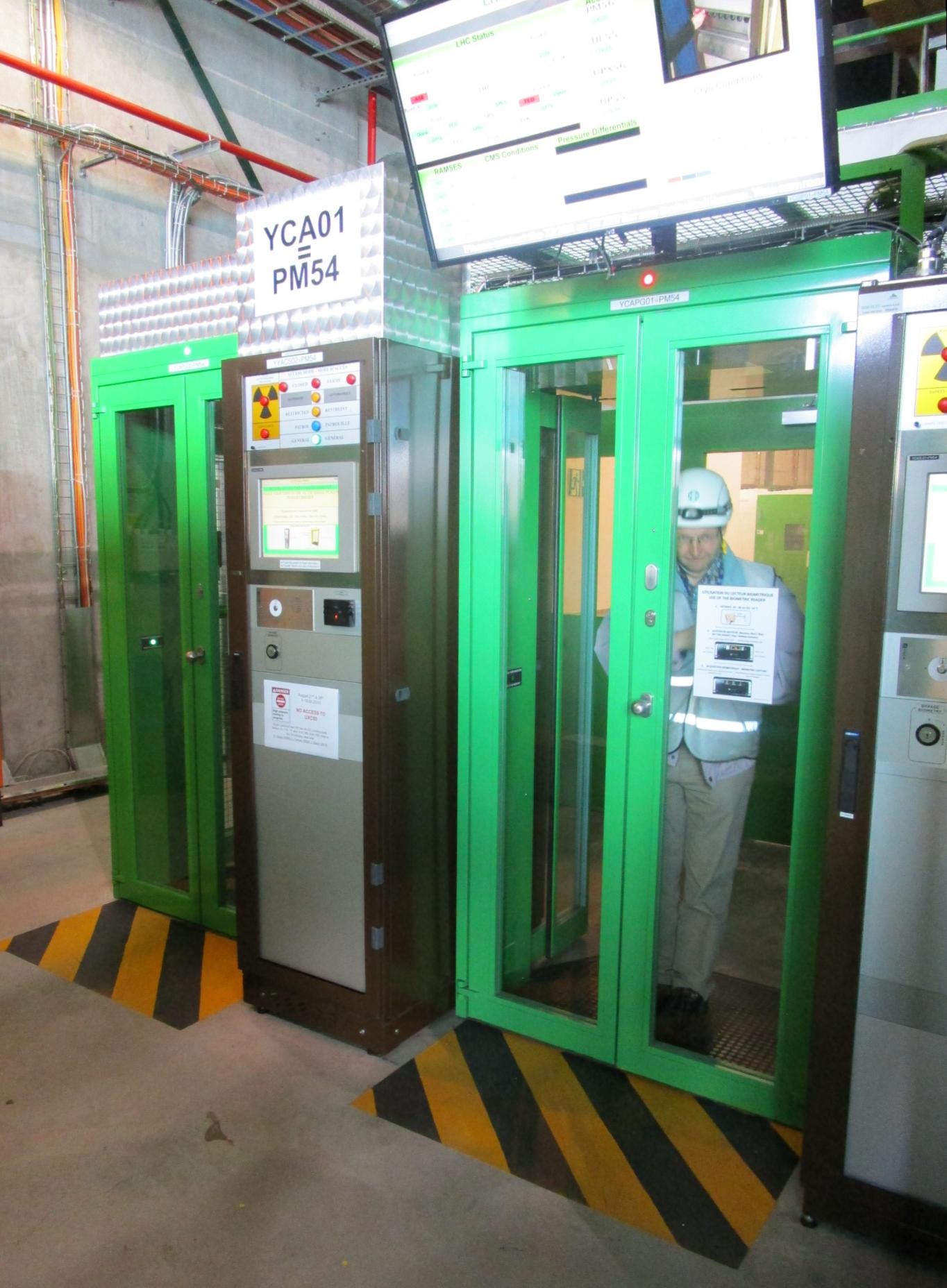 First they showed us around the surface level buildings, which contain various support items like cranes, gas storage tanks, air chillers, etc., but all on a very large scale.
 I don’t even remember the distance now, but I did grab this snapshot looking UP the main access shaft to the surface. That bore was some 60 feet wide, originally sized to lower the gargantuan experiment components down to the cavern, but once they finished loading down the big items, they filled in the shaft with various other infrastructure — like a couple proper elevators, ventilation, and so forth.
 As we worked our way closer to the cavern, we passed room after room of support equipment. Not everything has to be located right inside the experiment area proper, but it also can’t be located too far away (like at the surface), because then the computer communications would slow down. They are dealing with massive amounts of data, literally the highest data flows on the planet, and in those applications the distance the communications has to travel is a factor.
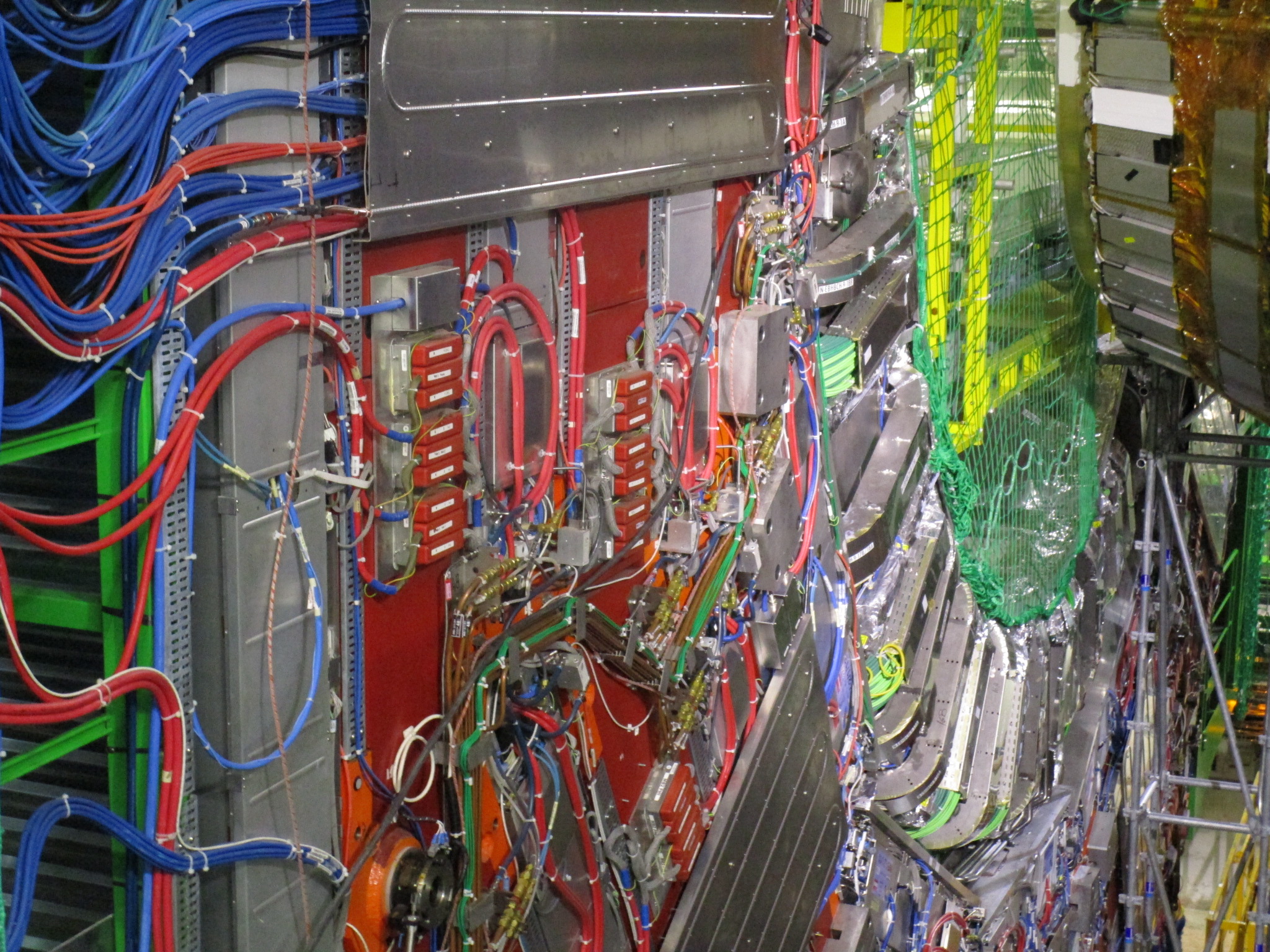 The picture above is of the center of the CMS experiment. When the LHC is operating, one beam crosses from left to right, and another one in the opposite direction, and they collider along the axis in the center. Surrounding that collision point is meters and tons of electronics to detect the various particles that spray away from the center. Pictured at right is a just a detail of part of the machine; click it to embiggen.
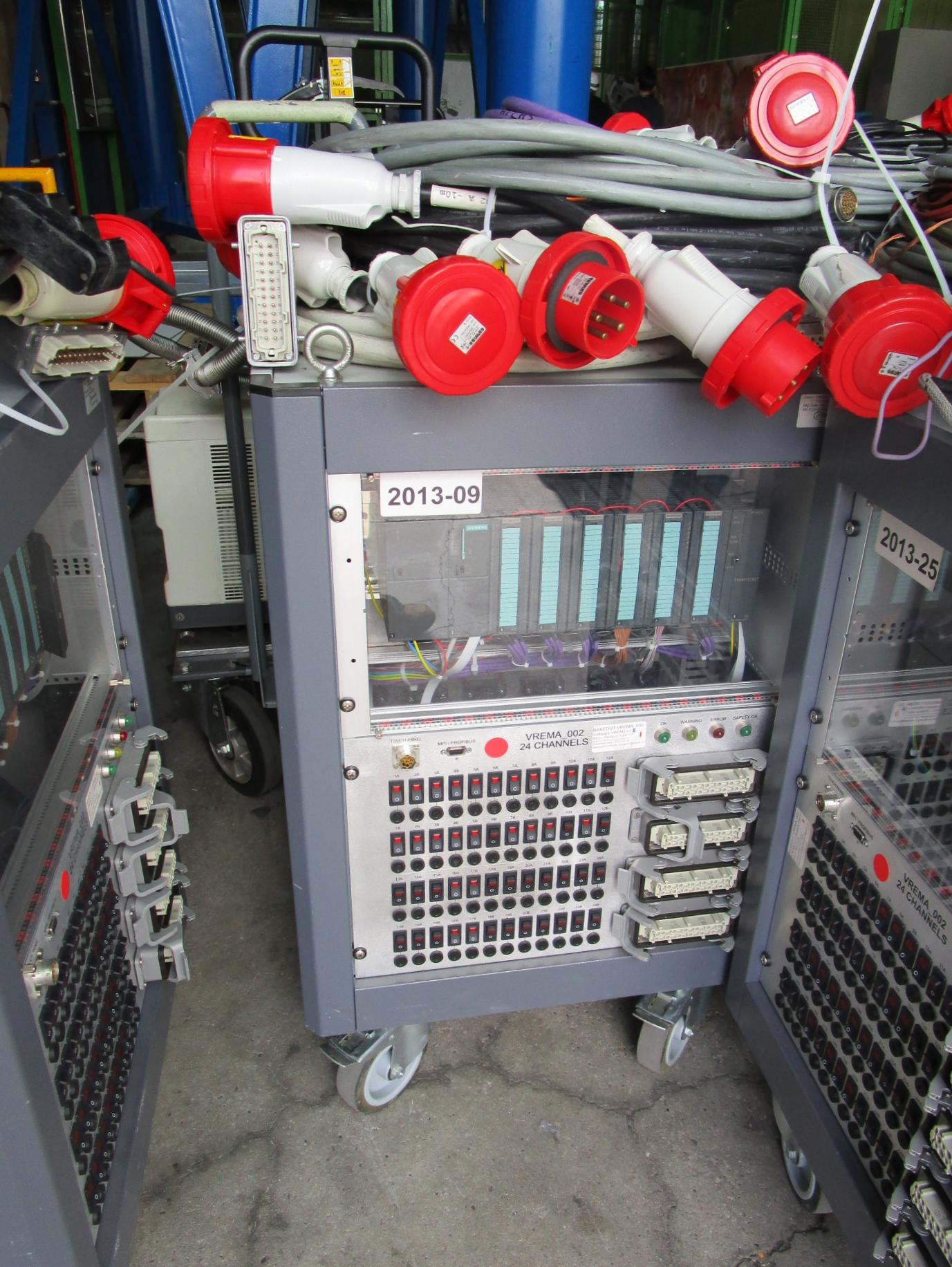 Aaand back up to the surface! Off in a corner I noticed some gear on carts, looked like data acquisition equipment. I just thought the connector were interesting — the big round ones are European-standard high power connectors, and the rectangular ones to the left are Amphenol parallel data connectors.
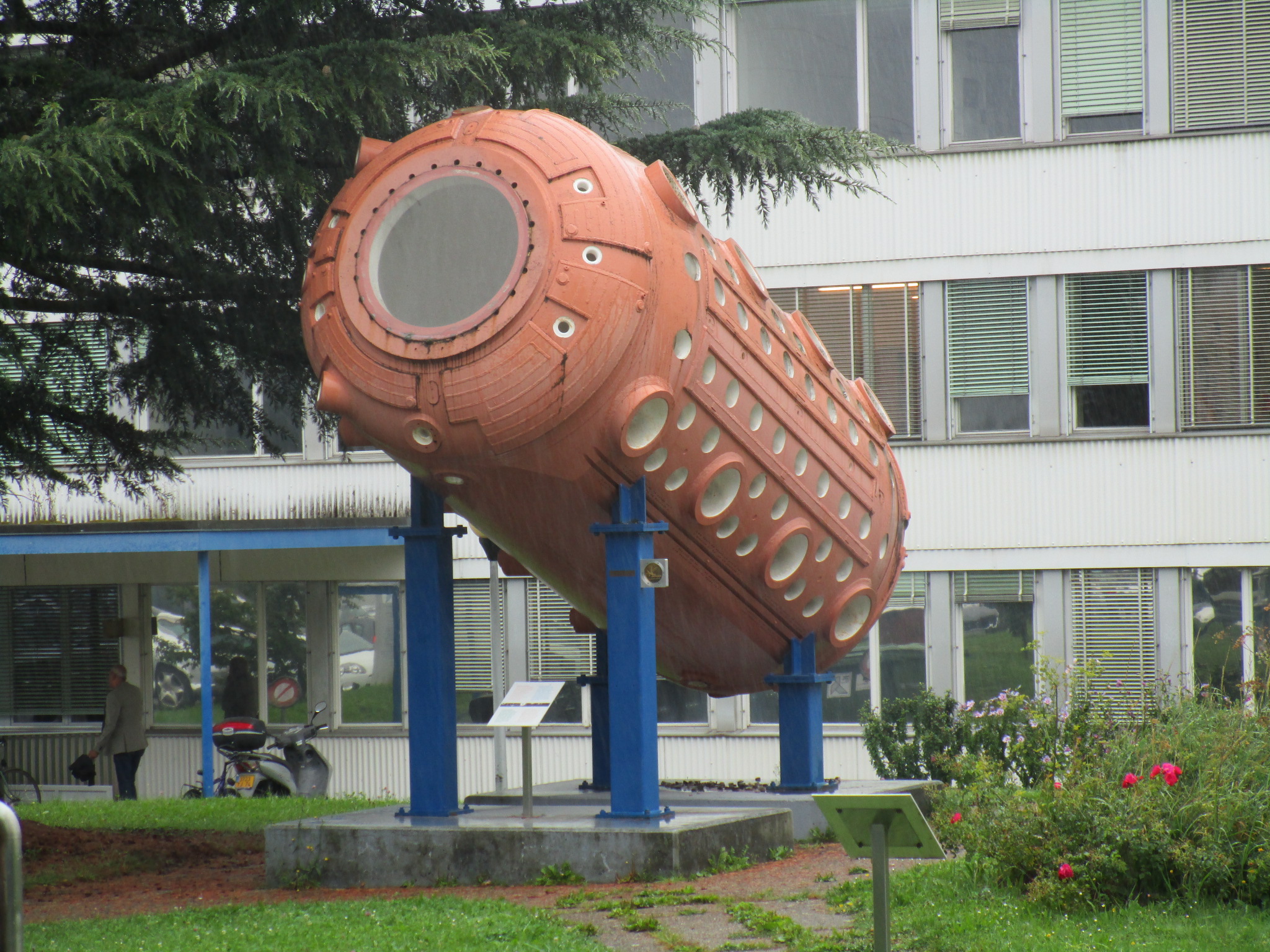
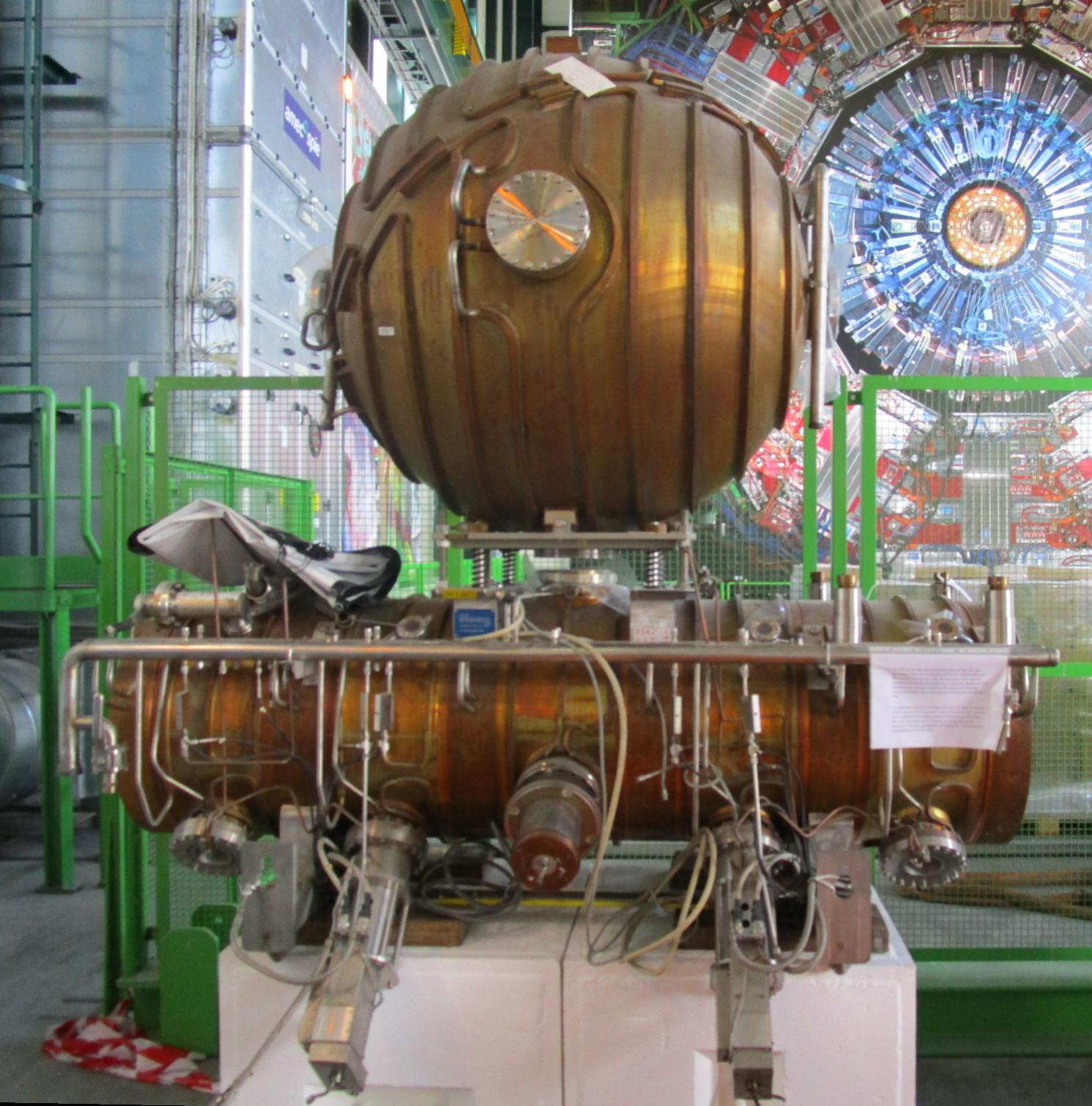 At the surface level, where they have a bit more room to spare, they have a few displays set up, such as this item reminiscent perhaps of a Jules Verne story, but actually an RF energy storage cavity for the old
 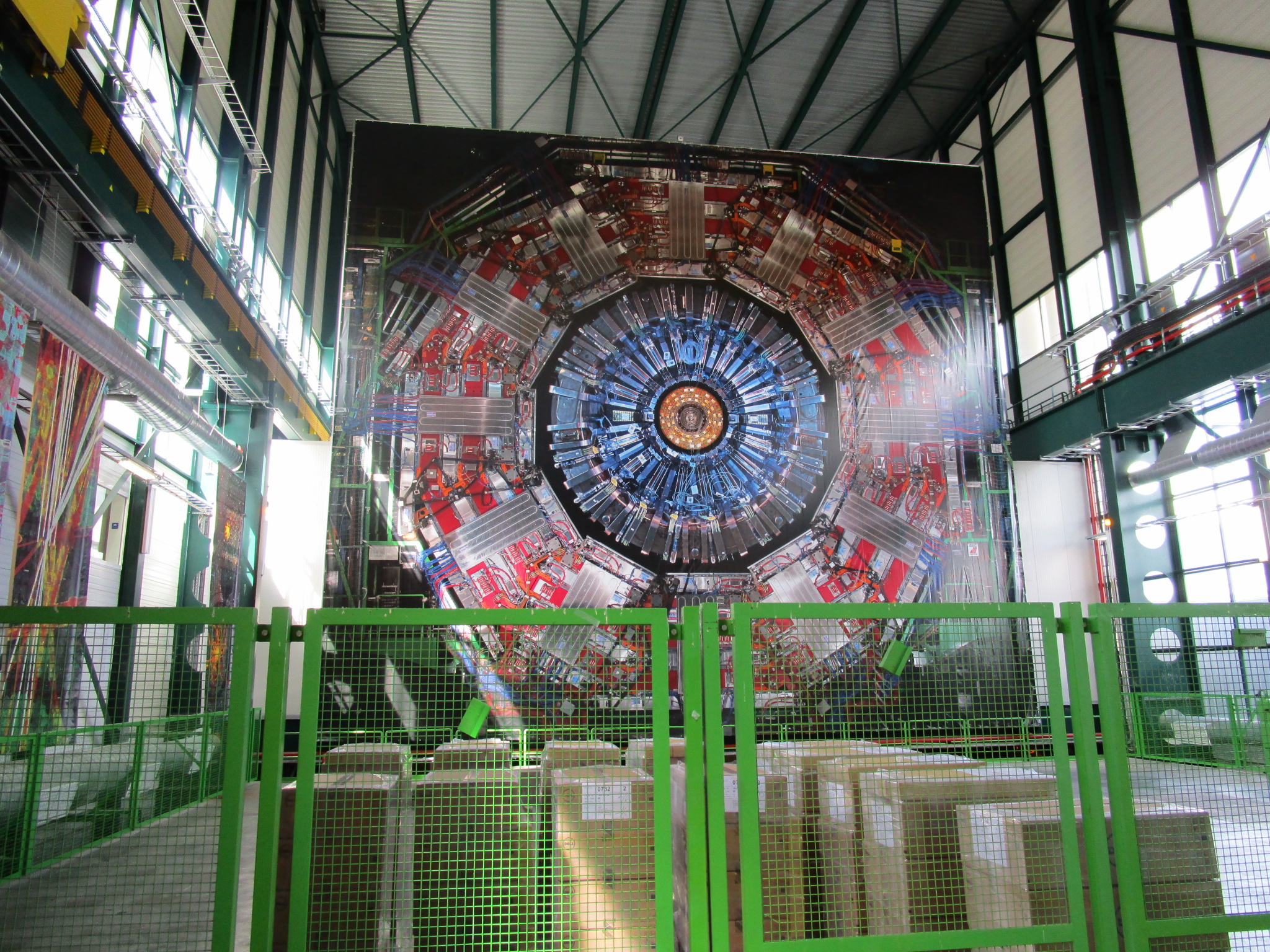 The assembly hall at the surface was sized big enough to put together the major components of the experiment, which were then lowered through the access shaft. This picture shows the end of the hall with a gigantic life-sized picture of one of the components, before it was lowered, showing how it did literally barely fit in the hall (and the shaft, and the cavern).
 Our last stop at the CMS complex was to visit a modest exhibition they had set up showing the various components. Here you could get up close and personal with the parts. In this picture you can see the scale of the superconducting magnets at the very center of the beam.
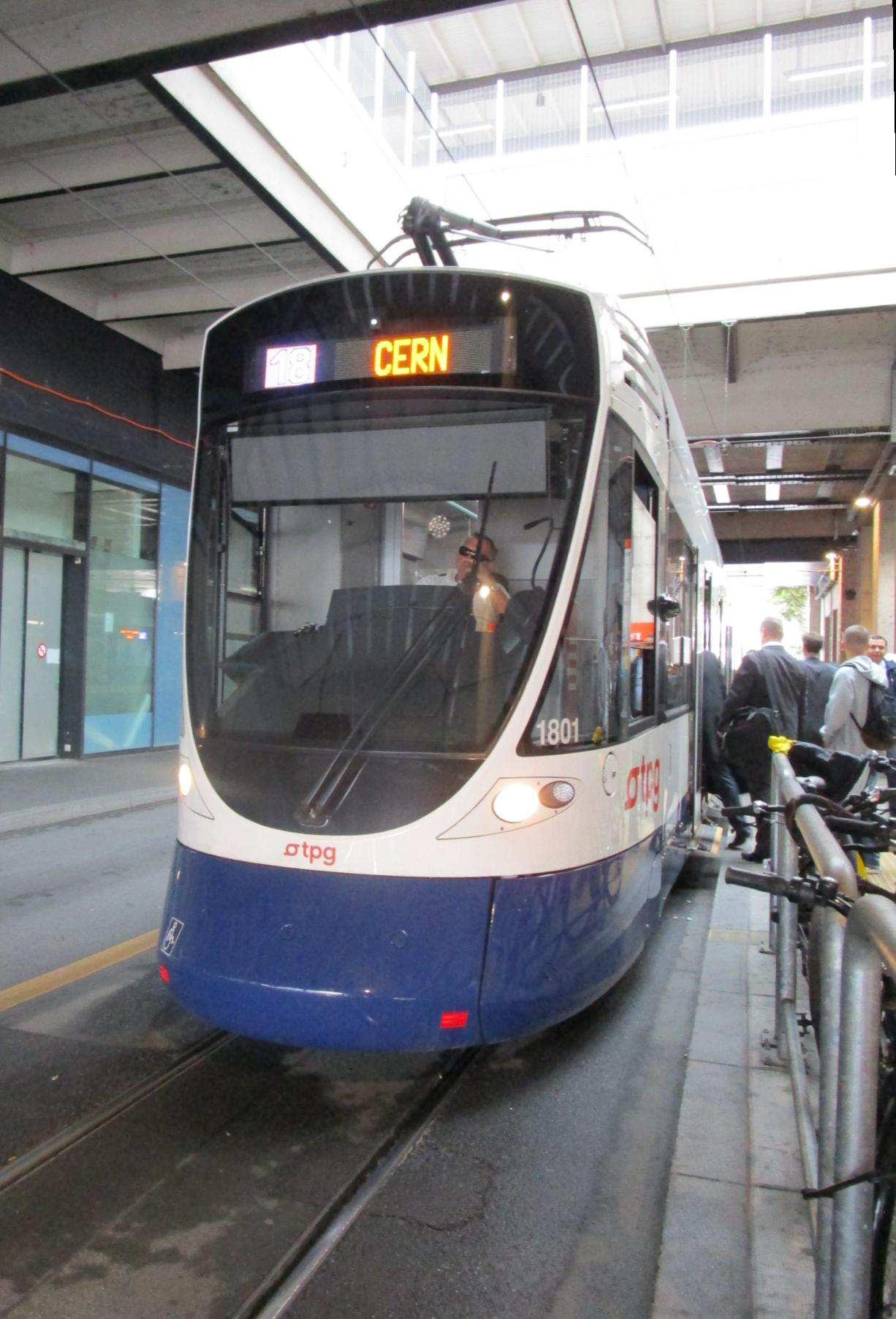 At long last, the day had come: I was going to visit CERN. For 50 years, the
 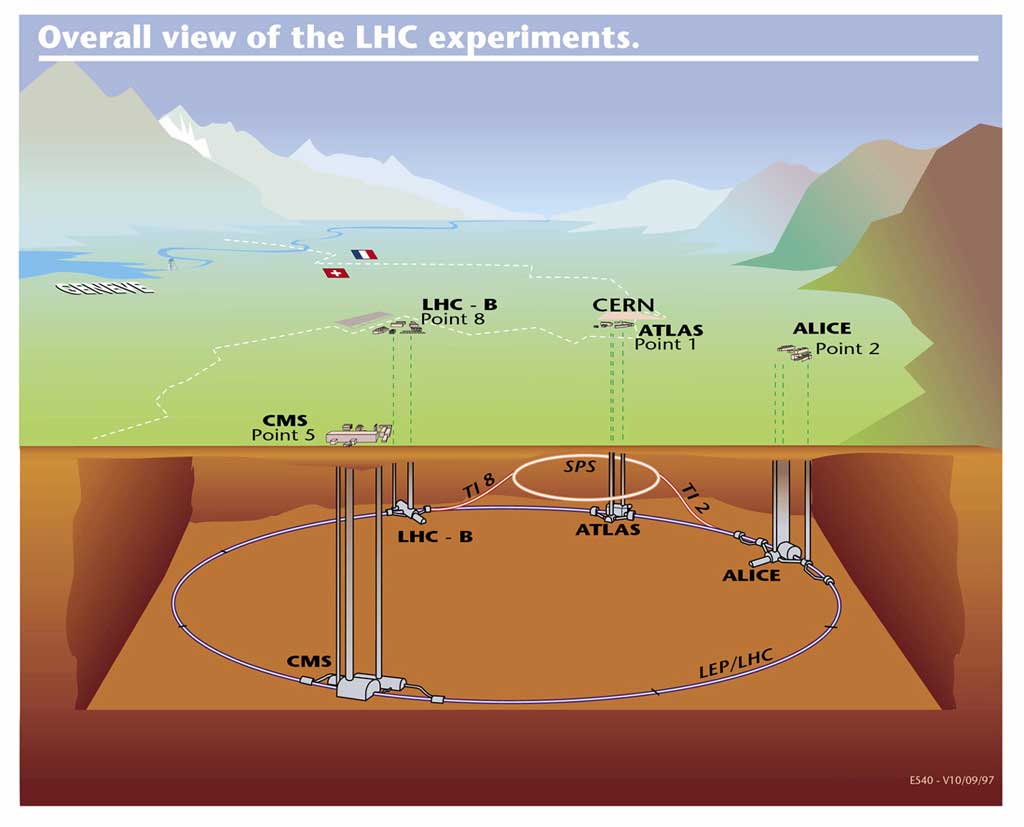 From the 1950s through the 1980s, CERN operated a series of accelerators, starting with a 600 MeV ring and ending with a 62 GeV system. The “eV” in there stand for “
 In 1989, CERN started up the
  In 2000, after years of planning, they shut down the LEP and started dismantling it. In its place, in the same tunnel, they would build the
  The United States had planned to build a similar particle accelerator on the same principles, but one that would have utterly dwarfed even today’s LHC. It was called the
  I should mention that it’s not just the “eV” power of the accelerator that matters. How those beams get focused, and how the data gets analyzed, are also crucial performance issues that drive how productive an accelerator is.
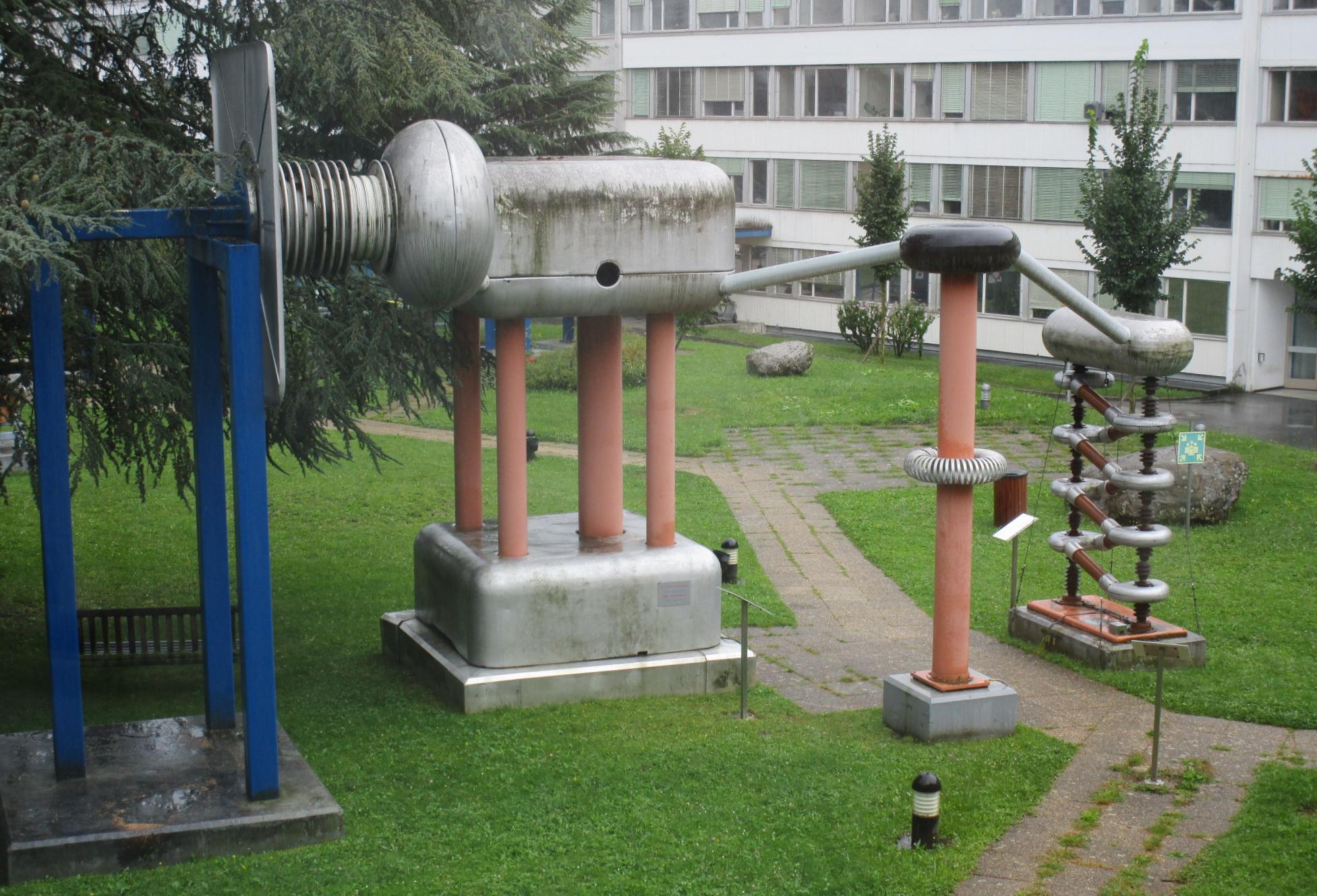
 The public face of the CERN complex is a surprisingly modest visitors center, but it hides a large museum, containing seemingly every artifact of 50 years of exploration at the smallest scales. Hardware of all shapes and sizes, displays and movies that explain what they do, examples of how computer storage worked back in the day … In a courtyard that we couldn’t get to, but could see through the windows, they had all sorts of impossibly exotic gear mounted and displayed, literally put out to pasture outside. Signs, signs, I have to read the signs!
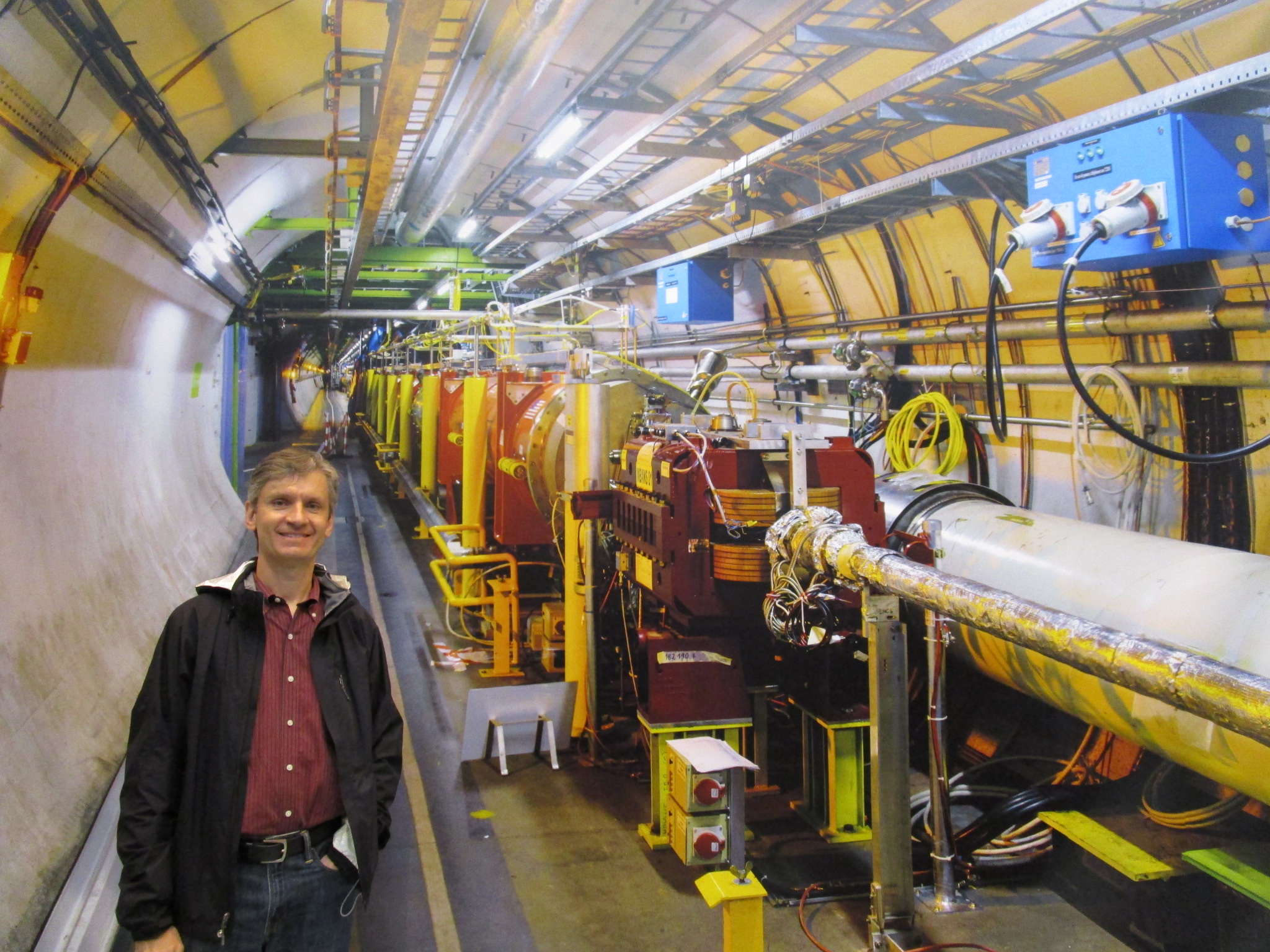
 Being able to see the tunnel was actually quite a unique opportunity. As a high energy physics experiment, when the beams are running, it’s quite radioactive in the tunnel, and nobody is allowed in there, not even workers. Like a nuclear power plant, everyone clears out of the tunnel and they seal the doors before starting the sequence to fire up the machine. Well, 2013-2014 was a major period or planned downtime, when they would be really shutting the machine down, and basically taking it apart and refurbishing it. So during that extended downtime, they were letting the public get even closer to the equipment than they normally would. However, the shutdown was coming to an end, and some parts of the tunnel were already off limits to even CERN workers. This timing is why I made the effort in the first place to get to Geneva on this trip.
 The CERN folks corralled us onto a bus and we headed off into the Swiss countryside. Well, actually, the French countryside, because right after pulling out of the parking lot, we crossed the Swiss-French border. There hasn’t been any border control in most of Europe since the Schengen Area was agreed to in the mid-90s, which the Swiss finally joined in 2008. So there are all these abandoned border posts, and we just drove right through it.
 Our first stop would be the LHCb. At each of four points around the 17-mile ring, CERN built a massive underground cavern around the precise spot where they would collide the beams. With a 7 TeV beam going in one direction around the ring, and a 7 TeV beam going the other direction, they would have 14 TeV collision energies, and the cavern was built to house the colossal machinery that would be needed to detect and measure the sub-atomic bits that came flying off. The “
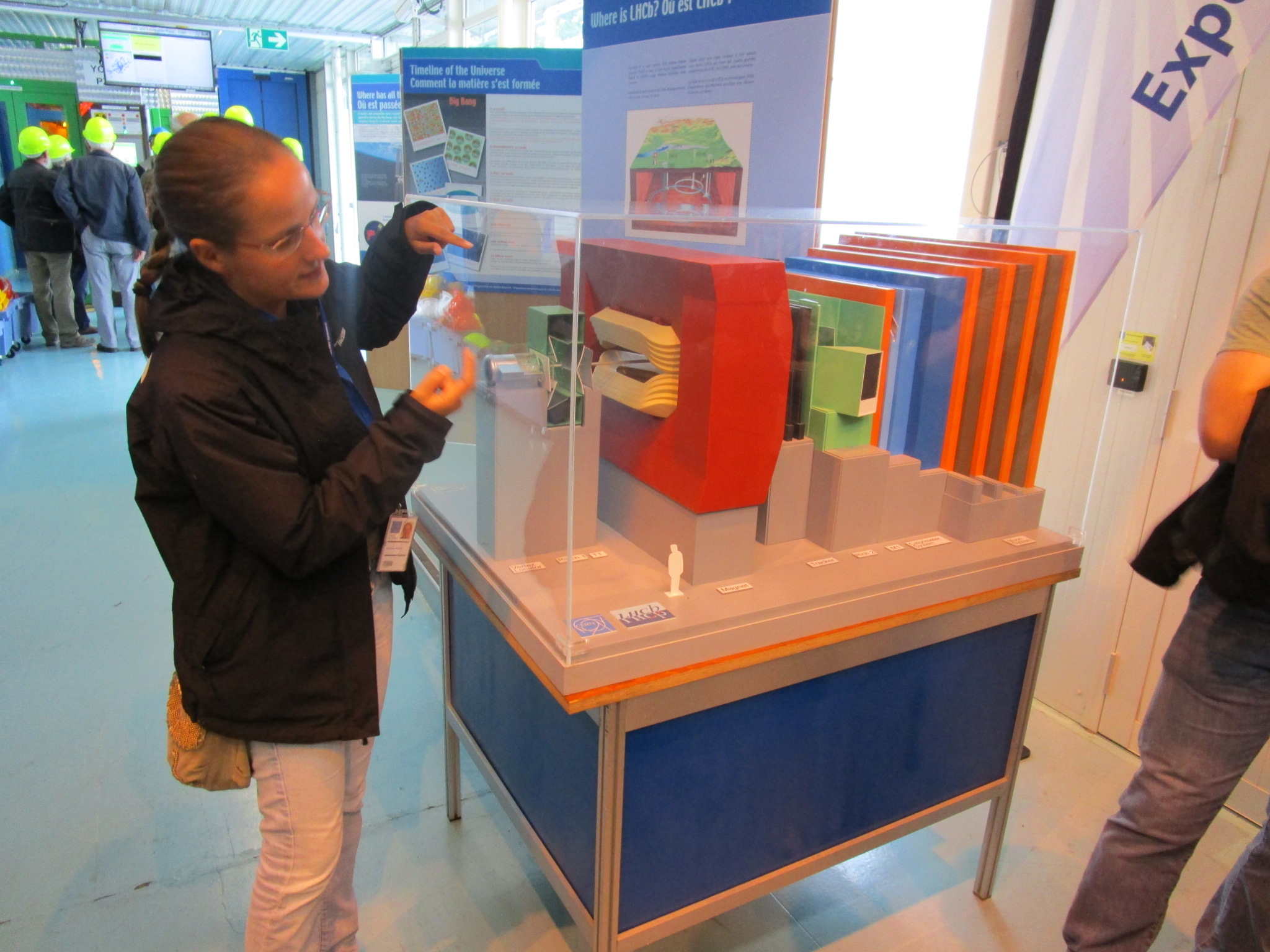
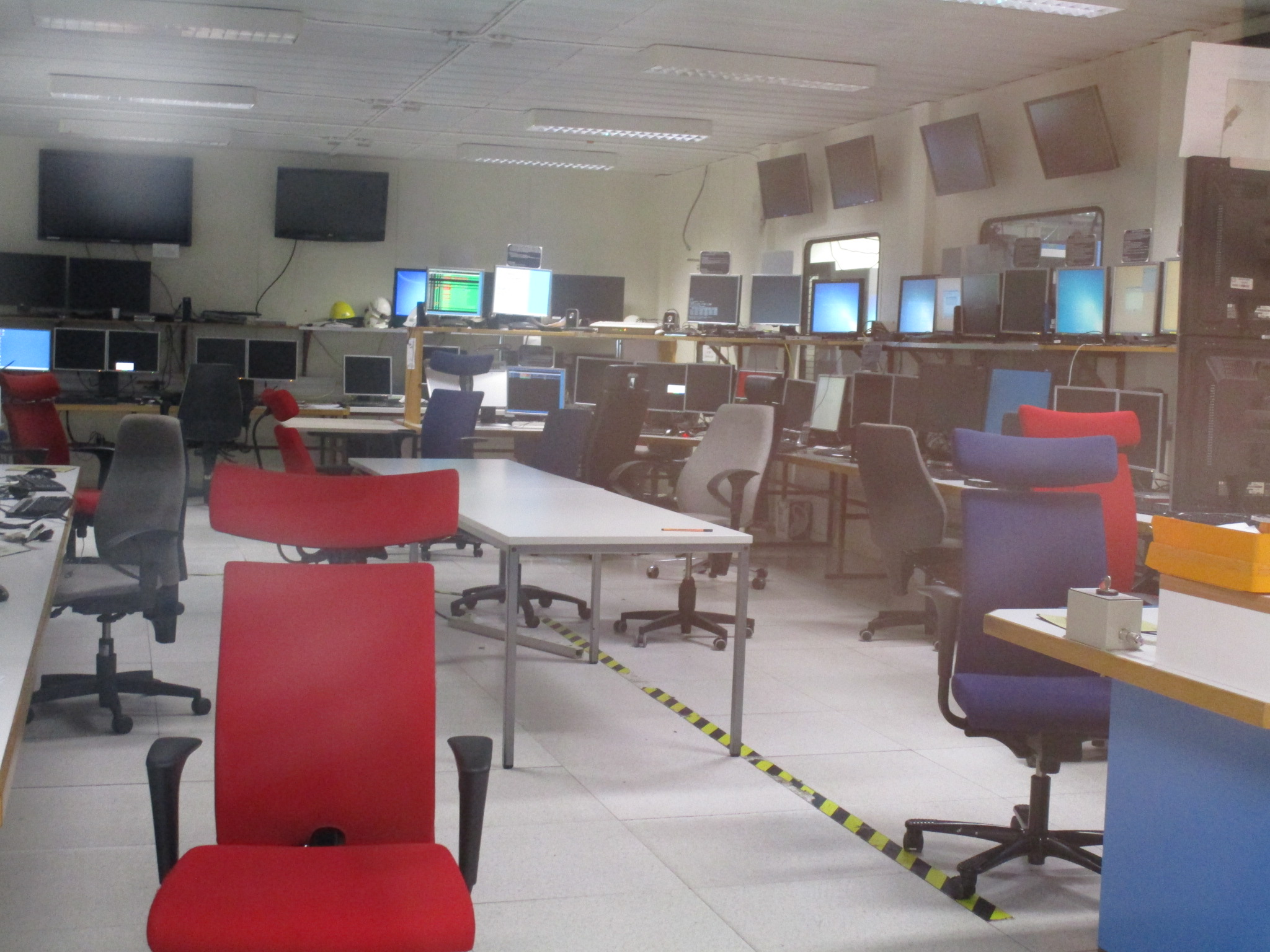 Our tour guide was a young Polish physicist named Agnieszka, and she led us first through the small displays they had set up in a waiting area at the surface level. The bulk of the machinery was below us, but they still need a hall at the surface to stage material and raise from / lower to the tunnel. Also up here was the main control room, unmanned because of the long-term shutdown, but which would be humming again soon enough.
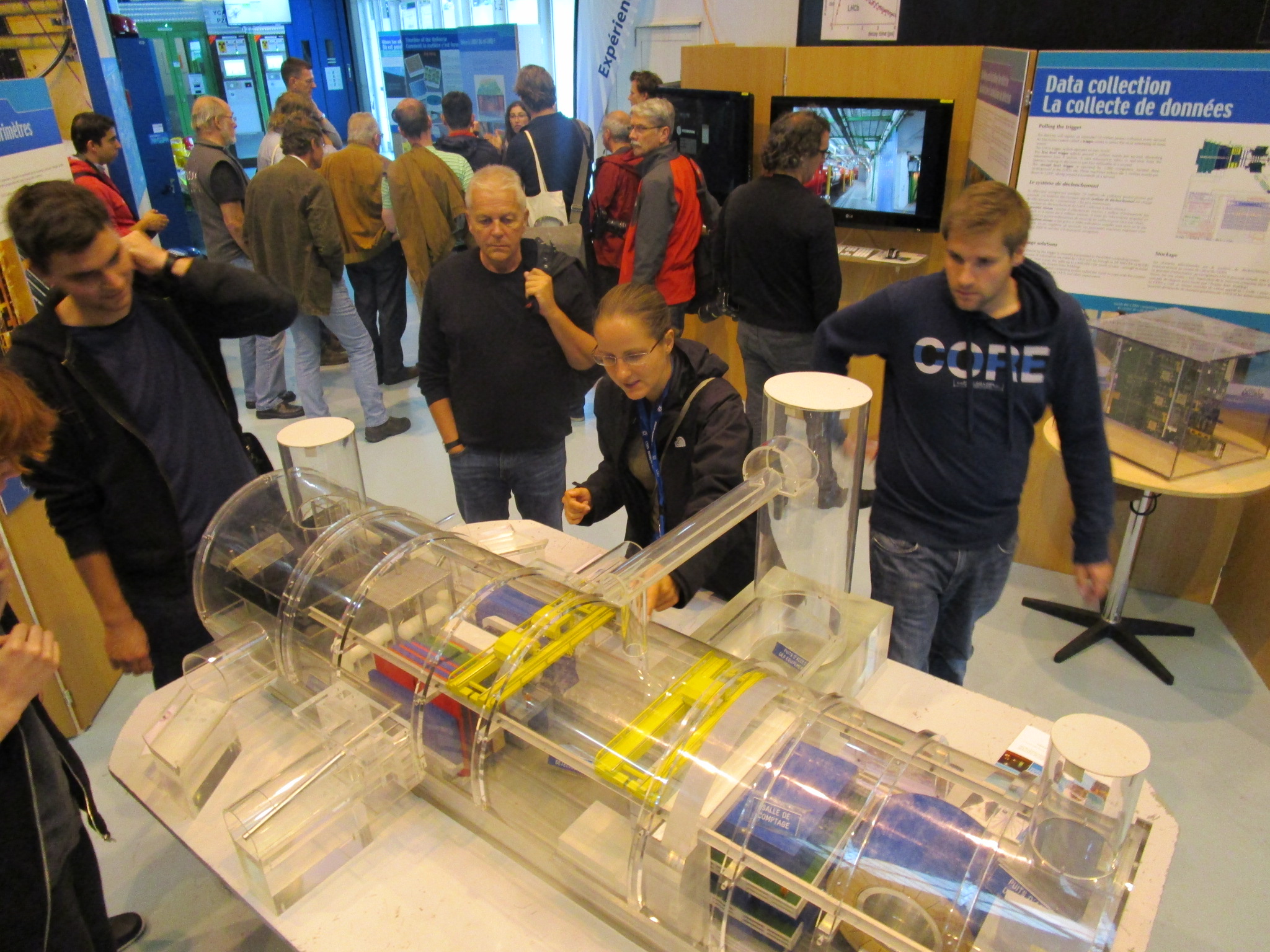 Right about this point is where I realized something horrible: my battery camera was almost dead. I had obviously been planning the logistics of this visit for a very long time, and I had packed extra camera batteries and made sure to charged them up. But I had left them at the hotel! Oh shiiiiiiiiit. I was about to into the CERN tunnel, and my camera would be dead!
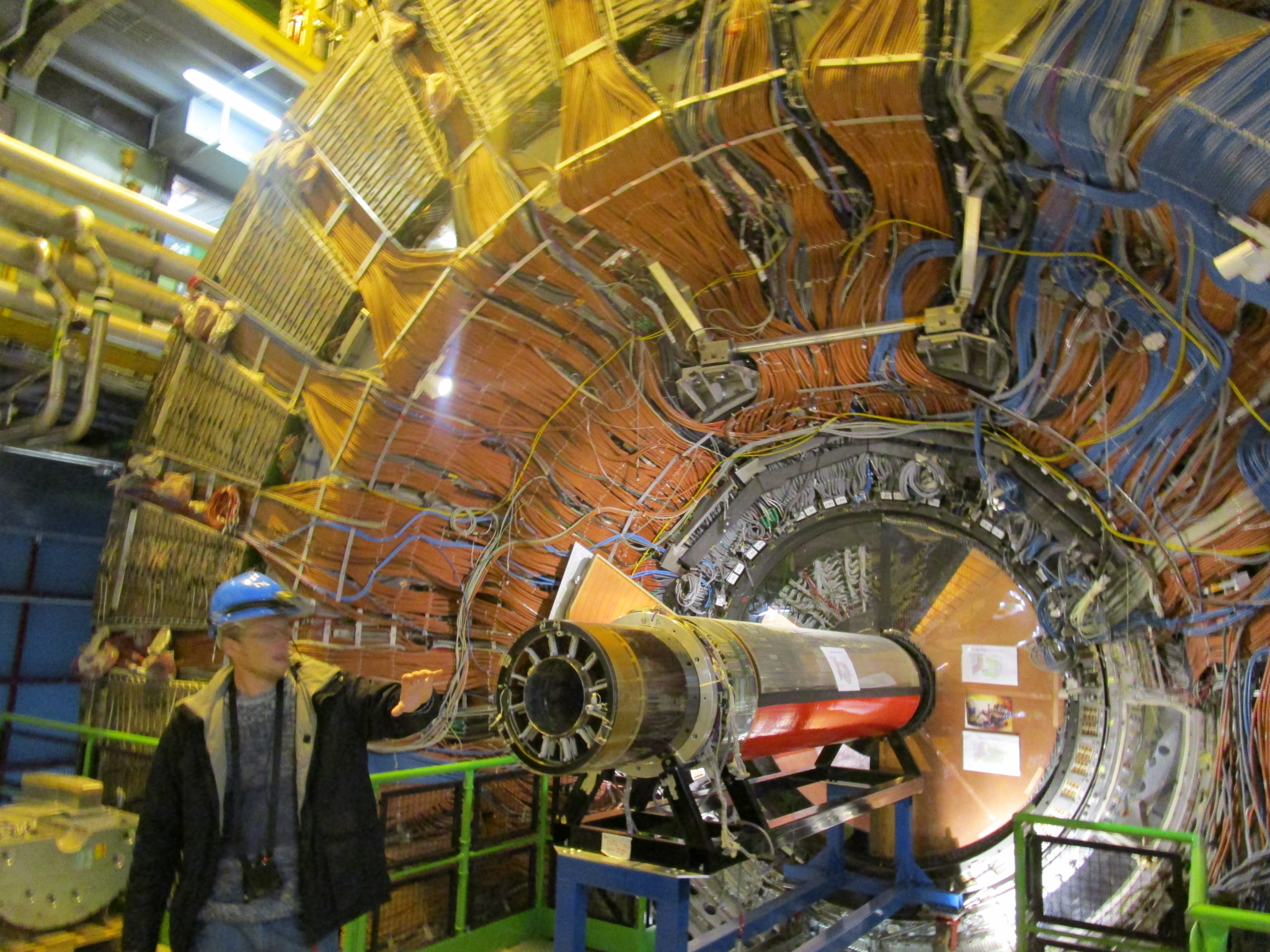 Agnieszka handed us off to her colleague (and fellow Pole) Rafal, who would take us down to the tunnel. They handed us all hardhats (color coded to our tour group) and had us go through the security checkpoint. This was basically a fancier version of what you go through at the airport, or what I used to do when working in nuclear power plants.
 ad scanned through, we got into a freight elevator and went down.
 eet high, with metal lattice work forming multiple levels (stories) for workers to use to access equipment. Our first stop was in a side section of the cavern containing a monstrous instrument left over from the LEP days. This same cavern had been used in the LEP, and when they dismantled that system and started building the LHC, they had room in this cavern to just shove this instrument off to the side. Since it obviously had been decommissioned, we were allowed to get up close and personal with it.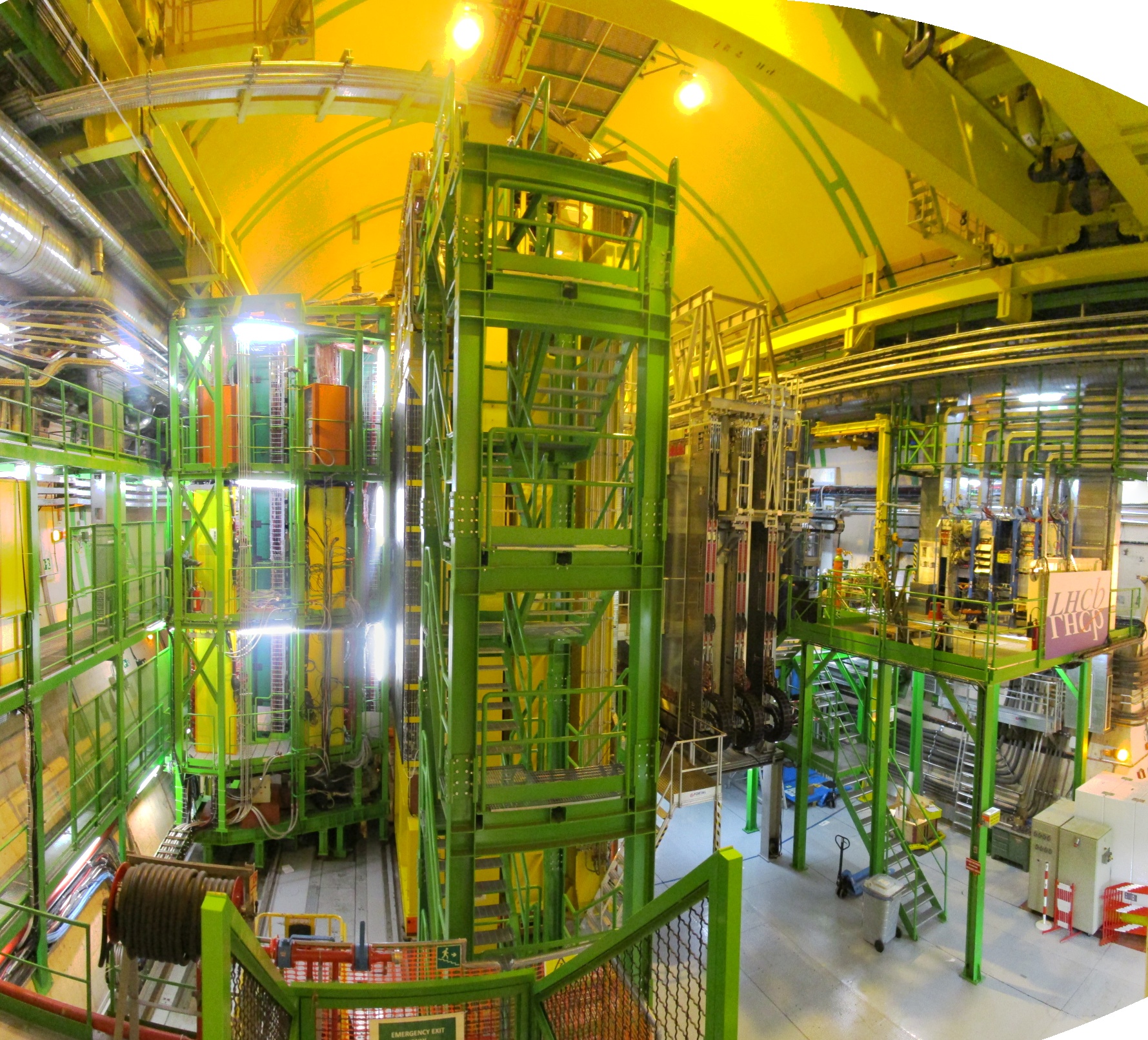
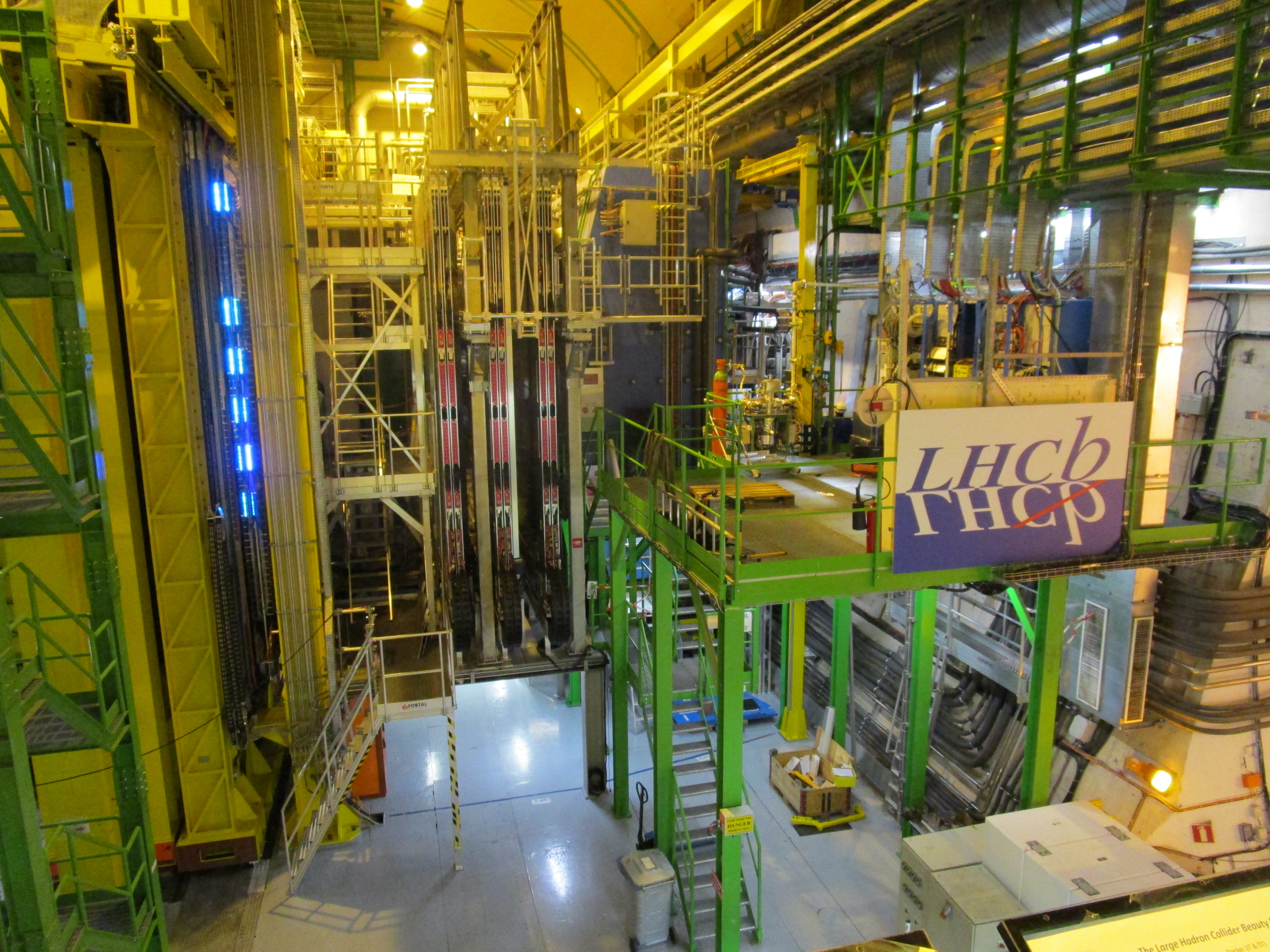
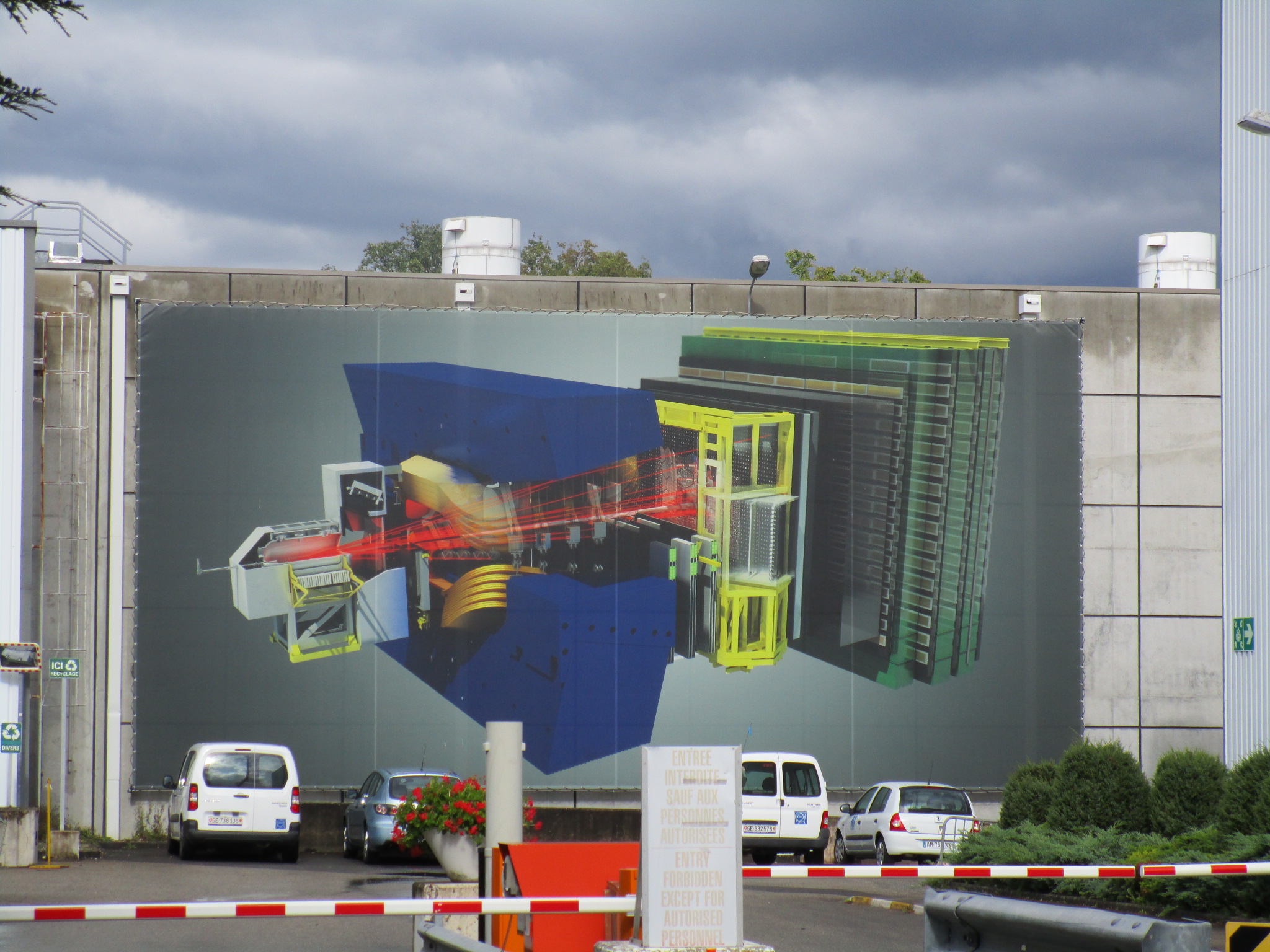
 y and (cue angelic choirs) the LHCb experiment! This machine was basically a horizontal stack of vertical layers. The beam would come in from the right, the collision would occur in the right side of the cavern, and the particles would spray off to the left, through all those detector layers. If you scrutinize the smaller LHCb photo above, you will see a man wearing a yellow hardhat. Go to the upper left corner of the blue and white “LHCb” sign, go to the left past the white circle with the red object in the center, and just to the left
 of that you’ll see him.
 oster of the women working on LHCb. Girl Power! Also, note the Comic Sans, which is a bit of
  “border”, back to the visitor’s center.
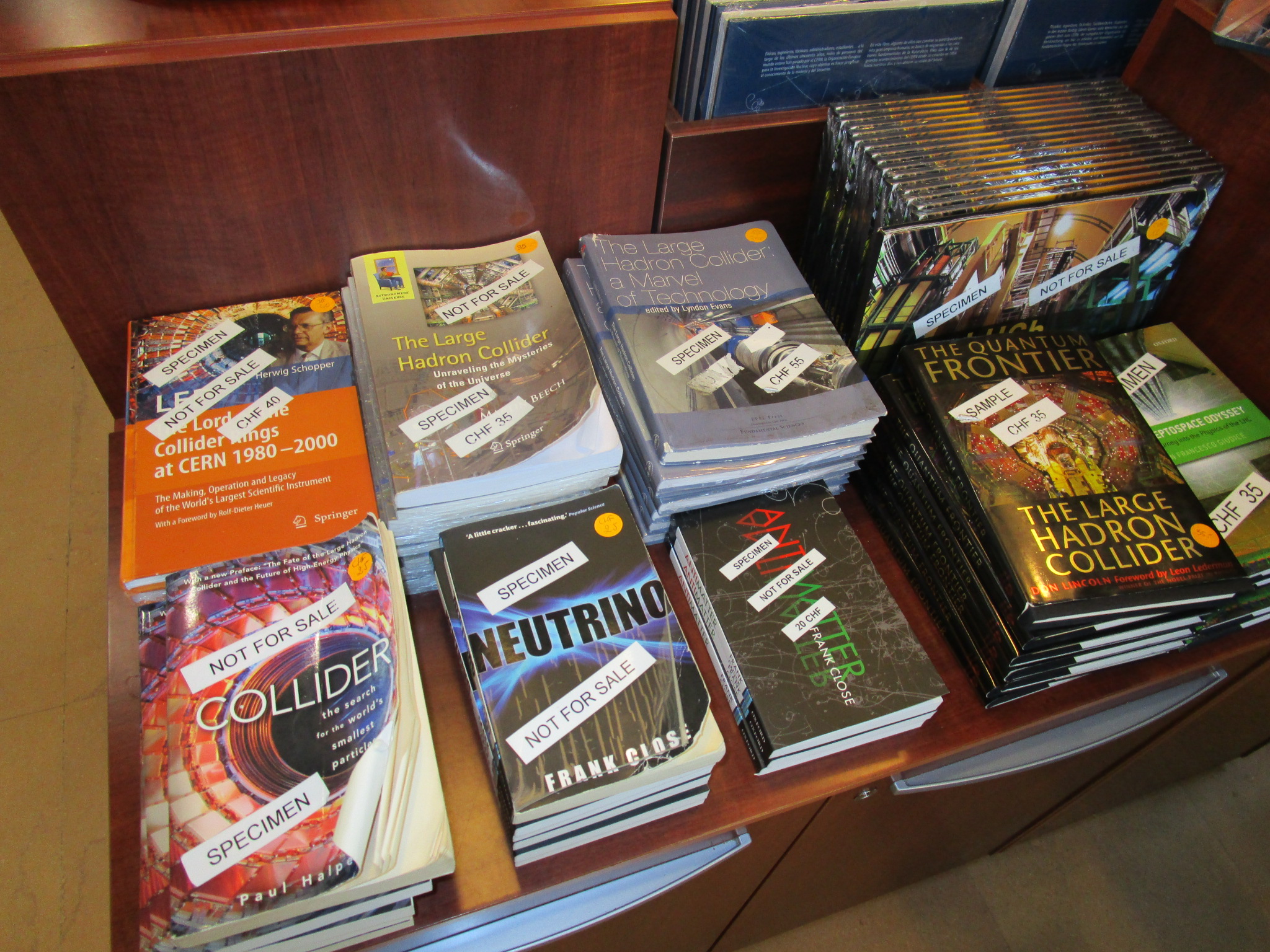 he gift store! The store was tiny (by US standards) but chock full of the most incredible books and science tchotchkes. I literally would have bought everything in the store, but everything was going to eventually need to fit into my suitcase, and later in this same trip I’d be lugging this suitcase onto a sailboat … So I bought some more compact items, took pictures of the bulkier items for future wishlist purposes, and headed back to the hotel.
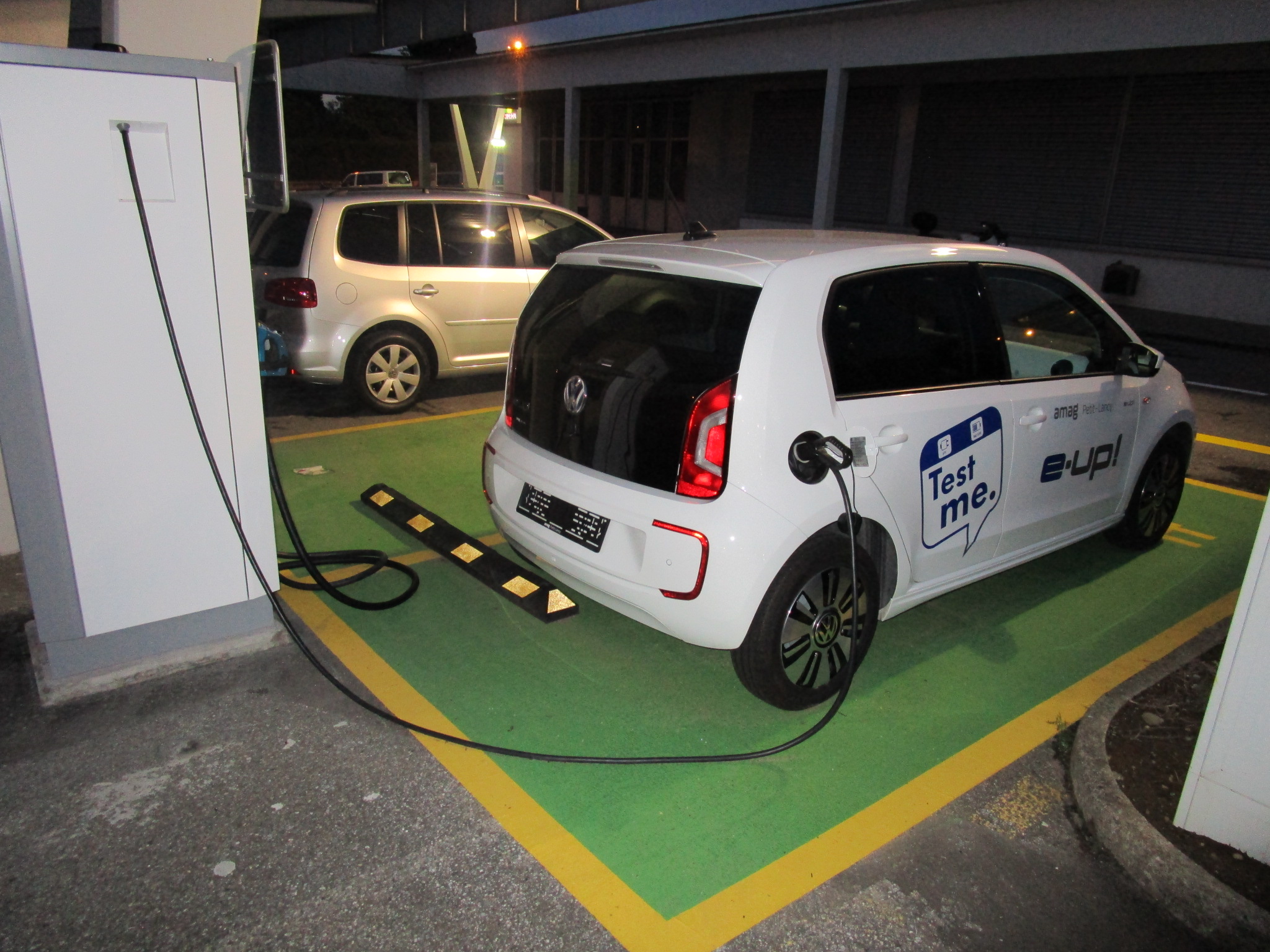 After resting at the hotel for a bit, and soaking up some internet, I struck out on an evening jaunt. One of the first high-power EV charging stations had supposedly been installed in a suburb just west of Geneva. The streetcars didn’t run out there, but the busses did. So, in the failing light of mid-evening, I literally got off a bus in the middle of some strange residential neighborhood and hunted around for this charging station. Walked up and down little alleyways, through parking lots, all over the place. In the end, the charging station was located a good bit away from the map marker I was chasing — at a Volkswagen dealership, duh. But I found it!
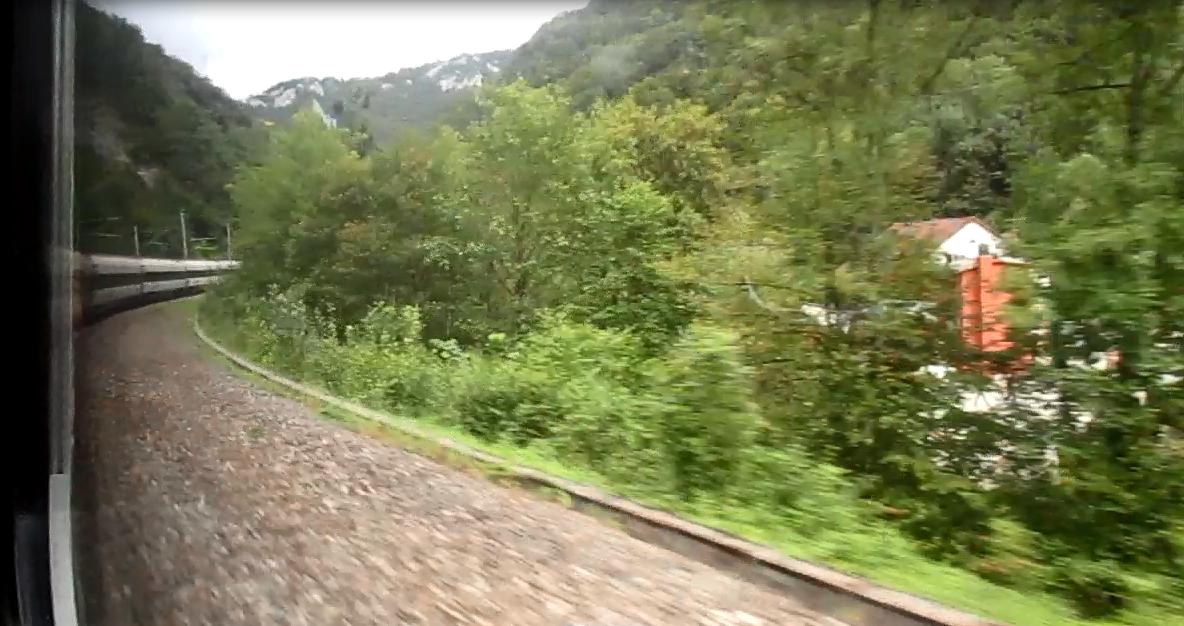 Next stop, two hours later, was the Swiss city of Basel, just over the border from Germany.
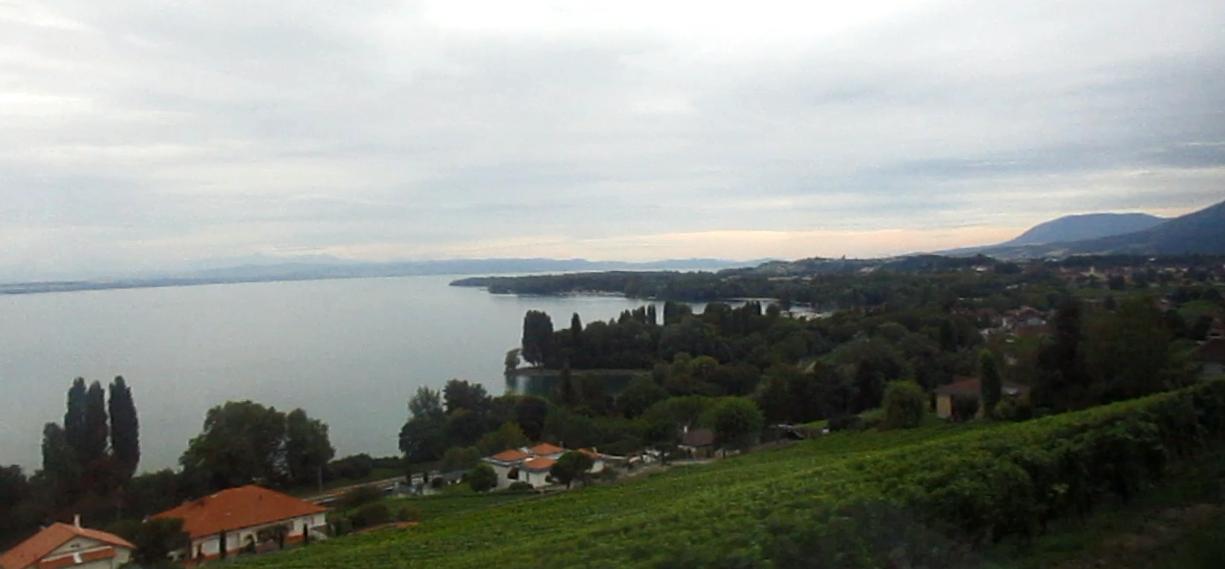
 One more train change and I was finally on the last leg to Geneva. For the last half hour or so, we rode along the north shore of Lake Geneva, and the good weather provided for impossibly beautiful views out the window.
 Which leads to another thing: the Swiss have not signed onto the Euro currency used nearly everywhere in Europe (insert monetary policy explanations here), instead sticking with their own Swiss Franc (CHF) currency. Stores will take Euros, but you’ll get your change back in CHF, which has a different exchange rate. Take that pile of strange coins in your hand, and couple that with the language barrier, and I suspect they routinely fudge the conversion numbers in their favor when giving you change. Geneva is already a very expensive city, and this only exacerbates it. Oh well.
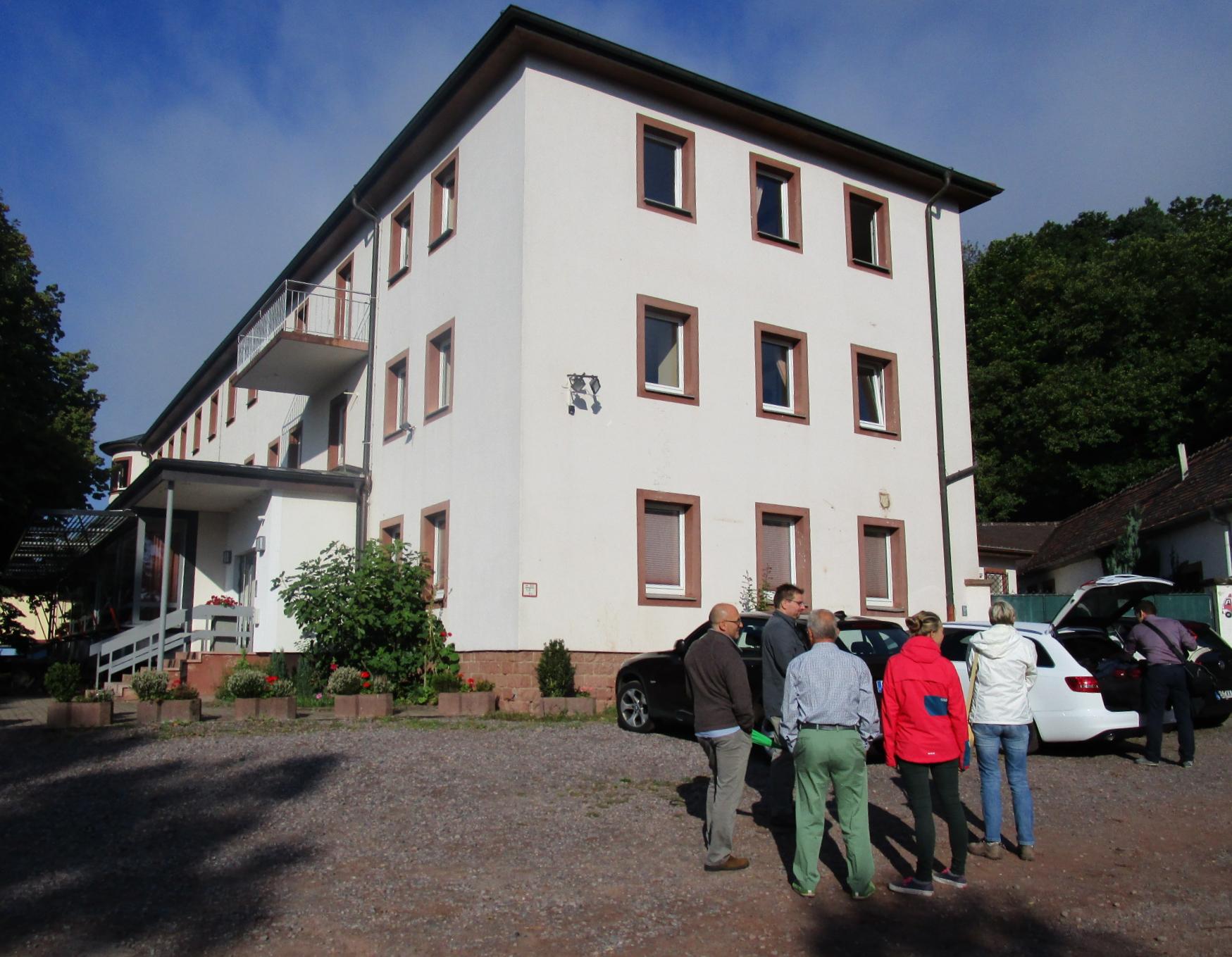 I survived the rough night and had a nice breakfast with the extended family in the hostel’s cafeteria. Actually, I took it easy on the breakfast, just sampling crackers etc., which was a shame since it was a typically luxurious German spread of meats and cheeses.
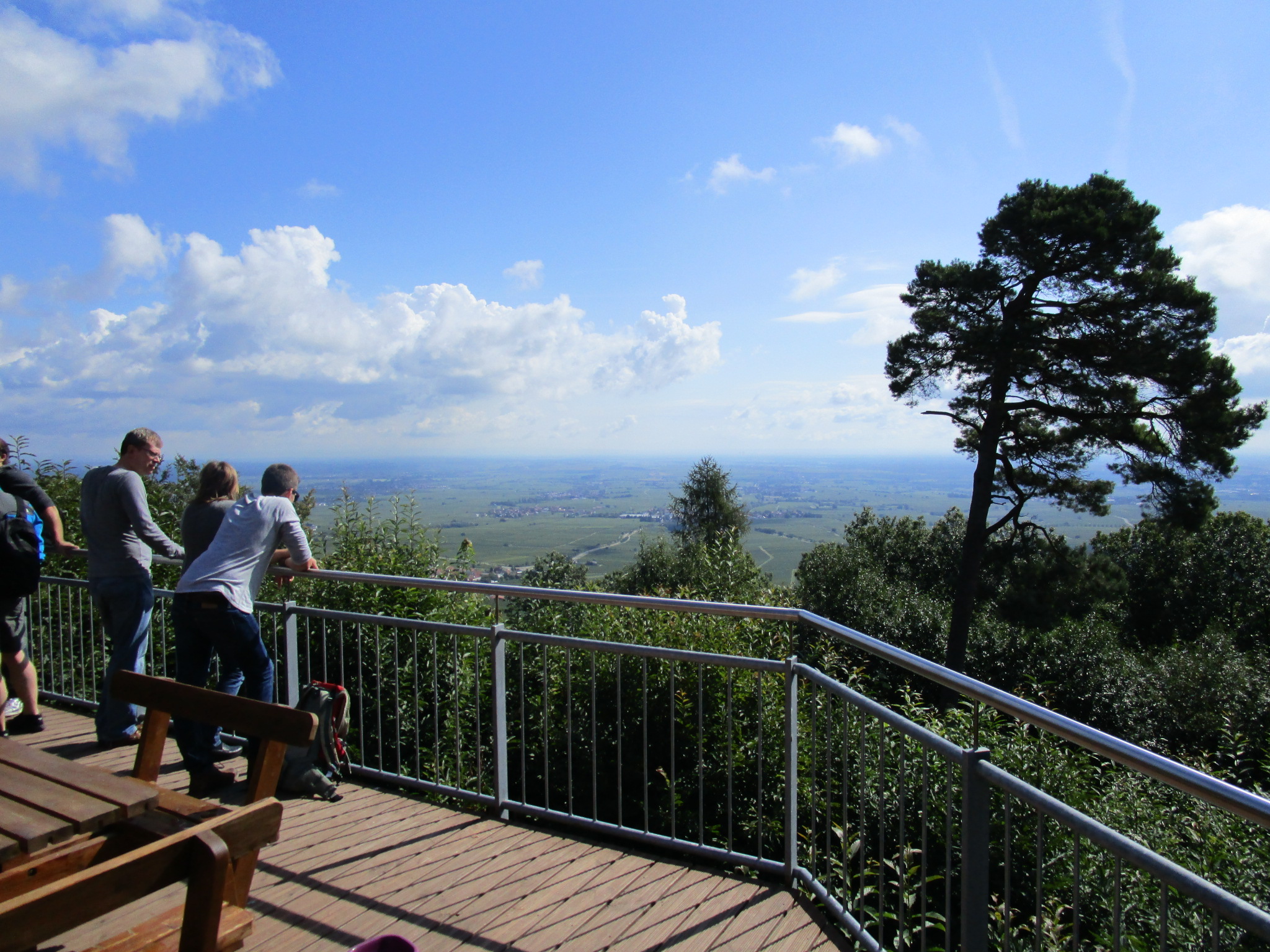 We gathered up the herd outside the hostel, took a few last pictures of the Trifels in the distance, and loaded up into the vehicles. Stefan’s planned activity for us this morning was to hike up the Ringelsberg, a small mountain nearby, which had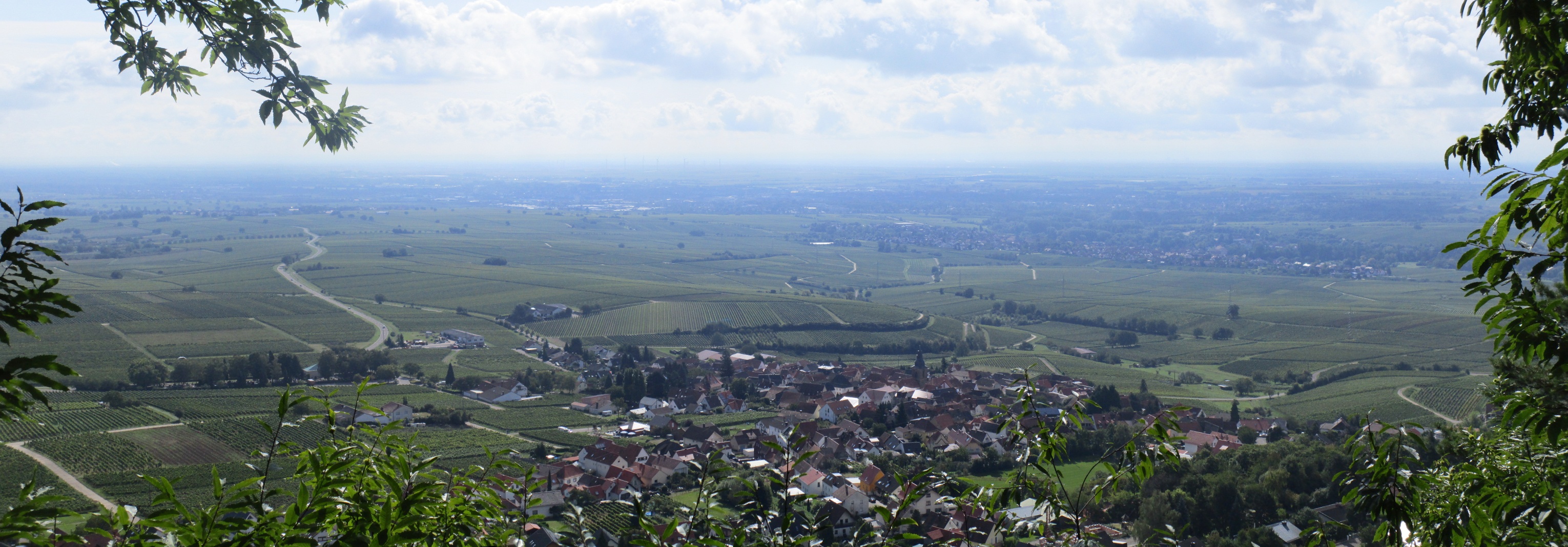
 If they’re not going on a long roadtrip somewhere, they’d rather just bike it or even walk it. Appropriately, the family business is a busy bike shop in central Heidelberg.
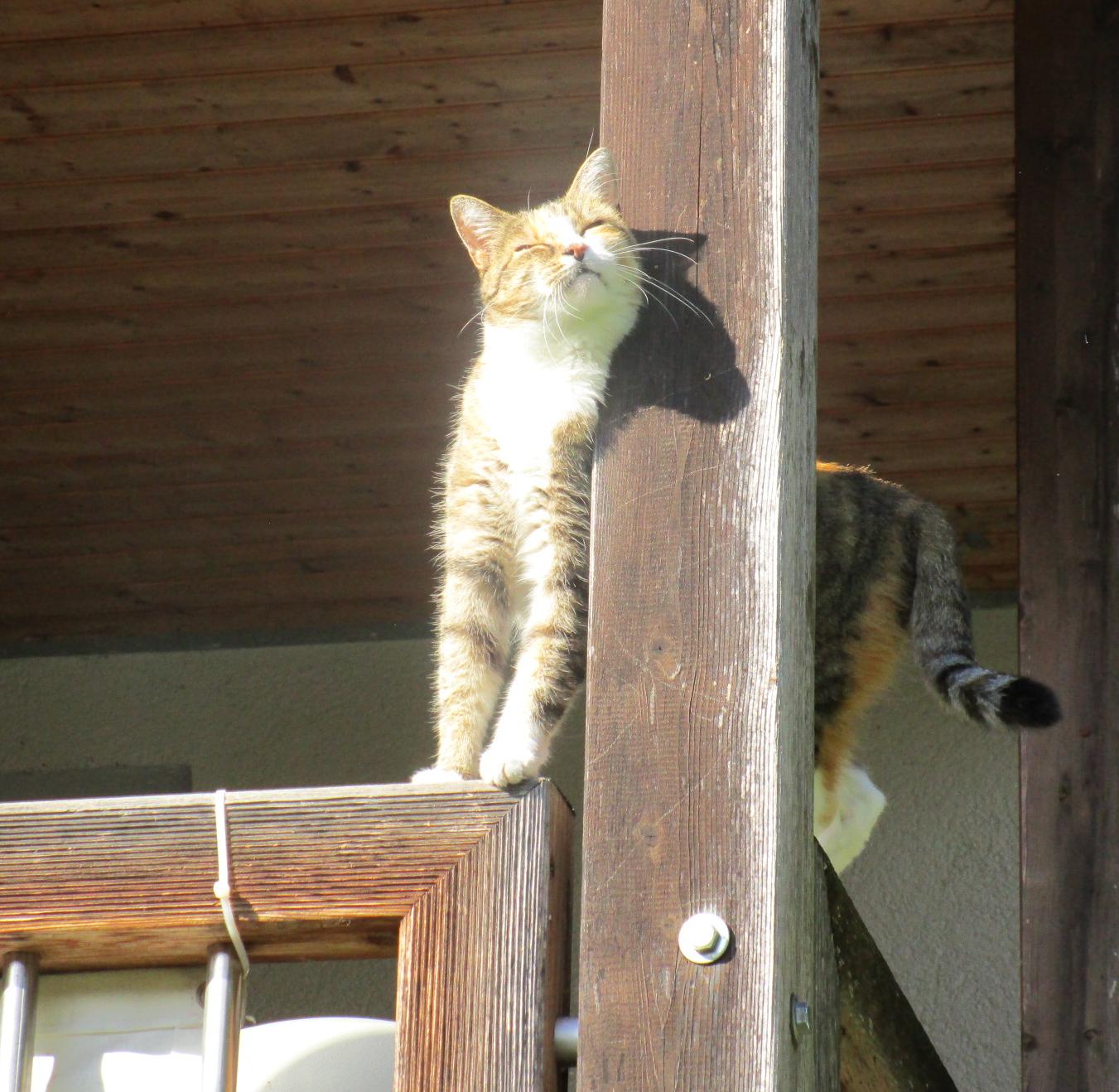
 So, naturally, upon arrival in at their Heidelberg house (greeted by cat), we had a snack and then promptly set out on a hike around the neighborhood. The city of Heidelberg is on the Neckar River, nestled between two ridges, one of which climbs up behind their house. So we hiked all around, starting with a visit to a property a few minutes away that Susann and Peter would be building a new house on .
 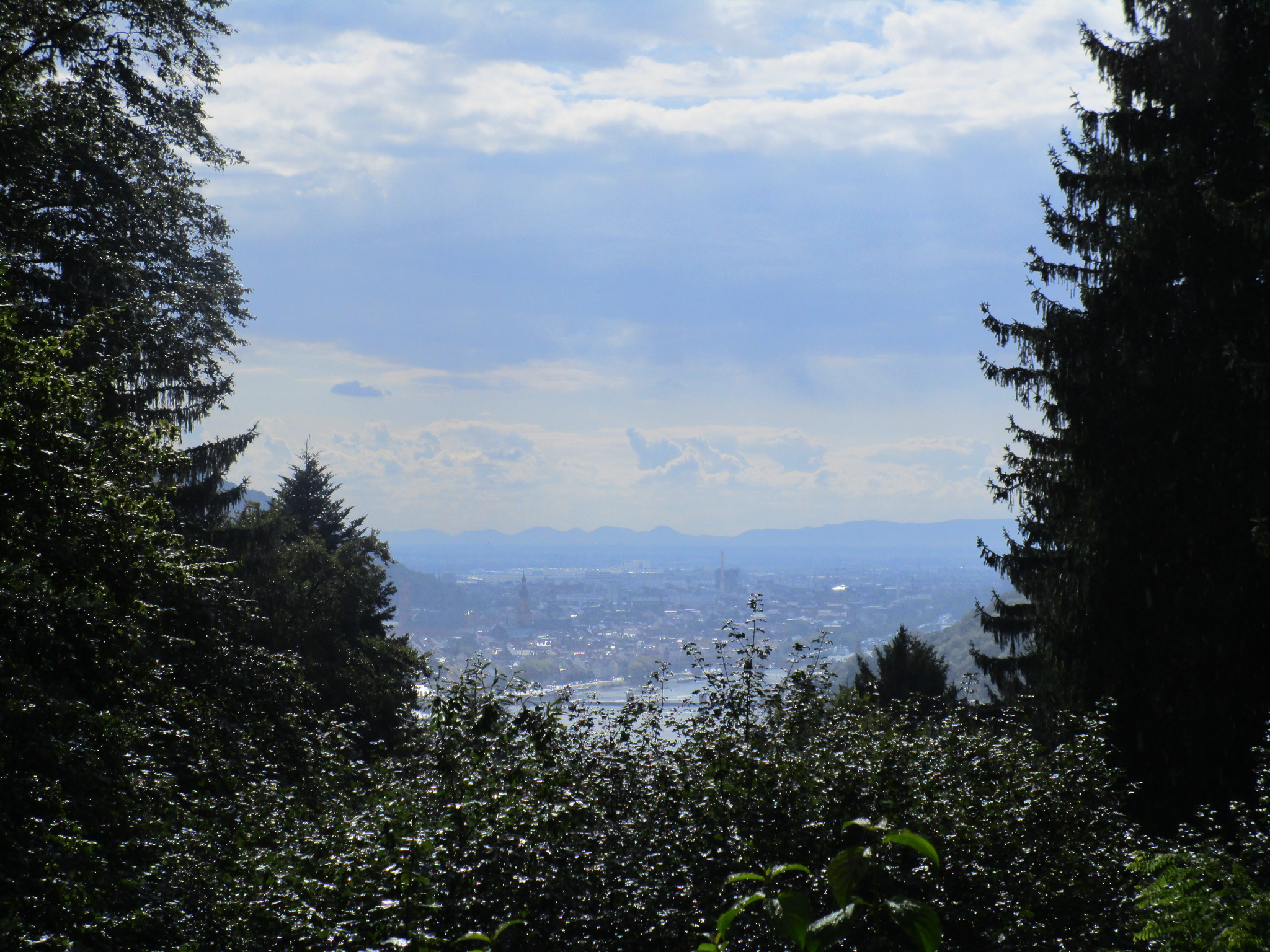 Continuing, we went up to the top of the ridge for a view, down past an old monastery, along the river, and generally had a great afternoon exploring.
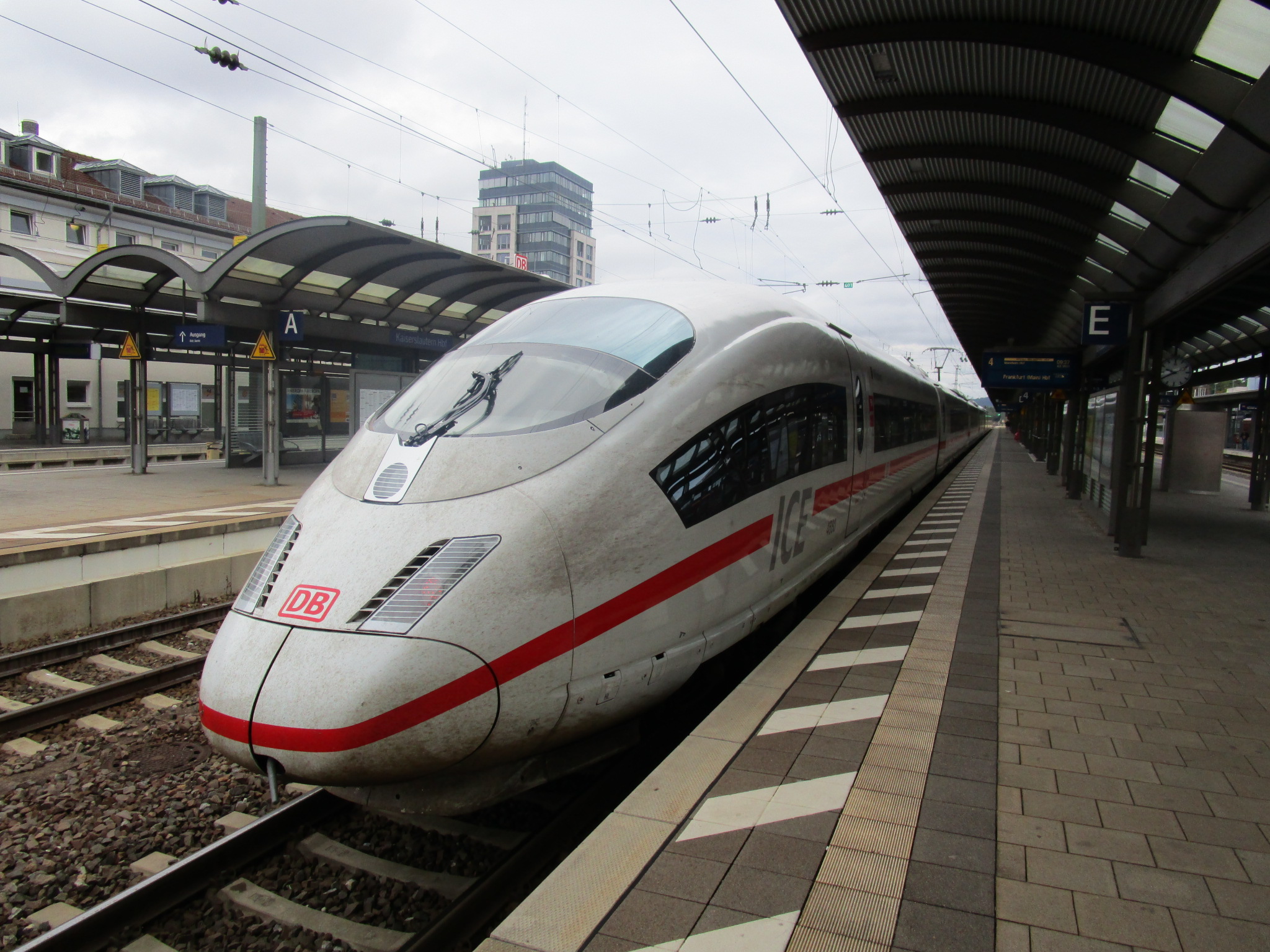 Booking a train that departed at 6am wasn’t going to be a problem for me, since I was going to be jetlagged and up by 5am anyway …
 Annweiler is a small town in southwestern Germany, very close to the French border, where my mother’s side of the family hails from. As a child of age 14, I lived in Annweiler with
  The extended family was gathering in Annweiler to celebrate my cousin Stefan’s 50th birthday. Stefan is the oldest of our generation — altogether there were (counts on fingers) nine of us born between 1963 and 1980, in two waves, as each of the three Conrad daughters had three children. Besides our generation, the older generation was fully represented, as was the younger generation, including the two latest additions Theodor and Lukas. I was the sole representation for the American arm of the family.
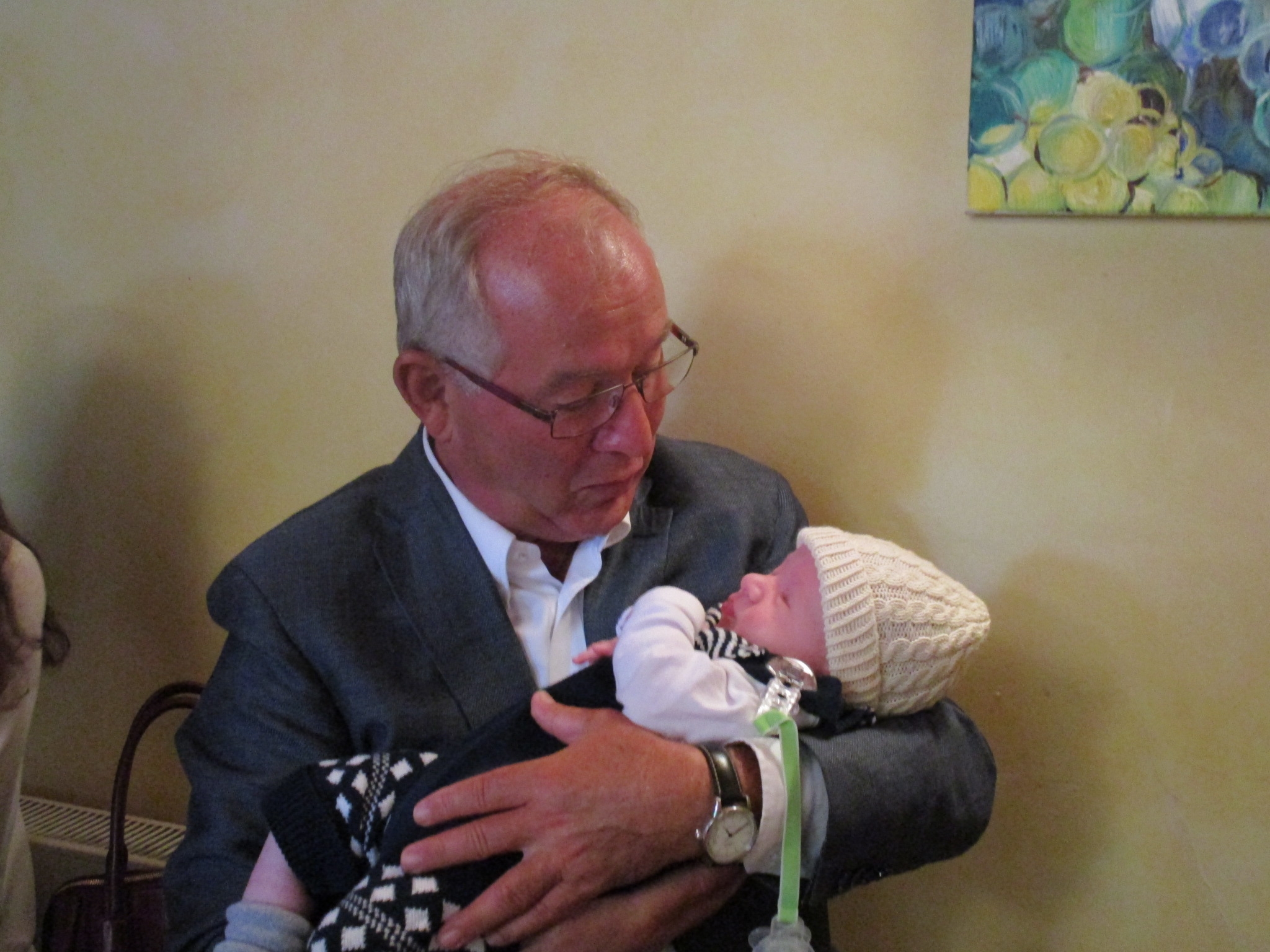 My first stop in Annweiler was to visit with Günther Frey. Günther is a longtime family friend, and by longtime I mean like over 50 years. He group with my mom and her sisters, and his wife Herma was my mom’s best friend growing up. Sadly Herma passed away a couple years ago. Renate joined me in visiting with Günther, which was very helpful because my German is always very weak at the beginning of these trips, and so she helped translate as needed. Günther looks to be in great health and it was amazing to visit the Frey household (one that I’d been in as a teenager) and catchup on the status of his children Anja, Klaus and Ulrike, now all grown and with kids of their own.
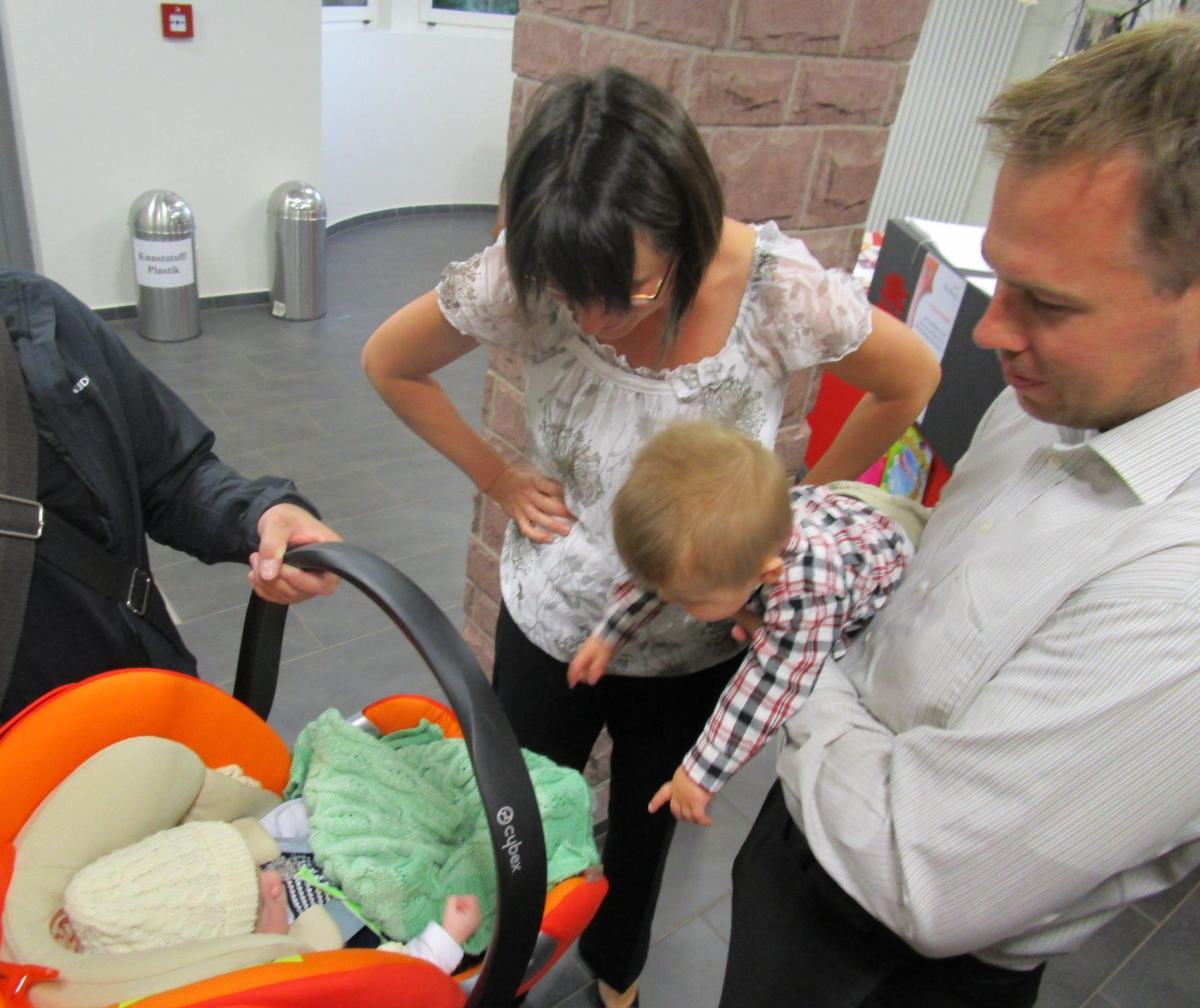 After parting with Günther, Renate and I met up with the whole family at a restaurant in the town center. After a bit of hanging out and snacking, we split up into various cars and headed out to a winery, where an afternoon tasting event had been planned. It’s just amazing to be driving through the heart of wine country in August, just before the harvest, seeing mile after mile of neat rows of grapevines flitter past. At the winery,
  After the winery, most of us migrated to the hotel for checkin. Well, not exactly “hotel” and not exactly “checkin”. The regular hotels in the area were all booked up (the region attracts nature tourist) and so we were going to be staying at the local hostel, the “
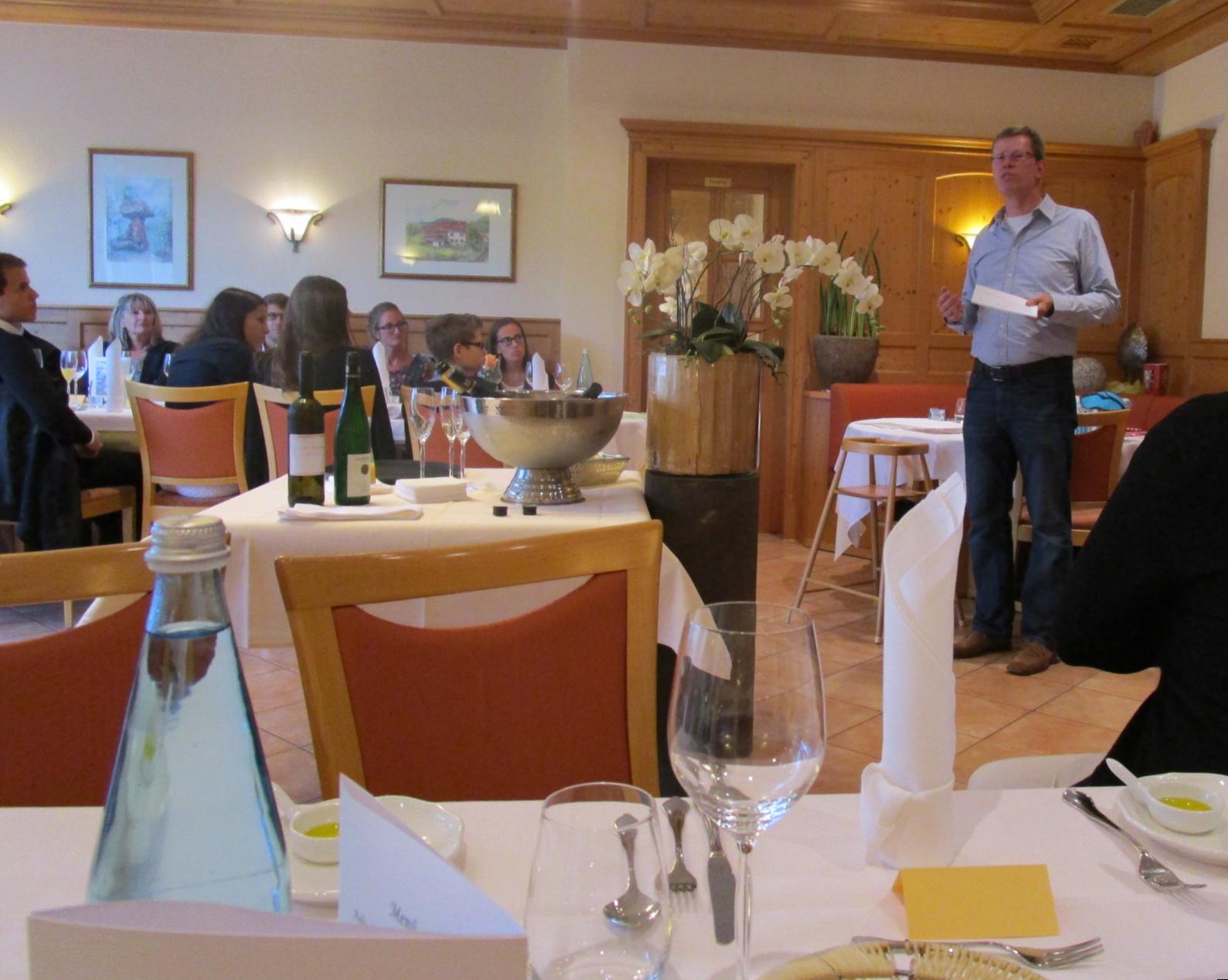 I got my first look at my other new nephew, Theodor, who is now about 6 months old. Just like his mother (my cousin), the cute meter is pegged on this kid, just off the charts. And Theodor got to meet Lukas!
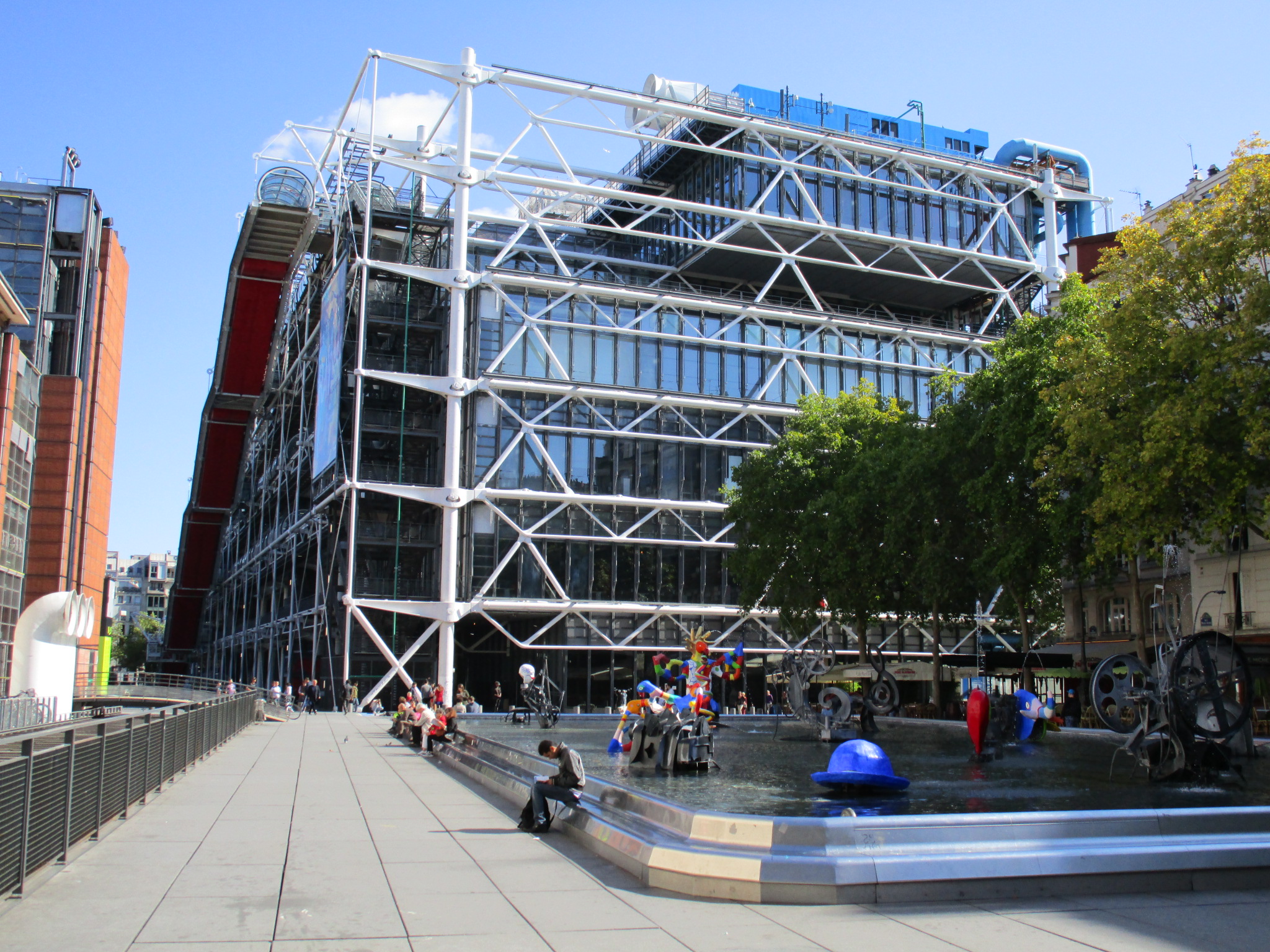 The Centre Georges Pompidou is the main modern art museum of Paris, and a place I’ve been trying to get to every time I’m in Paris. On this trip it was my highest priority, and I would finally succeed, but not quite yet. I walked up a little before 11am to find A) they weren’t open yet and B) there was a pretty big line. I’d come back later.
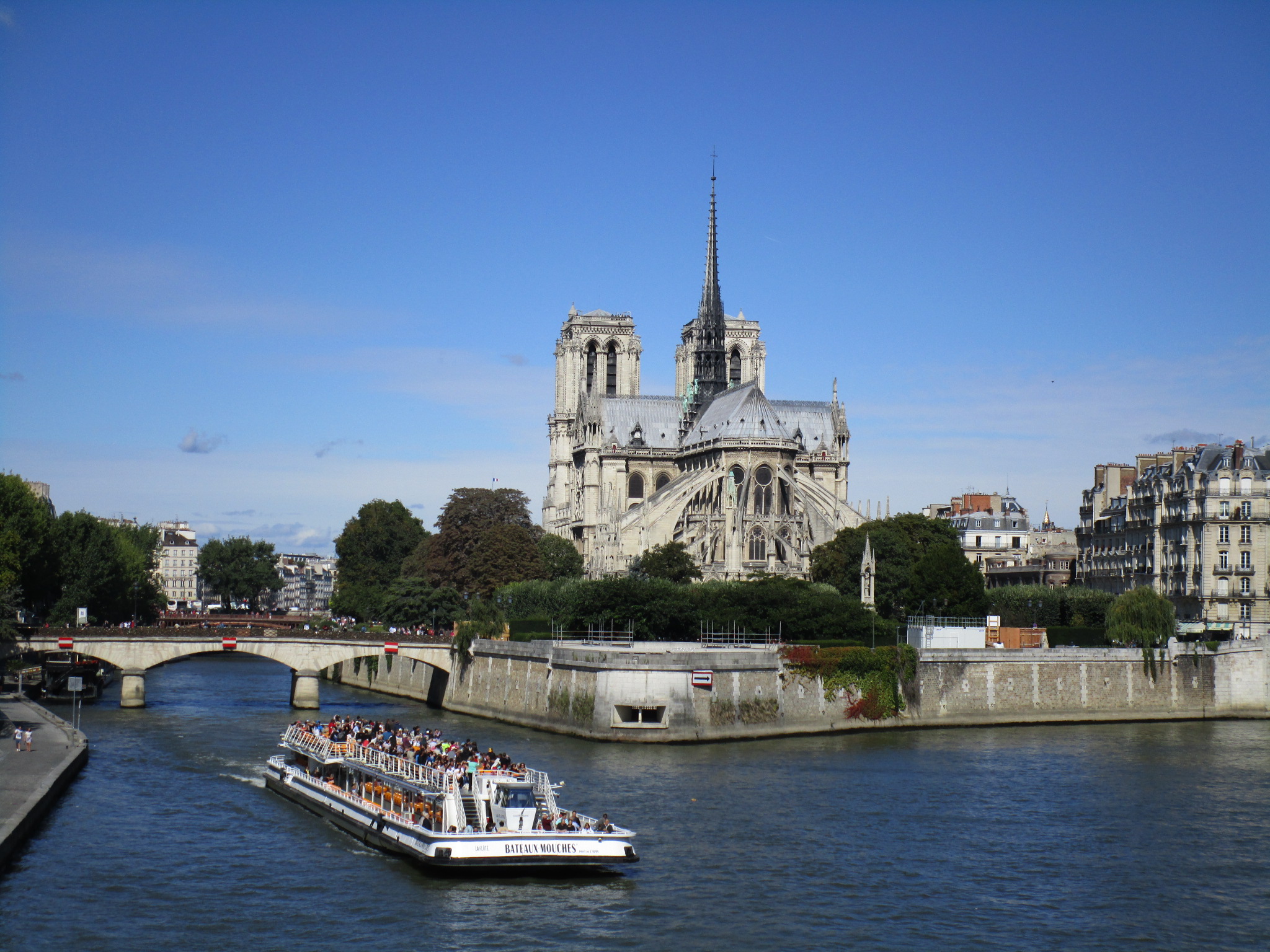 South across the Seine to Ile Saint-Louis (the smaller of the two islands in the river), wandered the streets, passed east of Notre Dame (which I’d get closer to later), and came out on the other side of the river on the Left Bank. Made my way up to the
 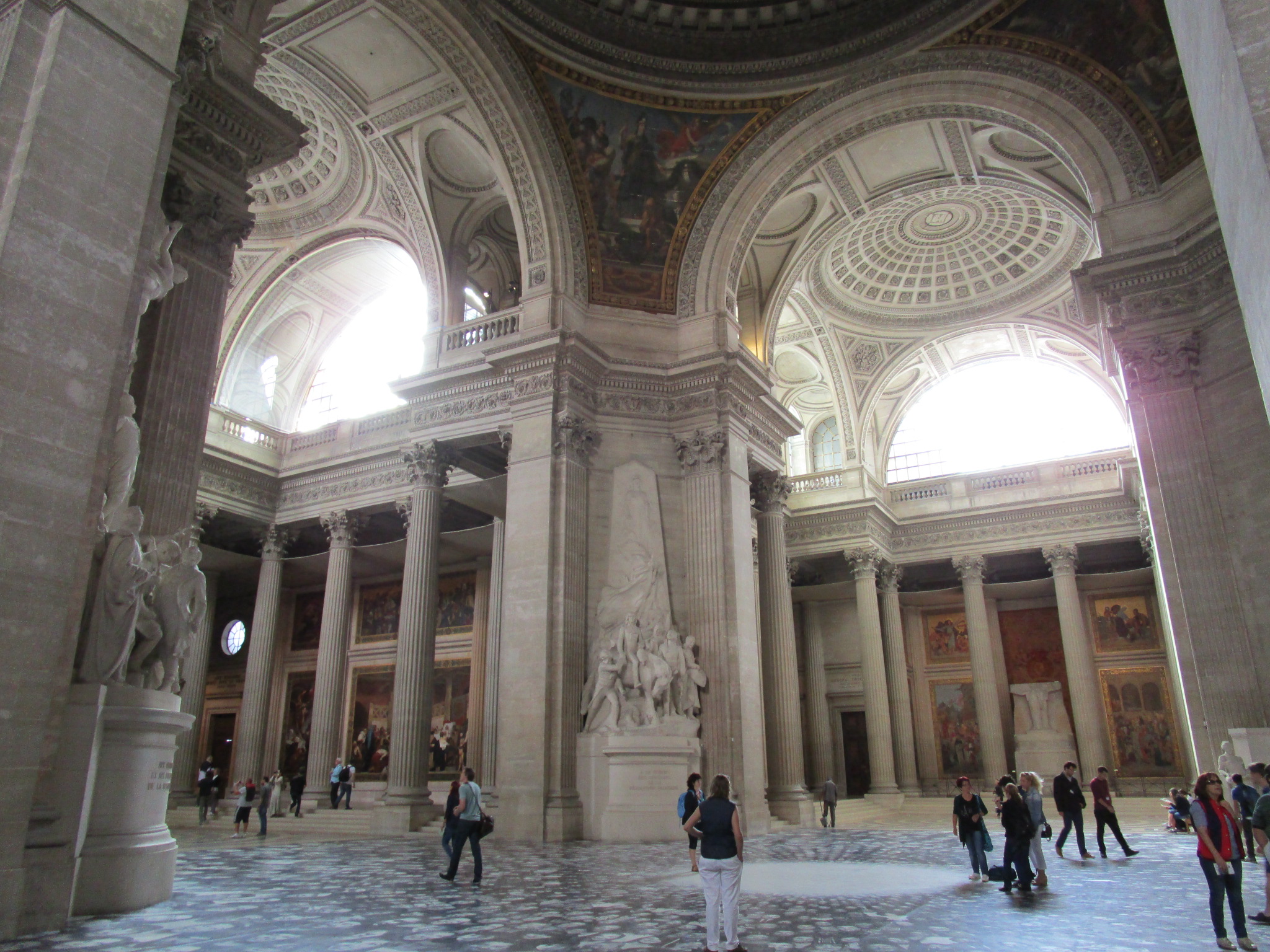 The interior you are presented with upon entrance is fabulous and ornate and amazing, with astonishing details wherever you look. For example, seemingly tucked in a corner is a huge mural “Death of St. Genevieve”
 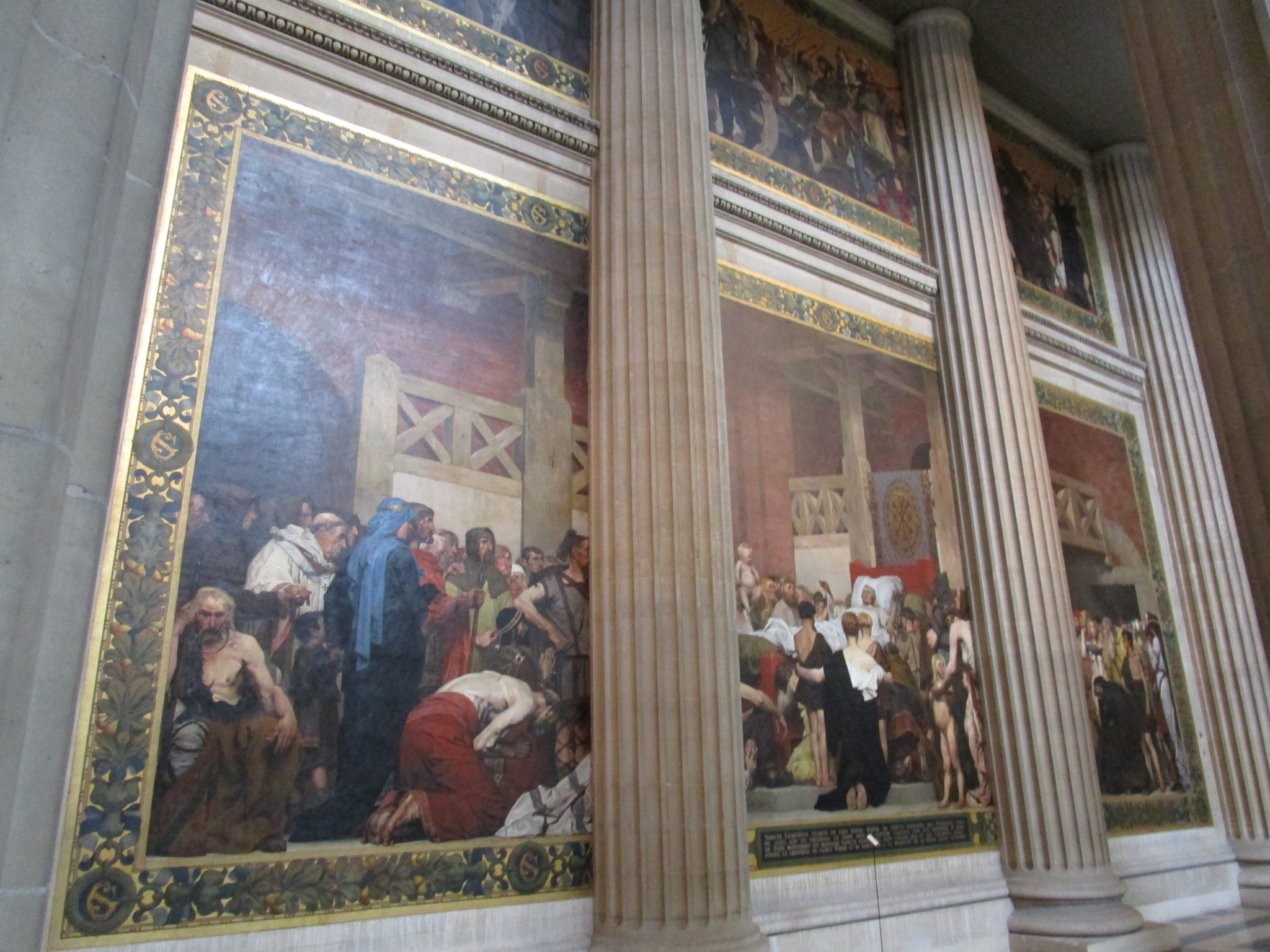 about the
 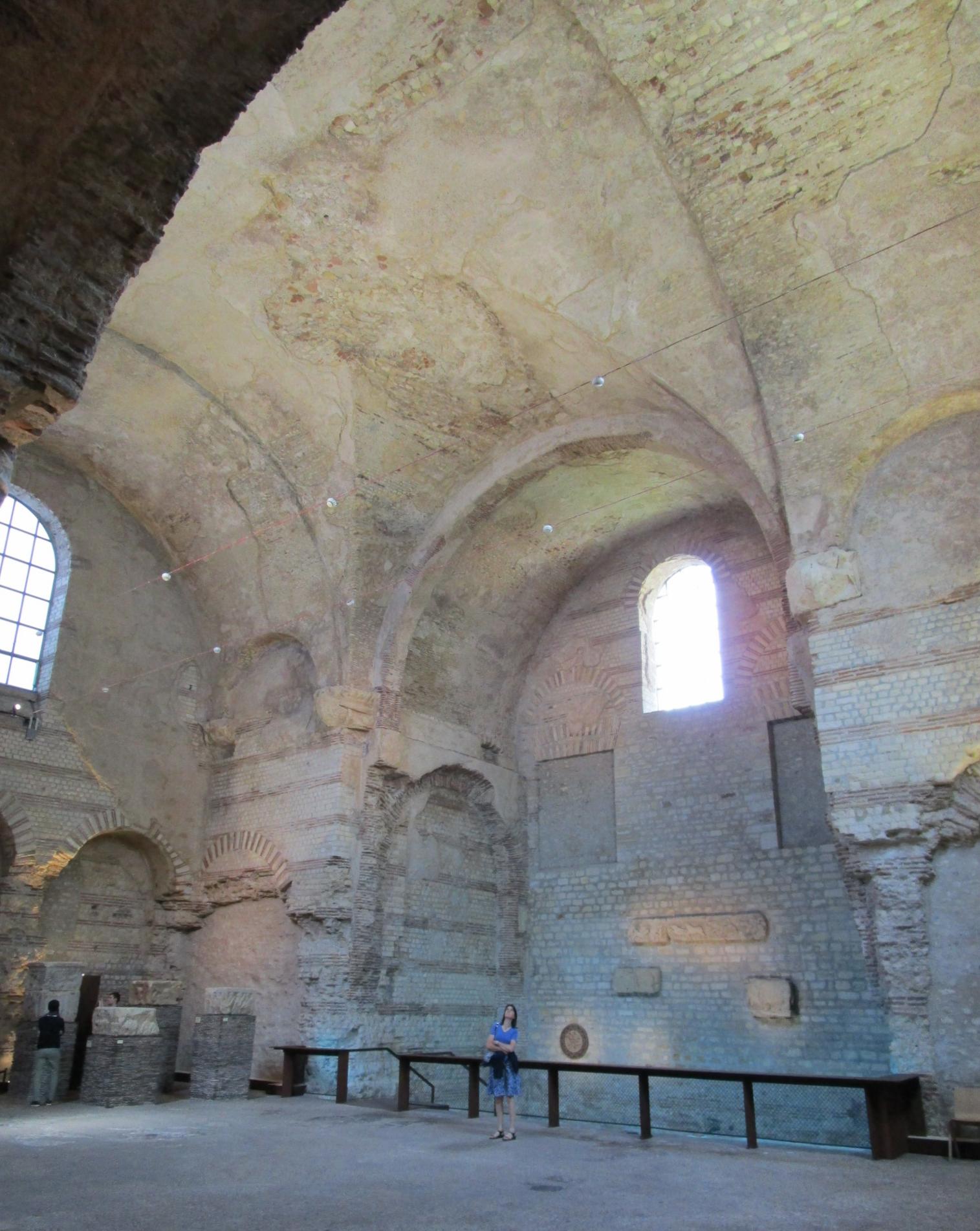 Deep within the museum was an entire
 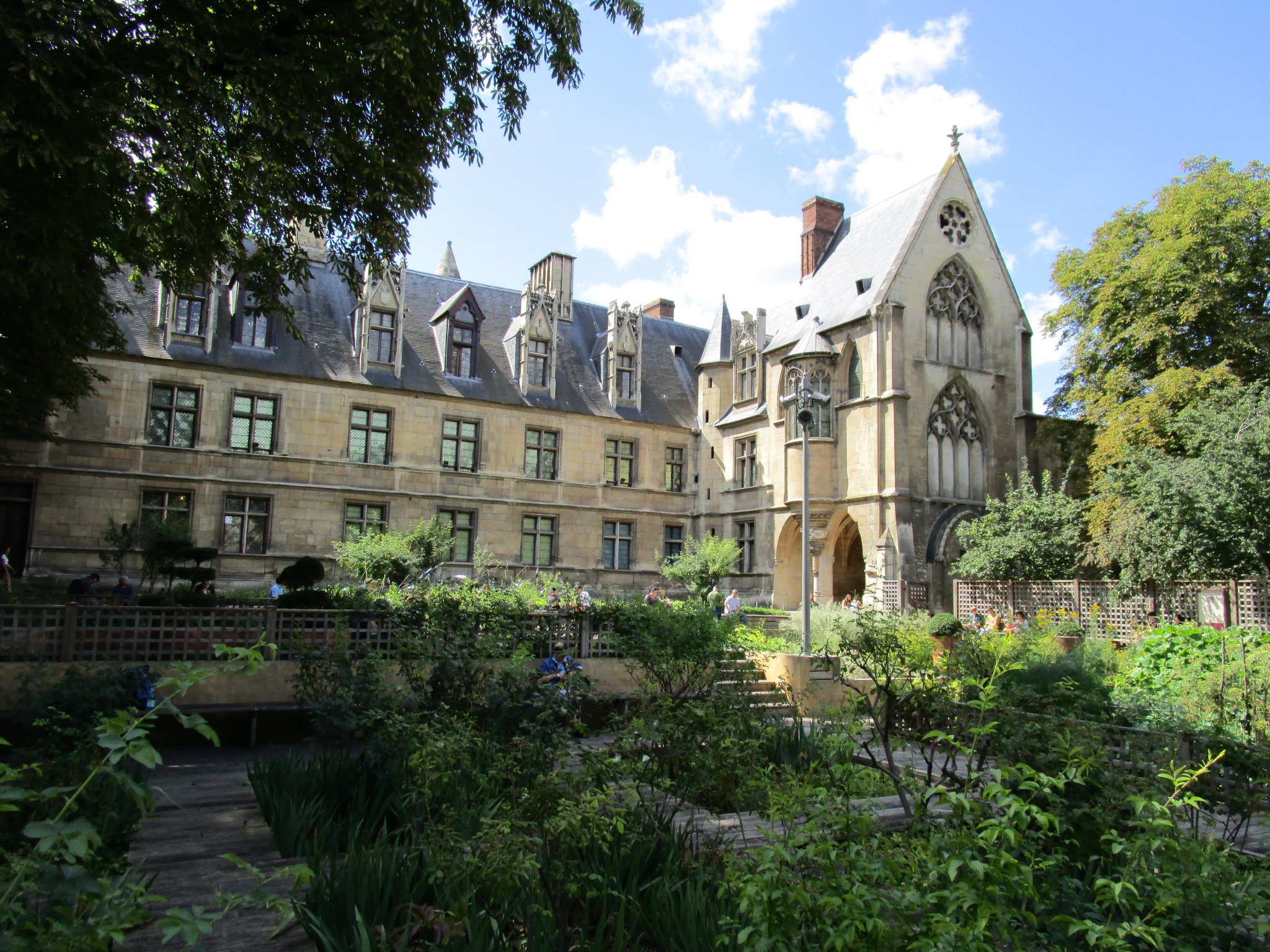 And on the grounds outside were fabulous gardens, full of lunching Parisians, not just tourists. Great place to stop for lunch, so I did.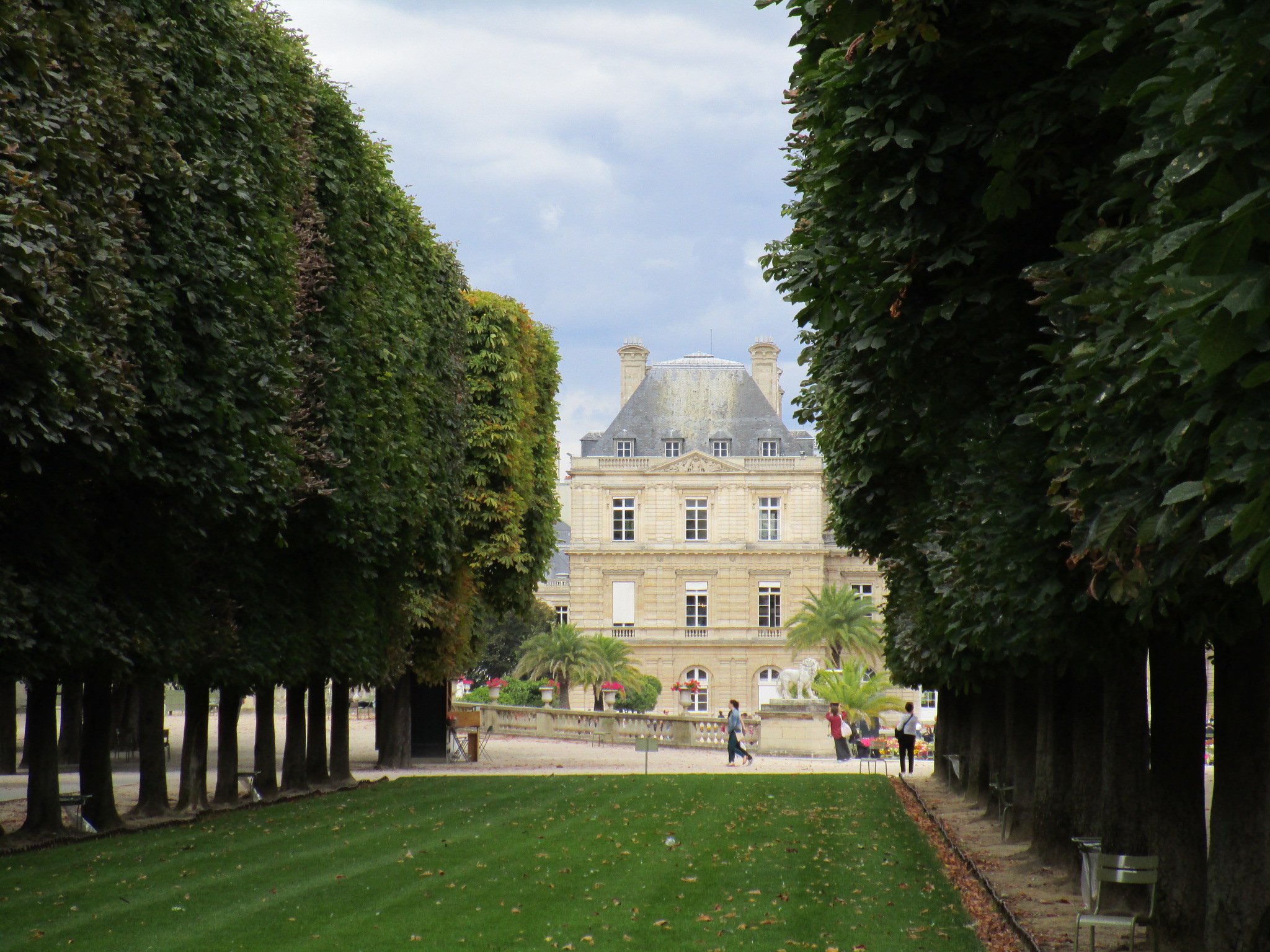
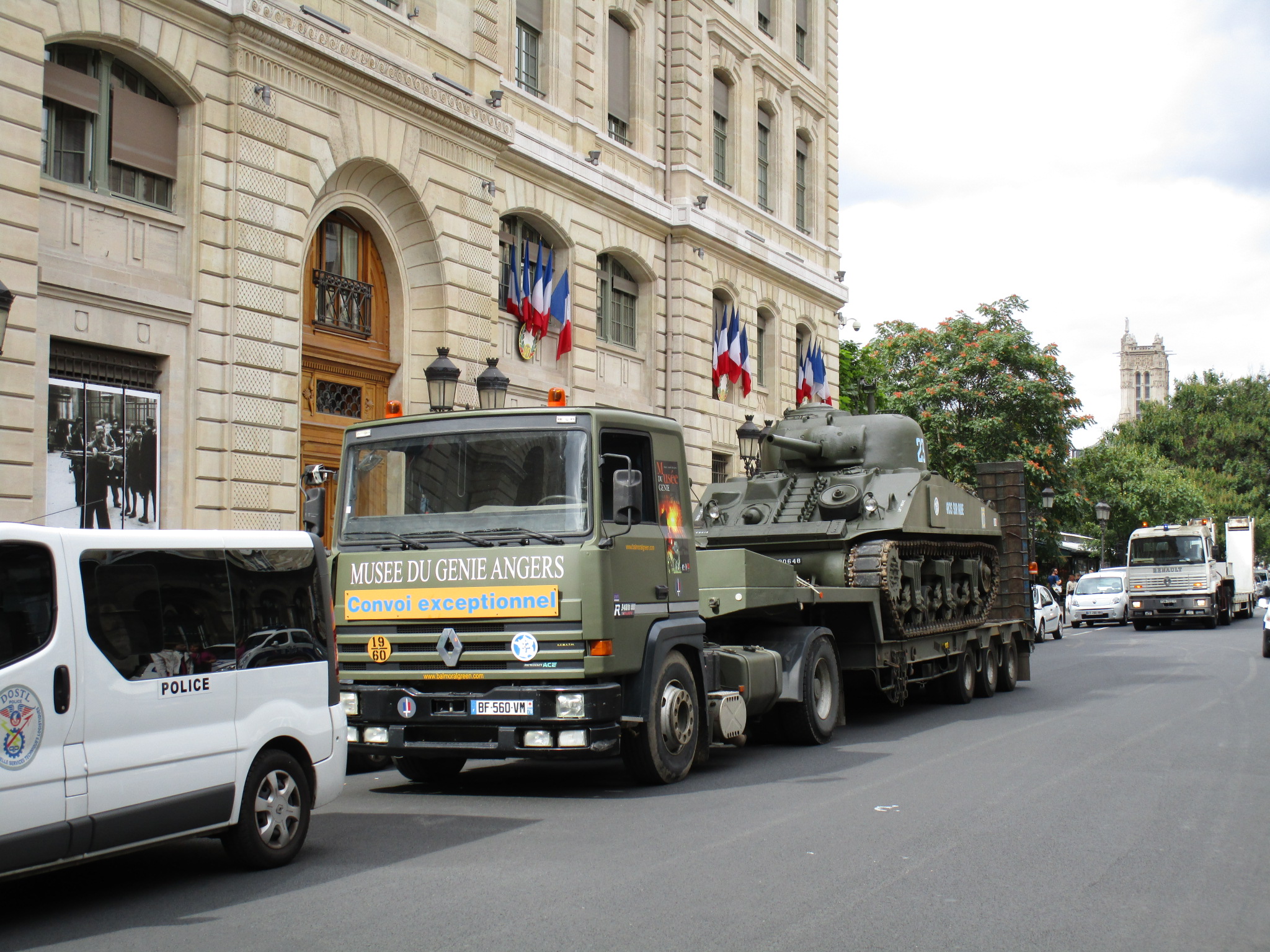 So I wandered around the outside a bit (had already taken
 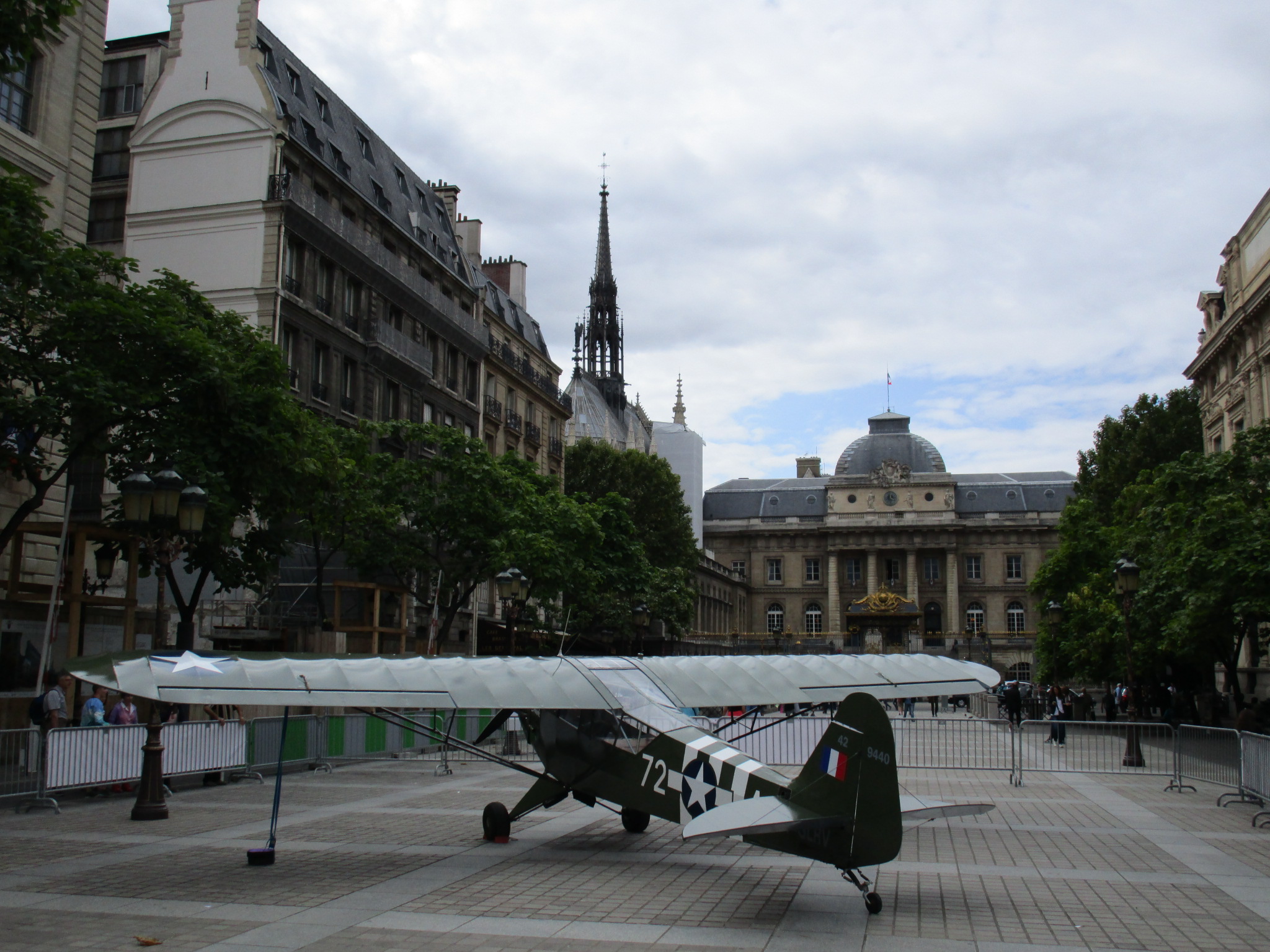 … To a Piper Cub right around the corner. Celebrating the 70th anniversary of the liberation of Paris from the Nazis, the display commemorated the moment on August 24th, 1944, the day before the actual liberation, when Leclerc’s approaching resistance forces flew an aircraft just like this one over this spot, dropping leaflets to the police below saying “
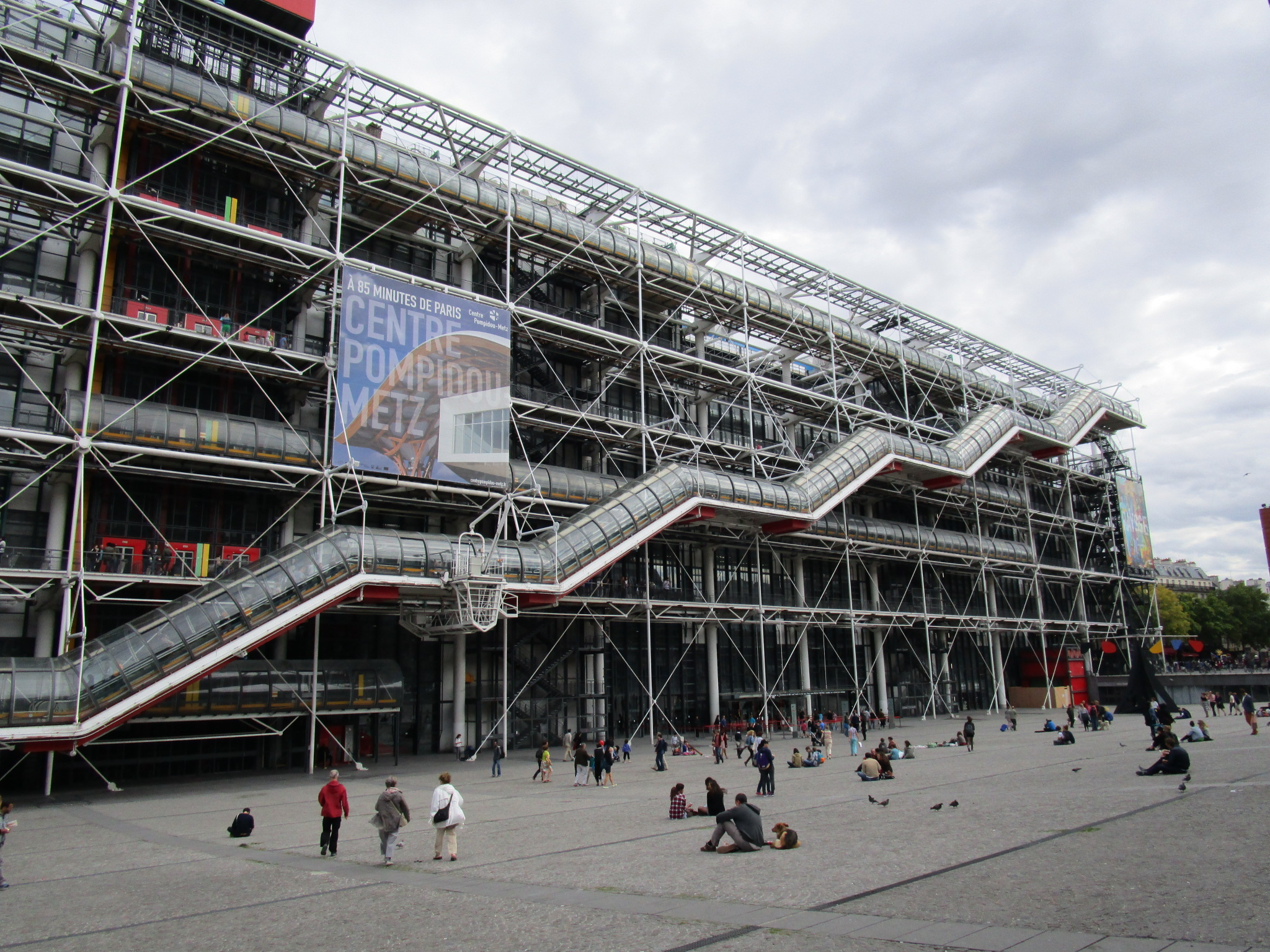 Finally, Centre Georges Pompidou. The most obvious feature of Renzo Piano’s early career design is that it turns a building inside out — putting major structural and functional elements on the outside of the building, instead of hiding them behind a curtain wall. Rode the iconic escalator up to the museum floors, and spent around two hours poring through everything they had.
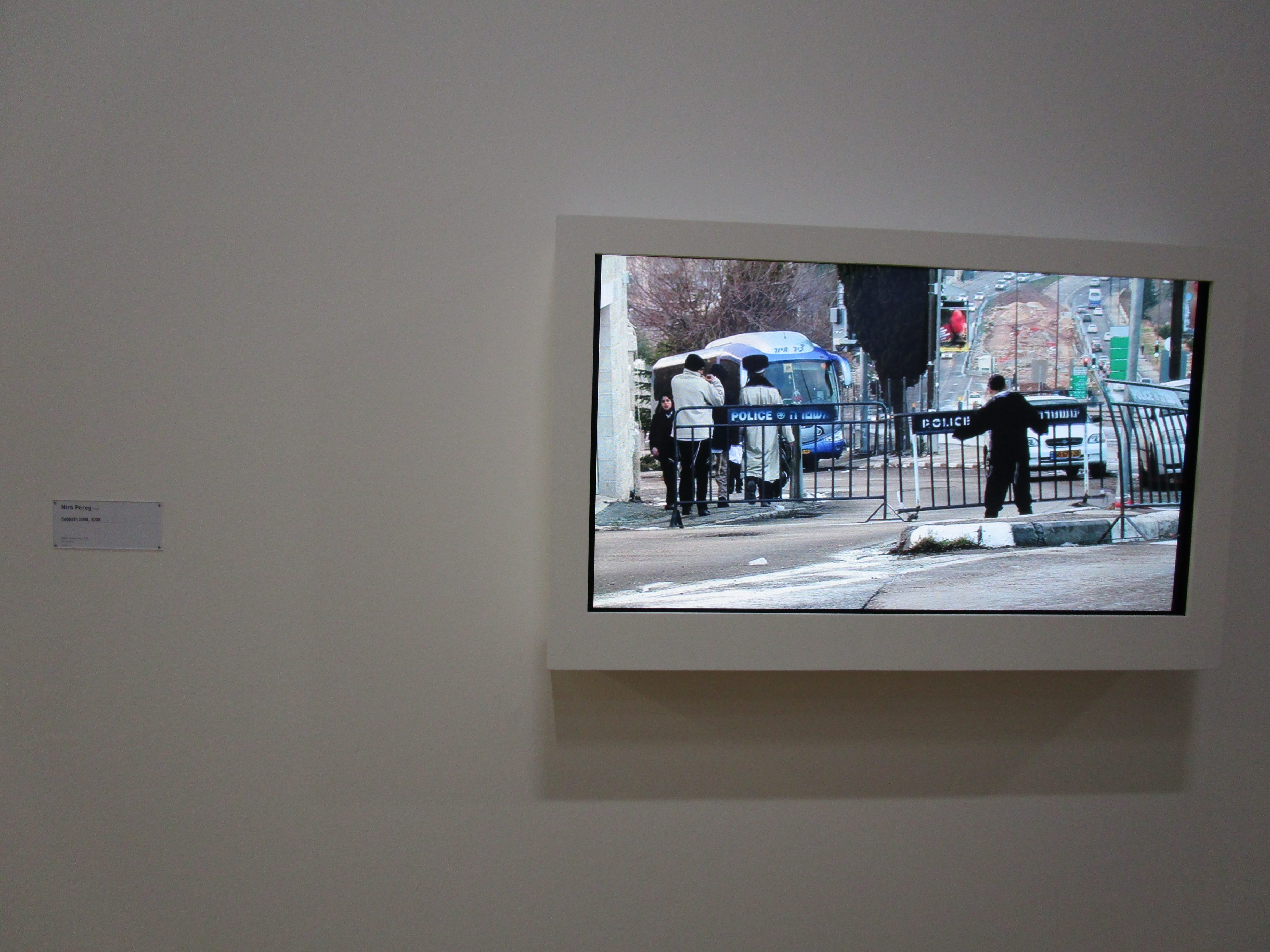 Nina Pereg’s 8-minute video “
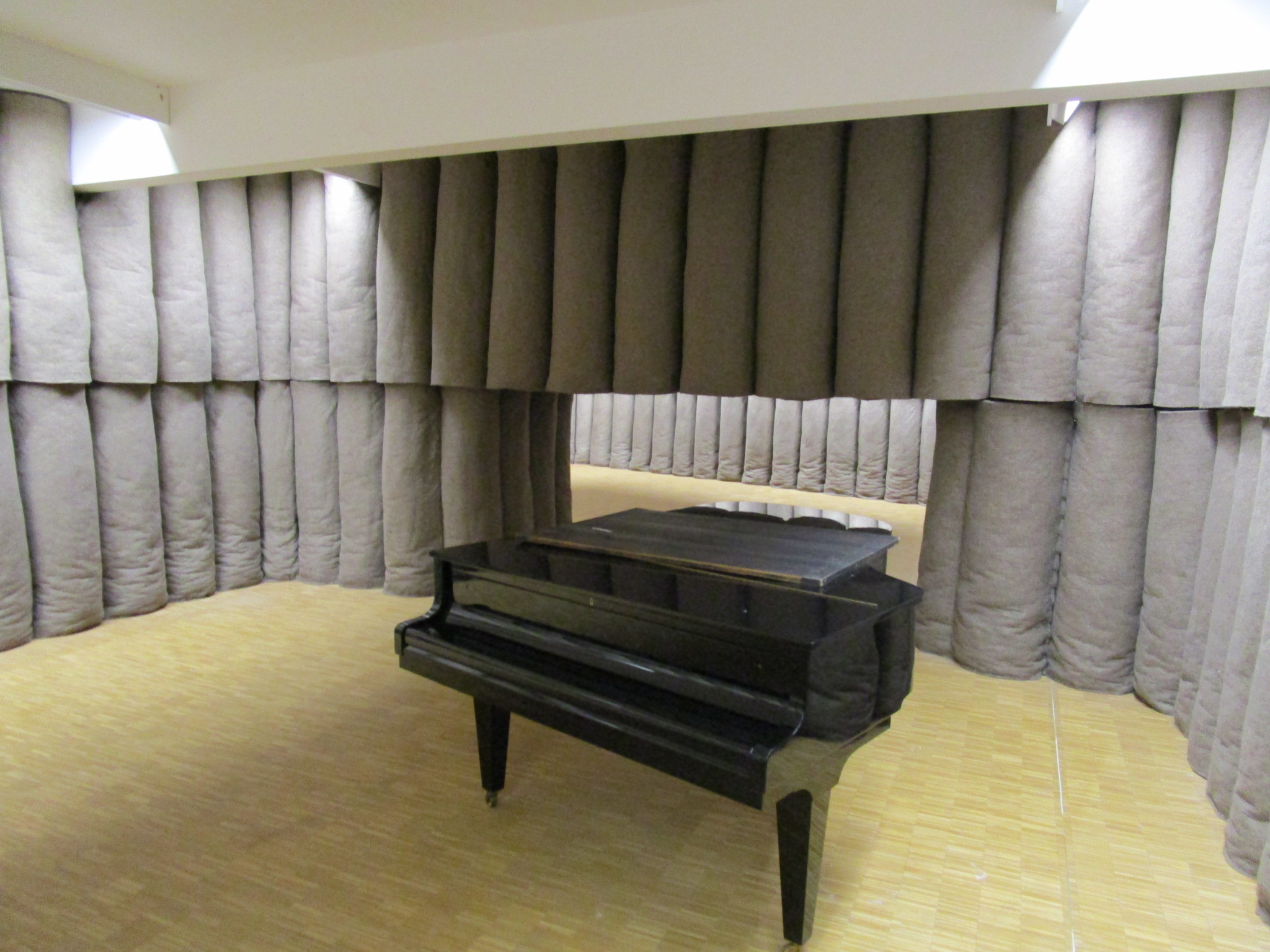 Stooping through a short tunnel-like entrance led to Joseph Beuys’ “